

6 Pin USB Type-C Connector SMT — Right Angle USB-C Female for Compact Charging & Data Applications
Vistar 6 pin USB Type-C connector SMT right angle female receptacle. Rated 3A, 30VDC, 10,000 cycles. Ideal for compact charging and data applications. RoHS compliant. Free sample.
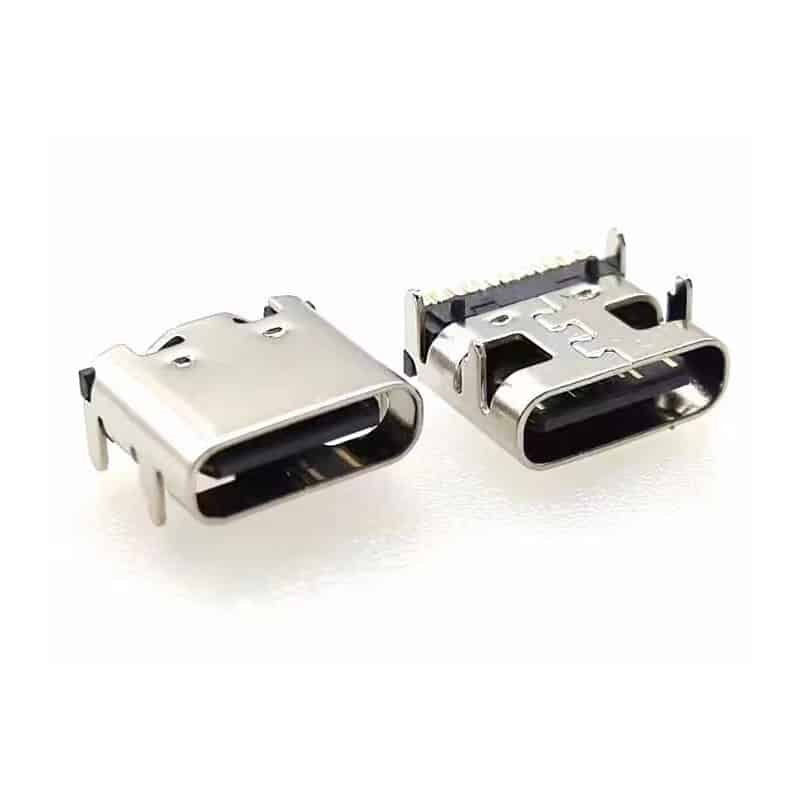
The USB-TC06-F02 is a right angle USB-C connector with a 6-pin SMT footprint. It’s designed for PCBs where every millimeter counts — think smartphones, wearables, IoT sensors, and portable speakers. The side-entry orientation lets you place the port right at the board edge, so you don’t waste internal space on cable clearance.
This 6 pin USB-C female carries the essentials: VBUS, GND, D+/D‑ for USB 2.0, and CC1/CC2 for plug orientation and power negotiation. It’s a cost‑effective drop‑in for designs that don’t need SuperSpeed data or Alt Mode video, but still want the modern USB‑C connector. Rated at 3A, it supports fast charging up to 60W (with proper PD controller), making it a solid choice for power‑focused products.
As an SMT USB Type-C receptacle, it’s compatible with standard reflow profiles and pick‑and‑place machinery. The high‑temp LCP housing and gold‑plated contacts ensure reliable soldering and stable contact resistance over thousands of cycles. Whether you’re building a power bank, a wireless earbud charging case, or a compact peripheral, this connector gets the job done without taking up unnecessary board real estate.
6 Pin USB-C Female — Full Technical Specifications
| Parameter | Value | Notes |
|---|---|---|
| Part Number | USB-TC06-F02 | Standard catalog item |
| Connector Type | USB Type-C Female Receptacle | 6-pin configuration |
| Mounting Type | SMT (Surface Mount) | Right angle orientation |
| Orientation | Right Angle (90°) | Side-entry PCB mount |
| Pin Count | 6 Pins | VBUS, GND, D+, D-, CC1, CC2 |
| Current Rating | 3A Max | Power delivery |
| Voltage Rating | 30V DC | — |
| Insertion Force | 20N Max | Maximum |
| Withdrawal Force | 5-20N | Minimum retention |
| Mating Cycles | 10,000 cycles | Durability |
| Contact Material | Copper Alloy | Gold plated |
| Housing Material | LCP (High-Temperature) | UL94V-0, SMT reflow compatible |
| Shell Material | Stainless Steel | EMI shielding |
| Operating Temperature | -40°C to +85°C | Industrial grade |
| Compliance | RoHS, REACH | Global export ready |
| Packaging | Reel / Tray | SMT assembly ready |
Why Engineers Choose This SMT USB Type-C Receptacle for Space‑Constrained Designs
6-Pin Core Functionality
Delivers what most portable devices actually need: power, ground, USB 2.0 data, and CC pins for orientation/PD negotiation. No unnecessary pins, no wasted space.
Right Angle SMT — Edge‑Mount Ready
The 90° orientation puts the port parallel to the board, letting you route cables from the side. This saves vertical height and simplifies enclosure design for slim gadgets.
3A Fast Charging Capability
Rated for 3A continuous, so you can support fast charge protocols (QC, PD, etc.) without worrying about overheating or voltage drop. Works with most standard battery charging ICs.
10,000 Mating Cycles
Built to handle daily plug‑in and unplug‑in for years. The gold‑plated contacts keep resistance low even after thousands of insertions.
Reel & Tray Packaging
Available in tape‑and‑reel for high‑volume SMT lines, or tray for prototyping and low‑volume runs. Consistent coplanarity ensures reliable solder joints.
RoHS & REACH Compliant
Fully compliant with EU environmental directives. Documentation available for export and supply chain audits.
Where to Use This USB-C 6p Connector — Typical Applications
From consumer gadgets to industrial IoT, this USB-C 6p connector is a popular choice whenever space is tight and charging is the primary function. Its simple footprint and reliable performance make it a go‑to part for engineers who want USB‑C without the complexity of a full‑featured 24‑pin part.
Frequently Asked Questions — 6 Pin USB Type-C Connector SMT
What is a 6‑pin USB‑C connector used for?
It’s used for charging and USB 2.0 data transfer in compact devices. The 6‑pin version gives you the essential signals (power, ground, data, and configuration) without the extra SuperSpeed pairs, making it smaller and cheaper than a full 24‑pin part.
What’s the difference between 6‑pin and 24‑pin USB‑C?
A 24‑pin connector supports USB 3.x / USB4 high‑speed data, Alternate Mode video, and higher power (up to 5A). The 6‑pin version is limited to USB 2.0 (480 Mbps) and 3A current. Choose 6‑pin when you only need charging and basic data.
Does this connector support USB Power Delivery?
Yes — the CC1/CC2 pins handle PD negotiation. With a suitable PD controller on your board, you can achieve up to 60W (20V × 3A) charging using this connector.
Is it compatible with SMT assembly?
Absolutely. It’s designed for standard reflow soldering and comes in tape‑and‑reel packaging for pick‑and‑place machines. The LCP housing withstands peak reflow temperatures up to 260°C.
Can I get free samples?
Yes. Engineering samples are free for qualified projects. Just email sales@vistarelectronics.com with your company info and project description, referencing part number USB‑TC06‑F02.
Is this connector RoHS compliant?
Yes, fully compliant with RoHS 3 and REACH. Certificates available on request.
6 Pin USB Type-C Connector SMT — A Practical Guide for Design Engineers
Why a 6‑Pin USB‑C Makes Sense for Many Products
Not every product needs the full 24‑pin USB‑C feature set. If you’re building a power bank, a wireless headset, a smart doorbell, or a simple peripheral, you probably only care about charging and maybe USB 2.0 data. That’s where the 6 pin USB Type-C connector SMT shines — it gives you the modern connector form factor without the cost and complexity of extra pins you’ll never use.
The right angle USB-C connector variant is especially useful because it lets you place the port right at the edge of the board. This means you can design a slim enclosure with the cable entering from the side, which is often more natural for handheld devices. No need to route cables through the middle of the board or stack extra components to clear the connector height.
For engineers who are used to micro‑USB, switching to USB‑C with a 6‑pin part is straightforward. The pinout is simple: two power pins (VBUS and GND), two data pins (D+ and D‑), and two configuration pins (CC1 and CC2). The CC pins handle orientation detection and also serve as the communication channel for Power Delivery negotiations. With a separate PD controller, you can enable fast charging without modifying the connector itself.
Electrical and Thermal Considerations
Rated at 3A, this connector can comfortably handle most fast charging scenarios. However, always check the PCB trace width and thermal vias under the VBUS pads to avoid excessive heating. The 30V voltage rating gives you headroom for most consumer and industrial applications.
Contact resistance is specified at ≤30 mΩ, which is stable over the life of the connector thanks to the gold plating. Insulation resistance is ≥100 MΩ, and the connector withstands 250V AC for 1 minute — plenty for typical low‑voltage systems.
Mechanical Durability
With 10,000 mating cycles, this connector is built for products that get plugged and unplugged daily for years. The stainless steel shell provides good EMI shielding and adds mechanical strength. The LCP housing is rated UL94V‑0 and can handle the heat of reflow soldering without warping.
For applications with higher vibration or shock, the right‑angle SMT design is generally more robust than a vertical through‑hole part because the solder joints are less stressed by cable tugging. Still, if you expect extreme conditions, consider adding a glue or mechanical bracket (Vistar offers custom solutions on request).
PCB Layout Tips
When laying out this SMT USB Type-C receptacle, keep these points in mind:
- Place the connector near the edge of the PCB to allow the cable to plug in without interference.
- Use wide traces for VBUS and GND — at least 1.5mm for 3A, or use a copper pour.
- Keep D+ and D‑ traces short and matched in length for USB 2.0 signal integrity.
- Add a 0.1µF bypass capacitor near the VBUS pin for decoupling.
- If using PD, place the CC pull‑up or pull‑down resistors close to the connector.
Comparison with Other USB‑C Variants
We also offer 16‑pin and 24‑pin versions for applications that need SuperSpeed data or higher power. The 6‑pin is our most cost‑effective option for charging‑focused designs. If you’re unsure which one fits, our engineering team can help you evaluate based on your system requirements.
Why Source from Vistar?
Vistar Electronics has been manufacturing connectors in Shenzhen since 2008. We keep a large inventory of standard parts and can adapt to OEM requests like custom plating, pin length, or packaging. All products are built in our ISO 9001:2015 certified facility, and we ship to customers worldwide.
For detailed drawings, 3D models, and footprint recommendations, just ask. We also provide free samples for testing, so you can verify fit and function before committing to volume orders.
If you need more technical insight, check out our blog for application notes and design guides. For direct support, reach out to our engineering team.
Need a Custom USB‑C Connector?
Vistar can tailor 6‑pin, 16‑pin, or 24‑pin USB‑C connectors to your exact height, plating, and packaging needs. Talk to us about your project.
USB-TC06-F02 — 6 Pin USB Type-C Connector SMT | Right Angle USB-C Female | RoHS & REACH Compliant | OEM/ODM Available

24 Pin USB 3.1 Type‑C Female Connector – 10Gbps Full‑Featured High‑Speed USB‑C Receptacle for Demanding Applications

USB c motherboard connector SMT horizontal 24P USB4.0 type-c female CL=0.5MM l=9.17

USB C Receptacle 24 pin DIP+SMT on Board

USB C Connector female 24 pin top mount right angle

PCB mount Connector USB Type C female 24 pin SMT horizontal CL=1.57 L=9.17

USB4 Type-C Connector 24 Pin Vertical SMT Female Receptacle
USB C 16 pin connector — USB 3.1 Type-C Female Right Angle PCB Mount (USB-TC16-F01)

24 pin Vertical USB-C SMT Connector

USB-C Mid Mount Connector Guide: PCB Layout, Footprint & Selection
A wearable device prototype came back from the assembly floor with a problem that no amount of firmware tweaking could fix. The...

USB PD Connector Guide: USB PD 3.1, 240W & Selection Tips
A USB PD connector is not simply a USB-C receptacle with a higher current rating. For a USB Power Delivery design, the...

USB-C 6 Pin vs 16 Pin vs 24 Pin Connector — Which One Does Your Design Actually Need?
USB-C 6 pin vs 16 pin vs 24 pin connector — compare charging capability, data speed, Alt Mode support, and PCB cost....