

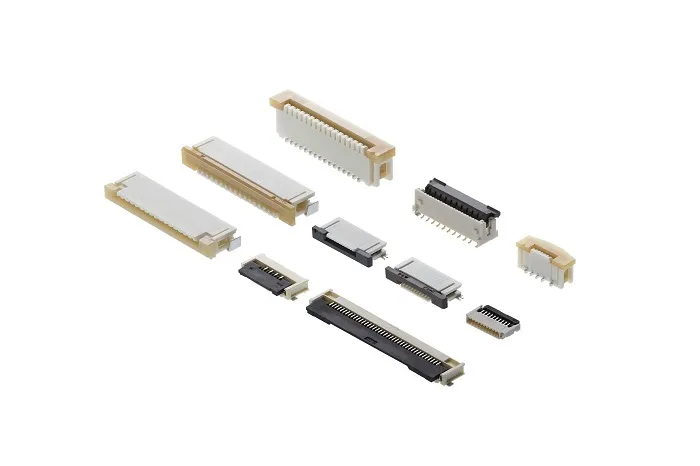
0.5mm FPC connector types Drawer SMD horizontal h=1.2 mm
What Is a 0.5mm FPC Connector?
A 0.5mm FPC connector is a high‑density interconnect designed for flexible printed circuits (FPC) and flexible flat cables (FFC) with a conductor pitch of 0.5mm. This pitch size has become the dominant standard in consumer electronics because it balances signal density with mechanical robustness. The 0.5mm spacing allows up to 20 or more circuits within a connector body that is often less than 5mm wide, making it indispensable for smartphones, tablet displays, camera modules, and wearable devices where board real estate is extremely limited.
Understanding 0.5mm FPC connector types is essential because the same pitch can be implemented in multiple mechanical configurations—ZIF (zero insertion force) with a flip lock, non‑ZIF with friction retention, SMT for automated assembly, and various contact orientations. Each type suits a specific application profile, and choosing incorrectly can lead to assembly difficulties, intermittent connections, or premature field failures. This guide explains every major variant, how they work, and where they should be used, with direct links to product pages for sourcing.
0.5mm FPC Connector Types – Complete Classification
ZIF (Zero Insertion Force) FPC Connector
ZIF connectors are the most widely used 0.5mm pitch FPC connector type in modern electronics. They feature an actuator—typically a flip lock or slider—that opens the contact cavity, allowing the flexible cable to be inserted with essentially zero force. Once the cable is positioned, closing the actuator presses the contacts against the cable’s exposed conductors, creating a gas‑tight electrical connection. This mechanism eliminates the risk of damaging delicate FPC cables during assembly and enables multiple re‑insertions without wear. A ZIF FPC connector 0.5mm is the default choice for display interfaces, camera modules, and any application where the cable may need to be disconnected and reconnected during service.
🔗 View related products: 0.5mm ZIF FPC Connectors
SMT 0.5mm FPC Connector
An 0.5mm SMT FPC connector is designed for surface‑mount technology assembly, where the connector is soldered directly to the PCB surface using reflow soldering. These connectors are supplied in tape‑and‑reel packaging for automated pick‑and‑place equipment, making them ideal for high‑volume production lines. The SMT footprint keeps the underside of the PCB free for additional routing, and the fine‑pitch terminals are optimised for lead‑free solder paste deposition. When selecting a 0.5mm SMT FPC connector, engineers must consider coplanarity, pad design, and stencil aperture size to achieve high first‑pass yields. SMT variants are available in both ZIF and non‑ZIF configurations, with top or bottom contact orientations.
Top Contact FPC Connector
A top contact FPC connector has its electrical contacts on the upper surface of the connector, meaning the flexible cable must be inserted with its conductive traces facing downward toward the PCB. This orientation is the most common configuration for display and touch‑screen connections because it naturally routes the cable over the top of the connector body and away from the board edge. Top contact designs simplify cable management in clamshell‑style devices such as laptops and flip phones, where the display cable must bend around a hinge. They also provide better protection against accidental disconnection when the device is assembled with the cable entering from above.
Bottom Contact FPC Connector
In a bottom contact configuration, the conductive pads face upward, and the cable is inserted with its traces facing away from the PCB. This orientation is useful when the cable must exit from underneath the connector or when the PCB layout places the connector near the board edge with limited overhead clearance. Bottom contact FPC connectors are frequently used in stacked PCB designs and compact modules where the cable routing path is constrained by adjacent components. Designers should carefully verify the contact orientation specification when ordering, as top and bottom contact versions of the same connector series may look identical from the outside.
Flip Lock / Lifting Cover FPC Connector
A flip lock FPC connector uses a hinged actuator that lifts upward to open the contact cavity. After the FPC cable is inserted, the actuator is pressed down, locking the cable in place with a firm mechanical grip. This mechanism provides higher retention force compared to slider‑type ZIF connectors, making it suitable for applications subject to vibration or mechanical shock—such as automotive infotainment systems, industrial handhelds, and drones. Flip lock connectors are available in both top‑contact and bottom‑contact variants, and many are rated for 30 or more mating cycles, sufficient for most serviceable connections.
🔗 Explore: Flip Lock FPC Connectors
Right Angle & Vertical 0.5mm FPC Connector
The physical orientation of the connector on the PCB significantly impacts enclosure design. Right angle 0.5mm FPC connectors position the cable parallel to the board surface, minimising the overall height and enabling side‑entry cable routing. This is the most common configuration for displays, where the cable must exit the module and fold behind the screen. Vertical connectors, in contrast, accept the cable perpendicular to the PCB, which can simplify routing when the cable approaches from directly above. Both orientations are available in SMT and through‑hole variants, with ZIF or non‑ZIF actuators.
🔗 View products: Right Angle FPC Connectors
How to Choose a 0.5mm FPC Connector – Complete Selection Guide
Selecting the optimal 0.5mm FPC connector requires evaluating six key parameters beyond just the pitch size:
- Pin Count: Determine the number of signals to be carried. 0.5mm pitch connectors typically range from 4 to 60 positions. Always include spare pins for future design revisions.
- Contact Type: Choose between top contact and bottom contact based on cable entry direction and PCB layout constraints. Top contact is more common; bottom contact solves routing challenges in tight enclosures.
- Actuator Type: ZIF with flip lock provides the highest retention force and is preferred for vibration‑prone environments. Slider‑type ZIF offers faster assembly. Non‑ZIF friction‑fit connectors are the most compact and lowest cost but cannot be re‑mated as many times.
- Mounting Style: SMT for automated high‑volume production; through‑hole for maximum mechanical strength in connectors that will experience frequent cable insertion.
- Orientation: Right‑angle for side‑entry, low‑profile designs; vertical for top‑entry applications where the cable approaches perpendicular to the PCB.
- Height Constraint: Verify the connector height above the PCB, especially in ultra‑slim devices where every fraction of a millimetre counts. Low‑profile ZIF connectors can be as short as 1.0mm.
View all FPC Connectors |
0.5mm FPC Connector Types Overview |
ZIF Type FPC Connectors
0.5mm FPC Connector Applications Across Industries
ZIF vs Non‑ZIF 0.5mm FPC Connectors – Which One Should You Choose?
The choice between ZIF and non‑ZIF 0.5mm FPC connector types ultimately comes down to assembly process and serviceability requirements. ZIF connectors dominate consumer electronics because they allow the flexible cable to be inserted and removed multiple times without damage, which is essential during manufacturing, testing, and field repair. The flip lock or slider actuator holds the cable securely while maintaining a consistent contact force across all pins. Non‑ZIF connectors, in contrast, rely on friction between the contacts and the cable to maintain the electrical connection. They are simpler, lower cost, and more compact, but the insertion force increases with pin count, and repeated removal degrades the retention force. Non‑ZIF types are best suited for permanent or semi‑permanent connections where the cable is inserted once during assembly and never removed. For applications requiring more than 10 mating cycles, ZIF is the recommended choice.
For detailed engineering comparisons, refer to IEC Standards for connector testing methodologies, and explore our FPC Connector Types Explained article for deeper technical background.
Typical Specifications for 0.5mm Pitch FPC Connectors
While exact specifications vary by part number, most 0.5mm FPC connectors in Vistar’s catalogue share these typical parameters:
| Parameter | Typical Range |
|---|---|
| Pitch | 0.5mm |
| Part Number | FPC-0512DL-nP |
| Positions | 4 to 60 |
| Mounting Type | SMT (surface mount) or Through‑Hole |
| Contact Orientation | Top contact or Bottom contact |
| Actuator | Flip lock, Slider, or Non‑ZIF |
| Current Rating | 0.5A per contact (typical) |
| Voltage Rating | 50V AC/DC |
| Operating Temperature | −40°C to +105°C |
| Compliance | RoHS & REACH |
For specific part numbers with exact specifications, please browse our FPC Connector catalogue or contact our engineering team.
Frequently Asked Questions – 0.5mm FPC Connector Types
What is the difference between 0.5mm and 1.0mm FPC connectors?
The pitch (distance between adjacent contacts) is the main difference. A 0.5mm FPC connector packs twice as many circuits in the same width compared to a 1.0mm connector, making it better for high‑density applications. However, 1.0mm connectors are more robust and easier to handle during assembly.
What is a ZIF FPC connector?
ZIF stands for Zero Insertion Force. These connectors use an actuator (flip lock or slider) that opens the contact cavity, allowing the FPC cable to be inserted without force. Closing the actuator locks the cable and makes the electrical connection.
Can I re‑insert an FPC cable into a ZIF connector multiple times?
Yes. ZIF connectors are specifically designed for multiple mating cycles, typically 20 to 50 cycles depending on the model. This makes them suitable for applications where the cable may need to be disconnected for testing or servicing.
What is the difference between top contact and bottom contact?
Top contact means the cable’s conductive traces face downward toward the PCB when inserted. Bottom contact means they face upward, away from the PCB. The choice depends on cable routing direction and enclosure design.
Are 0.5mm FPC connectors available in waterproof versions?
Some manufacturers offer IP‑rated FPC connectors, but they are less common. For moisture‑sensitive applications, consider our waterproof connector series or contact us to discuss custom sealed solutions.
How do I determine the correct pin count for my application?
Count the number of signals, grounds, and power lines in your design. It’s recommended to include 2–4 spare pins for future design changes. Our FPC Connector Selection Guide provides a detailed checklist.
Your Complete Resource for 0.5mm FPC Connectors
0.5mm FPC connectors are widely used in compact electronic devices requiring high‑density signal transmission and flexible board‑to‑board connections. Depending on design requirements, they are available in ZIF and non‑ZIF structures, SMT or through‑hole mounting styles, and various contact types including top contact and bottom contact. Vistar Electronics provides a full range of 0.5mm pitch FPC connectors designed for smartphones, wearable devices, displays, and industrial electronics with stable performance and reliable locking mechanisms. Whether you need a standard 0.5mm FPC connector for a prototype or a high‑volume order for mass production, our catalogue includes every major type covered in this guide.

Easy-on zif Fpc connector 1.0 mm lower contact

0.3 mm fpc connector zif flip type

0.5mm Pitch FFC FPC Connector SMT Vertical for Compact PCB Designs

0.5mm ZIF FPC Connector — Lifting Cover Flip Lock, Horizontal SMT, H=2.0mm

0.5mm FPC Connector — High-Density Flexible Flat Cable Connector for Compact PCB Applications, Consumer Electronics & Industrial Devices

Easy-on 0.5 mm FPC Connector Zif 2.0H smt Right Angle

0.5 pitch zif connector fpc Top contact

0.5mm FPC FFC ZIF Connector – Dual-Contact, Right-Angle SMT for Space‑Saving PCB Layouts

FPC Connector Types Explained: Complete Guide to Pitch, Contact, Mounting & Locking Styles
Complete guide to FPC connector types—pitch options, top vs bottom contact, ZIF vs non-ZIF, mounting styles, and locking mechanisms. Learn how to...
FPC Connector Pitch Selection Guide
Learn how to select the right FPC connector pitch—0.3mm, 0.5mm, or 1.0mm. Compare density, mechanical strength, applications, and key selection factors for...

FFC Connectors vs. FPC Connectors: 4 Crucial Differences You Need to Know!
A design team once spent three weeks debugging an intermittent display flicker on a new portable medical device. The root cause wasn’t...