

0.3 mm fpc connector zif flip type
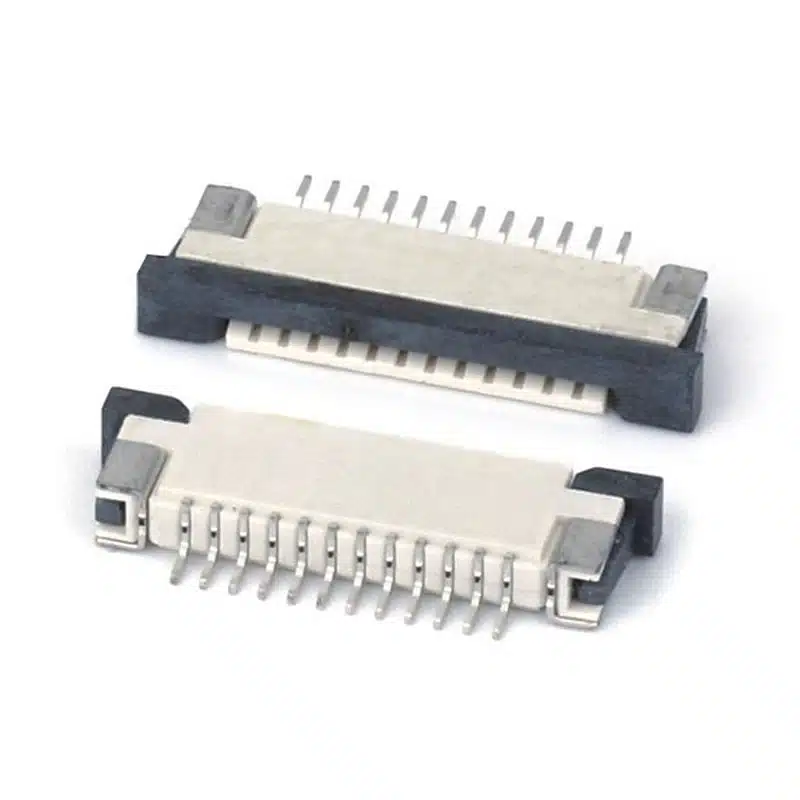
The FPC-0310FL-nP (where n = number of positions) is a 0.3mm ZIF FPC connector with a front flip locking mechanism, designed for surface‑mount horizontal PCB mounting. This 0.3mm FPC connector accepts 0.3mm pitch FPC/FFC cables with zero insertion force, ensuring safe, repeatable mating for up to 30 cycles. Rated 0.2A at 50V AC/DC. RoHS & REACH compliant. Tape & Reel packaging. MOQ 1,000 pcs. Free sample for qualified projects.
What Is a 0.3mm FPC Connector with ZIF Front Flip?
A 0.3mm FPC connector is an ultra‑fine‑pitch interconnect designed for flexible printed circuits (FPC) and flexible flat cables (FFC) with a conductor spacing of just 0.3mm. This pitch size represents the forefront of miniaturisation, enabling up to 30 or more circuits within a connector body that is often less than 4mm wide. When paired with a ZIF (Zero Insertion Force) mechanism—specifically a front flip actuator—the connector becomes exceptionally user‑friendly: the actuator hinges at the front, lifting upward to open the contact cavity, allowing the cable to be inserted with negligible force. Closing the actuator presses gold‑plated contacts against the cable’s exposed conductors, creating a gas‑tight electrical connection. This 0.3mm ZIF FPC connector is the enabling interconnect behind today’s highest‑resolution smartphone cameras, borderless OLED displays, and miniaturised medical sensors.
Compared to larger 0.5mm or 1.0mm pitch connectors, a 0.3mm pitch FPC connector provides roughly 40% more circuit density in the same board area. This allows designers to reduce PCB size or add more features without expanding the footprint. However, the finer pitch demands tighter PCB manufacturing tolerances—typically 0.1mm trace/space capability—and more precise SMT stencil design. The FPC-0310FL-nP series addresses these challenges with a precision‑moulded LCP housing that maintains consistent pad coplanarity, ensuring high first‑pass yields in automated assembly lines.
Why Choose a 0.3mm Pitch FPC Connector Over Larger Pitches?
Selecting a 0.3mm pitch FPC connector is fundamentally a decision about space versus handling robustness. A 20‑position 0.3mm connector occupies approximately 8mm of board edge, while an equivalent 0.5mm connector requires around 12mm—a 33% saving. In devices like smart glasses or in‑ear monitors, this margin can mean the difference between a feasible layout and a complete redesign. The 0.3mm FPC connector series also contributes to overall product thinness: with a mated height often below 1.0mm, it fits within the Z‑stack of even the most aggressive industrial designs.
The trade‑offs are manageable with proper assembly techniques. Because the pads are only 0.15mm wide, solder paste deposition must use Type 4 or finer powder, and stencil apertures should be reduced to 80% of the pad area to prevent bridging. The front flip actuator of the FPC-0310FL-nP simplifies visual alignment during manual assembly, as the opened actuator reveals the entire contact row. For fully automated lines, the connector is supplied in tape‑and‑reel packaging with a flat top surface ideal for vacuum pick‑up. For applications that do not require the absolute minimum pitch, Vistar also offers a full range of 0.5mm FPC connectors and 1.0mm FPC connectors.
Front Flip FPC Connector – Easier Assembly, Better Retention
A front flip FPC connector is distinguished by the location of its actuator hinge: it is positioned at the front edge, closest to the cable insertion point. When the actuator is lifted, it rotates upward and away from the PCB, fully exposing the contact area. This provides the operator with an unobstructed view of the cable alignment, reducing the chance of mis‑insertion. Once the cable is seated, closing the actuator requires a simple downward press that locks the cable in place with an audible click. The mechanism generates a consistent clamping force across all contacts, independent of cable thickness variations.
Compared to back‑flip or slider‑type ZIF connectors, the front flip FPC connector offers several practical advantages. First, the actuator motion is intuitive—lift up, insert cable, press down—which speeds up manual assembly and reduces training time. Second, because the actuator locks at the front, any accidental pulling force on the cable tends to tighten the grip rather than open it, providing superior retention in vibration‑prone environments. Third, the front‑flip design is more compact in depth, allowing the connector to be placed closer to the board edge. This is particularly valuable in smartphone mainboards where every fraction of a millimetre along the perimeter is contested by multiple connectors. For a broader overview of ZIF types, see our FPC Connector Types Explained guide.
ZIF FFC Connector – Flexible Cable Interfacing Made Simple
A ZIF FFC connector is equally at home with flexible flat cables (FFC) as it is with FPC. FFC cables, which consist of parallel conductors laminated between polyester insulation layers, are a cost‑effective alternative to custom FPCs for many applications. The ZIF mechanism handles FFC insertion in exactly the same way: lift the actuator, slide in the cable, close the actuator. The gold‑plated contacts of the FPC-0310FL-nP are compatible with both bare copper and gold‑plated FFC conductors, providing stable contact resistance below 50 mΩ even after 30 mating cycles. This versatility makes the ZIF FFC connector an excellent choice for display backlight connections, sensor interfaces, and internal wiring harnesses that may need to be disconnected for servicing.
When using an FFC cable, it is critical to verify the cable thickness specification. The connector is designed for 0.3mm thick cables with a stiffener backing. Using a thicker cable may prevent the actuator from closing fully, while a thinner cable may not achieve adequate contact force. The FPC-0310FL-nP series includes a cable guide feature that helps align the FFC during insertion, reducing the risk of offset connections that could cause short circuits or open circuits on the outermost pins. For more information on FFC compatibility, refer to IEC Standards for connector testing procedures.
Technical Specifications – 0.3mm ZIF Front Flip FPC Connector
| Parameter | Value |
|---|---|
| Part Number | FPC-0310FL-nP (n = positions, e.g., 10, 20, 30) |
| Pitch | 0.3mm |
| Mounting Style | SMT Horizontal |
| Actuator Type | ZIF Front Flip |
| Contact Material | Phosphor Bronze, Gold Plated |
| Housing Material | LCP (UL94 V‑0), High‑Temperature |
| Current Rating | 0.2A per contact |
| Voltage Rating | 50V AC/DC |
| Contact Resistance | ≤50mΩ initial |
| Insulation Resistance | ≥100MΩ @ 100V DC |
| Mating Cycles | 30 cycles |
| Operating Temperature | −40°C to +105°C |
| Packaging | Tape & Reel |
| Compliance | RoHS & REACH |
The “n” in the part number denotes the number of positions. Standard options include 10, 20, and 30 pins. Custom pin counts are available upon request.
Key Features of the 0.3mm ZIF Front Flip Connector
Ultra‑Fine 0.3mm Pitch
Enables up to 30 circuits in a sub‑4mm wide connector body, maximising signal density for the most compact devices.
Front Flip ZIF Actuator
Intuitive lift‑and‑close mechanism provides clear visual access during cable insertion and reliable locking retention.
Low‑Profile SMT Horizontal Mount
Keeps overall mated height below 1.0mm, enabling ultra‑slim product enclosures and improved airflow.
Gold‑Plated Phosphor Bronze Contacts
Ensures stable low contact resistance and corrosion resistance across the full operating temperature range.
Automated SMT Assembly Ready
Tape‑and‑reel packaging compatible with high‑speed pick‑and‑place equipment and lead‑free reflow soldering up to 260°C.
RoHS & REACH Compliant
Meets global environmental regulations. See RoHS Compliance Guide.
Applications Across Miniaturised Electronics
How to Select the Right 0.3mm ZIF FPC Connector for Your Design
Choosing the correct 0.3mm ZIF FPC connector involves evaluating five critical parameters. Pin count must match the number of signals, grounds, and power lines in your cable—the FPC-0310FL-nP series is available in standard counts of 10, 20, and 30, with custom options available for volume orders. Actuator type should be selected based on assembly process: front flip is optimal for manual or semi‑automated assembly with visual alignment, while slider types may be preferred for fully automated lines. Cable thickness must be 0.3mm with a stiffener; using an incorrect thickness risks poor contact or actuator damage. Contact plating—gold over nickel is standard for this series—is recommended for all applications requiring low contact resistance and corrosion resistance. Reflow compatibility should be confirmed: the LCP housing and tape‑and‑reel packaging of this connector are designed for lead‑free reflow up to 260°C peak.
For a detailed selection checklist covering pitch size, contact orientation, and mating cycle requirements, see our FPC Connector Selection Guide. For broader product comparisons, browse our complete FPC Connector catalogue.
Frequently Asked Questions – 0.3mm ZIF FPC Connector
What is the advantage of a 0.3mm pitch over 0.5mm?
A 0.3mm pitch provides approximately 40% higher circuit density than 0.5mm, enabling more signals in a smaller connector body—critical for cameras, displays, and wearables. The FPC-0310FL-nP achieves up to 30 positions in under 10mm of board length.
What is the difference between front flip and back flip actuators?
Front flip actuators hinge at the front and lift upward toward the user, providing better visual access during cable insertion. Back flip actuators hinge at the rear and may be preferred when board‑edge clearance is limited.
Is this connector compatible with both FPC and FFC cables?
Yes. The FPC-0310FL-nP accepts both flexible printed circuits (FPC) and flexible flat cables (FFC) of 0.3mm thickness with stiffener. Gold‑plated contacts ensure reliable connection with either cable type.
How many mating cycles can this connector support?
The connector is rated for 30 mating cycles. This is sufficient for production testing, servicing, and occasional reconfiguration. For applications requiring frequent re‑mating, consider our higher‑cycle ZIF series.
What does “nP” in the part number mean?
The “n” stands for the number of pin positions. Standard options for the FPC-0310FL-nP include 10, 20, and 30 pins. Custom pin counts can be developed for OEM projects.
Do you offer free samples for prototyping?
Yes. Free engineering samples are available for qualified projects. Contact sales@vistarelectronics.com with your company details, required pin count, and the part number FPC-0310FL-nP.
Your Source for Ultra‑Fine Pitch ZIF FPC Connectors
The 0.3mm ZIF FPC connector is the definitive interconnect solution for the most demanding miniaturised electronics. Its front flip actuator, SMT horizontal footprint, and gold‑plated contacts deliver the reliability and density required by smartphone cameras, OLED displays, and medical wearables. As a specialist manufacturer, Vistar Electronics offers this 0.3mm FPC connector in a range of standard pin counts with consistent quality, competitive lead times, and full RoHS/REACH compliance. Whether you need a 0.3mm pitch FPC connector for a prototype or a front flip FPC connector for high‑volume production, our engineering team provides CAD models, footprint libraries, and application support to streamline your design process.
📩 Need a specific pin count or custom configuration? Contact our engineering team at sales@vistarelectronics.com for a free consultation and sample request.

0.5mm FPC FFC ZIF Connector – Dual-Contact, Right-Angle SMT for Space‑Saving PCB Layouts
1mm Pitch FPC Connector zif top contact SMT horizontal

0.5mm Pitch FFC FPC Connector SMT Vertical for Compact PCB Designs

0.5mm FPC connector types Drawer SMD horizontal h=1.2 mm

Easy-on 0.5 mm FPC Connector Zif 2.0H smt Right Angle

Easy-on zif Fpc connector 1.0 mm lower contact

0.5 pitch zif connector fpc Top contact

0.5mm ZIF FPC Connector — Lifting Cover Flip Lock, Horizontal SMT, H=2.0mm

FPC Connector Types Explained: Complete Guide to Pitch, Contact, Mounting & Locking Styles
Complete guide to FPC connector types—pitch options, top vs bottom contact, ZIF vs non-ZIF, mounting styles, and locking mechanisms. Learn how to...
FPC Connector Pitch Selection Guide
Learn how to select the right FPC connector pitch—0.3mm, 0.5mm, or 1.0mm. Compare density, mechanical strength, applications, and key selection factors for...

FFC Connectors vs. FPC Connectors: 4 Crucial Differences You Need to Know!
A design team once spent three weeks debugging an intermittent display flicker on a new portable medical device. The root cause wasn’t...