

4 Pin SMT Miniature Detector Switch 2×3×2.5 mm — DS-023 Ultra-Compact Position Sensor for PCB Mount in IoT, Wearables & Consumer Electronics
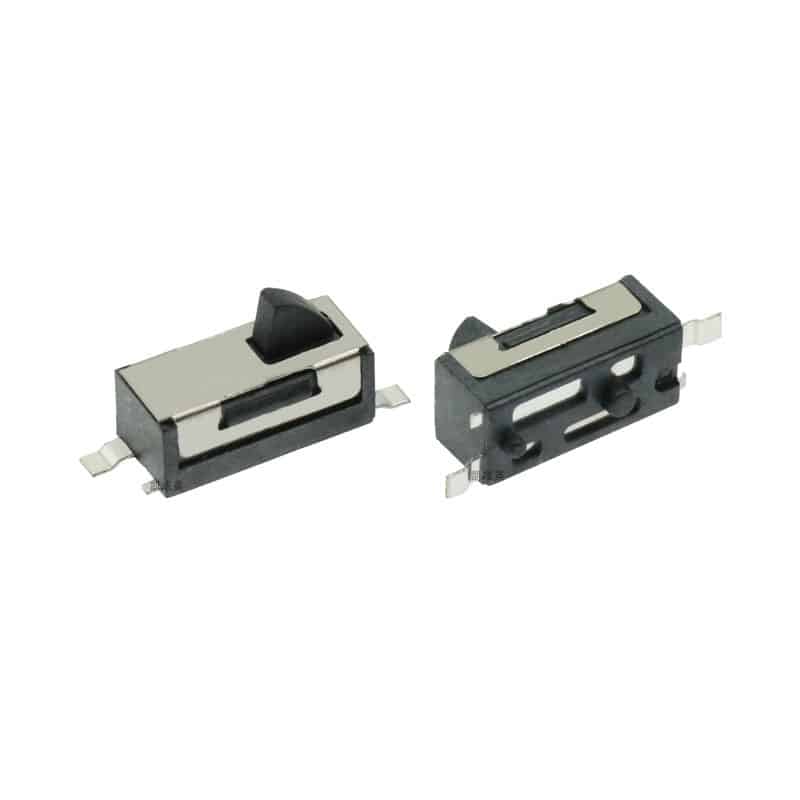
The DS-023 is a 4 pin SMT miniature detector switch 2×3×2.5 — an ultra-compact surface-mount position sensing switch designed for high-density PCB layouts where space is at a premium. Rated 50mA at 12V DC, with a precise 2.1 mm travel and 25 gf operating force, this miniature position sensor switch PCB delivers 50,000 operating cycles of reliable mechanical detection. Its 2×3×2.5 mm footprint makes it one of the smallest SMT detector switches available for modern compact electronics, IoT devices, wearables, and smart consumer products. RoHS compliant. Reel/Bag packaging. MOQ 1,000 pcs. Free sample available.
4 Pin SMT Miniature Detector Switch 2×3×2.5 — Product Overview
This 4 pin SMT miniature detector switch 2×3×2.5 is engineered for engineers who need reliable position detection in the most space-constrained PCB designs. With an incredibly small 2 mm × 3 mm × 2.5 mm body, this compact detector switch 50,000 cycles rated component occupies minimal board real estate while delivering consistent mechanical sensing performance.
As a miniature position sensor switch PCB solution, this component utilizes a precision-engineered U-type actuator that responds to physical displacement with a light 25 gf operating force. When a mechanical component (such as a battery door, cartridge, cover, or connector) presses against the actuator, the internal spring contacts close the circuit, sending a clear digital signal to the system controller. When pressure is released, the actuator returns to its original position and the circuit opens — providing simple yet effective position feedback.
This SMT detector switch 50mA 12V is designed for low-current signal detection applications where power consumption and board space are critical design constraints. The 4 pin SMT terminal configuration ensures stable surface-mount attachment during automated reflow assembly, while the robust contact system maintains electrical integrity across the full 50,000 cycle operational life.
Engineers select this detector switch for products where every millimeter counts: smartwatches, fitness trackers, wireless earbuds charging cases, portable medical devices, compact security sensors, and IoT modules. Its 2×3×2.5 mm form factor allows placement in areas where larger detection switches simply cannot fit, enabling product miniaturization without sacrificing functional reliability.
Detector Switch — Full Technical Specifications
| Parameter | Value | Notes |
|---|---|---|
| Part Number | DS-023 | Standard catalog item |
| Switch Type | Detector / Position Sensing Switch | SPST-NO (Normally Open) |
| Pin Count | 4 Pins | Surface-mount terminals |
| Mount Type | SMT (Surface Mount Technology) | Reflow soldering compatible |
| Body Dimensions | 2.0 × 3.0 × 2.5 mm (L×W×H) | Ultra-compact footprint |
| Electrical Rating | 50mA, 12V DC | Signal-level switching |
| Contact Arrangement | SPST-NO | Normally open, closes on actuation |
| Actuator Type | U-Type / Triangular | Top-actuated for position detection |
| Travel | 2.1 ± 0.20 mm | Total actuator displacement |
| Operating Force | 25 gf | Light-touch actuation |
| Operating Life | 50,000 cycles | Commercial grade durability |
| Contact Resistance | ≤ 150 mΩ | At rated load |
| Insulation Resistance | ≥ 100 MΩ | At 100V DC |
| Dielectric Strength | 100V AC (50-60 Hz) for 60 sec | Between terminals and housing |
| Operating Temperature | −10°C to +70°C | Standard commercial range |
| Contact Material | Phosphor Bronze, Silver Plated | Low, stable contact resistance |
| Actuator Material | High-Temperature Thermoplastic | LCP / PA compatible with reflow |
| Terminal Material | Phosphor Bronze, Silver Plated | Excellent solderability |
| Packaging | Reel / Bag | Tape & reel for automated assembly |
| RoHS Compliance | RoHS 3 Compliant | EU Directive 2015/863 |
Why Engineers Choose This SMT Detector Switch 50mA 12V for Ultra-Compact PCB Designs
2×3×2.5 mm — One of the Smallest Detector Switches on the Market
This detector switch occupies just 6 mm² of PCB area with a 2.5 mm height profile, making it ideal for wearables, hearables, and ultra-compact IoT modules where board space is the primary design constraint. This miniature position sensor switch PCB solution enables product miniaturization without eliminating critical detection functionality.
4 Pin SMT — Automated Assembly Ready
Four surface-mount terminals positioned for stable reflow soldering attachment. The 4 pin SMT design integrates seamlessly into standard SMT pick-and-place and reflow assembly lines, reducing manual handling and improving production throughput for high-volume manufacturing.
50,000 Cycles — Long-Term Reliability for Consumer Products
With a 50,000 cycle electrical life rating, this compact detector switch 50,000 cycles provides dependable position detection throughout the typical lifespan of consumer electronics, wearables, and portable devices. The precision spring contact system maintains consistent switching force and electrical performance from cycle 1 to cycle 50,000.
25 gf Light-Touch Actuation — Sensitive Position Detection
The 25 gf operating force ensures reliable actuation even with lightweight mechanical components such as thin battery doors, small connector housings, or delicate cartridge mechanisms. The light-touch design reduces mechanical stress on mating parts while maintaining positive switching action.
Reflow Compatible — High-Temperature Materials
Constructed with LCP (Liquid Crystal Polymer) and high-temperature thermoplastic housing materials, this detector switch withstands standard lead-free reflow soldering profiles (peak 245–260°C) without deformation or performance degradation. Suitable for modern RoHS-compliant manufacturing processes.
RoHS 3 & REACH Compliant — Globally Export Ready
Fully compliant with RoHS 3 (EU Directive 2015/863) and REACH SVHC substance regulations. This component meets international environmental standards for unrestricted global distribution, making it suitable for products sold in the EU, North America, and Asia-Pacific markets.
Where to Use This 4 Pin SMT Miniature Detector Switch 2×3×2.5 — Applications for IoT, Wearables, Medical & Consumer Electronics
Miniature Position Sensor Switch PCB — Design & Integration Guide
PCB Layout Recommendations
When integrating this 4 pin SMT miniature detector switch 2×3×2.5 into your PCB design, allocate a 2.0 mm × 3.0 mm component keepout area with additional clearance for the 2.5 mm actuator height. The four SMT terminals should be connected to signal traces with adequate width for 50mA current capacity. Place the switch where the mechanical mating component will apply force directly to the U-type actuator tip, ensuring the 2.1 mm travel is fully utilized without over-travel that could damage the internal mechanism.
Actuator Orientation & Force Direction
This detector switch features a top-actuated U-type actuator designed for vertical or near-vertical compression. The actuator should be oriented so that the mating mechanical component presses downward (toward the PCB surface) within ±15° of the actuator centerline. Side-loading or shear forces should be minimized through mechanical design of the mating component to prevent premature wear or actuator damage.
Soldering & Assembly
As a surface-mount component, this detector switch is compatible with standard lead-free reflow soldering profiles. Recommended peak temperature: 245–260°C for 3–5 seconds. Avoid exposing the switch to temperatures above 270°C or prolonged heating that could affect the internal spring contact system. For prototype or low-volume applications, hand soldering with a fine-tip iron (350°C, 3 seconds max per terminal) is acceptable with proper ESD precautions.
Electrical Interface
The 4 pin SMT configuration provides two independent contact pairs (typically pins 1-2 and 3-4 as normally open contacts). Connect one pair to your detection circuit and use the second pair for redundant sensing or as a backup contact. The 50mA 12V DC rating is suitable for direct microcontroller GPIO input with pull-up/pull-down resistors, or for low-current signal routing through FETs or optocouplers for isolation.
Miniature Detector Switch Comparison — Why Choose the 2×3×2.5 mm Form Factor
When selecting a miniature position sensor switch PCB component, engineers often compare this model against slightly larger alternatives such as the DS-013 (3.6×4.8 mm) or DS-011 (2×3×2.5 mm triangular type). This 4 pin SMT miniature detector switch 2×3×2.5 offers the critical advantage of minimum footprint — at just 6 mm² of PCB area, it occupies 40% less space than 3.6×4.8 mm alternatives while delivering equivalent electrical performance (50mA, 12V) and cycle life (50,000 operations).
For products where the 2×3×2.5 mm body size is sufficient for the mechanical detection requirement, this component eliminates the need to compromise on product dimensions or eliminate detection features. Its 25 gf operating force is lighter than many competing 40 gf designs, enabling detection of more delicate mechanical components without requiring stronger springs or heavier actuation mechanisms in the mating part.
Compared to through-hole detector switches, the SMT detector switch 50mA 12V design of this component eliminates drilled holes in the PCB, preserves inner layer routing space, and enables double-sided component placement — critical advantages in high-density designs where every layer and every square millimeter counts.
4 Pin SMT Miniature Detector Switch 2×3×2.5 — Frequently Asked Questions
What is the difference between this detector switch and the DS-011 model?
This model and the DS-011 share the same 2×3×2.5 mm body dimensions and 4 pin SMT configuration. Both are rated 50mA at 12V DC with 50,000 cycle life. The primary difference lies in the actuator geometry and operating force tuning. This DS-023 features a U-type actuator optimized for 25 gf light-touch applications such as battery door detection and delicate component sensing. The DS-011 (triangular type) may feature a different actuator profile suited for applications requiring a specific contact geometry or force curve. For detailed comparison, contact sales@vistarelectronics.com with your mechanical detection requirements.
Can this detector switch be used for high-current power switching?
No. This component is rated for 50mA at 12V DC — it is designed for signal-level detection and control applications, not for power switching. For applications requiring higher current capacity, consider Vistar’s tactile switch or micro switch product lines which offer higher current ratings. Using this component beyond its rated 50mA may result in contact arcing, accelerated wear, and premature failure.
What is the MOQ and can I get a free sample?
Standard MOQ is 1,000 pieces with a 2–4 week production lead time. Free samples are available for qualified engineering and product development projects. Contact sales@vistarelectronics.com with your company details, project application, and part number (DS-023), or click the “Get a Quote” button at the top of this page.
Is this detector switch compatible with automated SMT assembly?
Yes. This 4 pin SMT miniature detector switch 2×3×2.5 is specifically designed for automated surface-mount assembly. It is supplied in tape-and-reel packaging compatible with standard pick-and-place machines. The four terminals provide stable placement during reflow, and the high-temperature LCP housing withstands standard lead-free soldering profiles. For assembly guidelines, refer to IPC standards for SMT component mounting and soldering.
What applications benefit most from the 2×3×2.5 mm size?
The 2×3×2.5 mm form factor is ideal for any product where PCB area and height are severely constrained. Primary applications include: TWS earbud charging cases (lid detection), smartwatches (battery door sensing), fitness trackers (strap lock verification), portable medical devices (cartridge detection), compact IoT sensors (enclosure tamper detection), and slim smartphones (SIM tray sensing). If your product has a PCB thickness under 1 mm or total device height under 5 mm, this detector switch is likely the optimal choice.
Does this detector switch support custom actuator heights or force tuning?
Yes. Vistar offers customization services for this detector switch including custom actuator geometries, modified operating forces (within 15–40 gf range), and alternative terminal plating options. Custom tooling may be required for significant dimensional changes. Contact our engineering team at sales@vistarelectronics.com with your specific mechanical and electrical requirements for a custom solution quotation.
Detector Switch Standards & Engineering Resources
For engineers designing with this 4 pin SMT miniature detector switch 2×3×2.5, the following industry standards and resources provide valuable guidance on switch selection, PCB integration, and reliability testing:
- DS Series Detector Switch Specifications & Dimensions — Comprehensive technical datasheet covering detector switch ratings, dimensions, and performance characteristics.
- CK Switches DS Series Detect Switches Catalog — Industry reference for detector switch design parameters, contact materials, and lifecycle testing methodologies.
- IPC International Standards — Global standards for PCB design, SMT assembly, and electronic component qualification.
- UL Certification Standards — Safety certification requirements for switches and electromechanical components in consumer and industrial applications.
Detect Switch SMD 4 Pin Vertical — DS-011 Ultra‑Miniature SMT Detection Switch for PCB, IoT & Industrial Sensors

4pin SMT detector switch 3.8*4.7

4 pin SMD Detector switch 3.6*4.8

Mini Through-Hole Detector Switch 4 Pin Right Angle — DS-012 Micro Detect Switch 50mA DC 12V for Printers, Laptops & Industrial Automation

detector switch DIP 4p

SMD Detector Switch – 4-Pin PCB Switch, 6.5mm Height

6 Pin Silent Detector Switch — Compact SMT Switch for PCB Position Detection

Detector Switch SMT 4 Pin for Device Detection, Position Sensing & PCB Control Applications

Detector Switch Selection Guide: How to Choose the Right Component for Precision Detection Applications
Detector Switch Selection Guide. Covers actuators, ratings, sealing & SMT specs for consumer electronics and industrial use. The Silent Failure That Kills...

Detector Switch vs Micro Switch: What’s the Difference?
Detector Switch vs Micro Switch: What’s the Difference? When a product fails in the field, engineers often investigate firmware bugs, PCB defects,...
What Is a Detector Switch? Complete Guide for Engineers
In modern electronic products, many critical functions happen silently in the background. A laptop knows when its lid is closed. A printer...