
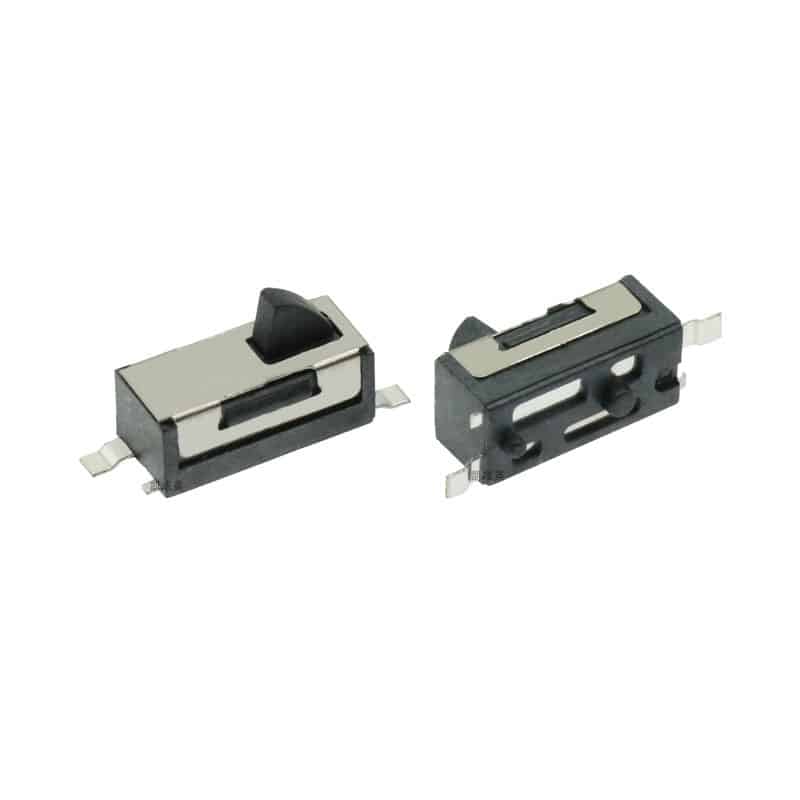
Detect Switch SMD 4 Pin Vertical — DS-011 Ultra‑Miniature SMT Detection Switch for PCB, IoT & Industrial Sensors
The DS-011 is a detect switch SMD 4 pin vertical — an ultra‑compact surface‑mount detection switch with 4‑pin SMT termination, vertical actuation direction, 0.8mm travel and 200,000‑cycle mechanical life. Rated 0.1A at 12V DC. Normally open. RoHS & REACH compliant. Tape & Reel packaging. MOQ 1,000 pcs. Free sample for qualified projects.
DS-011 Detect Switch SMD — Vertical SMT Detection Switch Product Overview
The DS-011 detect switch SMD is a miniature vertical‑actuation detection switch built specifically for high‑density PCB designs where accurate position sensing, door/cover open‑close detection, or mechanical limit functionality is required. With a tiny footprint of 4.5mm × 3.2mm and a low profile of just 1.8mm above the board, this detect switch SMD 4 pin vertical provides a crisp mechanical click and a reliable electrical make‑or‑break signal to your microcontroller.
Designed for surface‑mount reflow assembly, the DS-011 eliminates through‑hole processing entirely, reducing PCB drilling costs and speeding up SMT line throughput. The 4‑pin vertical configuration offers both better mechanical anchoring and the possibility to use auxiliary monitoring pins, while the high‑temperature LCP housing comfortably withstands lead‑free reflow profiles up to 260°C. Over a lifecycle of 200,000 operations, contact resistance remains stable thanks to a gold‑over‑nickel plating on phosphor bronze, making this detection switch a go‑to component for smart home appliances, portable medical devices, office equipment, and industrial automation modules.
The vertical actuation direction means the switch’s plunger is pushed perpendicularly to the PCB surface, ideal for side‑panel buttons, sliding tray detection, or limit‑stop applications where the actuating member moves towards the board. Combined with an IP40 dust‑resistant structure (IP67 optional) and a crisp tactile ratio, the DS-011 delivers the consistent feedback that product designers and end users both appreciate.
SMD 4 Pin Vertical Detect Switch PCB — DS-011 Full Technical Specifications
| Parameter | Value | Notes |
|---|---|---|
| Part Number | DS-011 | Standard catalog item |
| Switch Type | Detection Switch (momentary) | Single pole, normally open |
| Pin Count | 4 Pins (SMT) | Gull‑wing leads, 2 signal + 2 anchor |
| Mounting Style | SMD (Surface Mount) | Reflow solderable |
| Actuation Direction | Vertical (top push) | Plunger perpendicular to PCB |
| Actuator Type | Stem / plunger | Stainless steel or resin plunger |
| Actuation Force | 60 ±20 gf | 0.59N typical |
| Travel | 0.8 ±0.2 mm | Pre‑travel 0.5mm, over‑travel 0.3mm |
| Return Force | ≥20 gf | Guaranteed positive reset |
| Mechanical Life | 200,000 cycles | At rated load |
| Electrical Rating | 12V DC, 100mA (0.1A) | Resistive load |
| Contact Resistance | ≤100 mΩ (initial) | After 50,000 cycles ≤300 mΩ |
| Insulation Resistance | ≥100 MΩ @ 100V DC | Between open contacts |
| Dielectric Strength | 250V AC (1 minute) | No breakdown |
| Contact Material | Phosphor Bronze, Gold over Nickel | Low and stable resistance |
| Terminal Material | Brass, Gold over Nickel | Solderable pads |
| Housing Material | LCP (UL94 V‑0), high‑temp | Lead‑free reflow compatible |
| Environmental Sealing | IP40 standard / IP67 optional | Silicone seal on actuator |
| Operating Temperature | −20°C to +70°C | Commercial grade |
| Storage Temperature | −30°C to +80°C | — |
| Soldering Profile | Reflow 260°C, 10s max | Per JEDEC J‑STD‑020 |
| Packaging | Tape & Reel (2,000 pcs/reel) | Standard 13‑inch reel |
Why Product Engineers Choose the Vertical SMD Detect Switch 4 Pin 0.1A — DS-011 Key Advantages
Miniature Footprint & Low Profile
The DS-011 occupies only 4.5×3.2mm of board area and stands just 1.8mm tall, enabling vertical SMD detect switch 4 pin 0.1A placement in the slimmest IoT sensors, wearables, and portable electronics without compromising adjacent component clearance.
Robust 4‑Pin SMT Anchoring
Two additional anchor pins, besides the signal pair, provide extra mechanical strength against lateral forces and repeated actuation. This 4‑pin configuration significantly reduces solder joint stress compared to 2‑pin alternatives, ensuring stable operation over 200,000 cycles.
IP67 Sealing Option for Harsh Environments
For outdoor sensors, industrial interlocks, and white goods that encounter dust or splashing water, the DS-011 can be specified with an IP67‑rated silicone actuator seal. The seal maintains full travel and tactile feel while preventing ingress.
RoHS & REACH Compliant, Lead‑Free Reflow Ready
Fully compliant with RoHS 3 (2015/863) and REACH SVHC. The LCP housing and gold‑plated terminals withstand lead‑free SAC305 reflow profiles up to 260°C peak, meeting JEDEC J‑STD‑020D moisture sensitivity level 1 requirements. For further regulatory details, refer to the ECHA REACH regulation.
Where to Use the Surface Mount Detect Switch 4 Pin — Applications for Smart Home, Medical & Industrial Automation
PCB Layout & SMT Assembly Guidelines for the DS-011 Detect Switch
Recommended Land Pattern
For optimal solder joint reliability and reflow performance, use a 1:1 land pad dimension based on the switch terminal width plus a 0.15mm extension on each side. Maintain a solder mask opening that is 0.1mm larger per side than the copper pad. The anchor pins should have identical pad dimensions to the signal pads, and all four pads must be connected to the same ground or signal net per your design requirements.
Stencil Design
A laser‑cut stainless steel stencil of 0.1mm or 0.12mm thickness is recommended. Aperture openings for the four pads should be reduced to 90% of the pad area to prevent solder bridging during reflow. For the center ground pad (if present), use a window‑pane reduction pattern to achieve approximately 50% solder coverage, which reduces voiding under the component body.
Pick‑and‑Place
The DS-011 is supplied in standard 8mm‑wide tape on a 13‑inch reel (2,000 pieces per reel). The flat top surface of the actuator serves as a reliable pick‑up area for vacuum nozzles. Ensure the nozzle tip diameter is at least 2.5mm and the placement force is limited to 3N to avoid pre‑actuation during placement.
Reflow Profile
Follow JEDEC J‑STD‑020 guidelines for lead‑free reflow. The peak temperature should reach 245–260°C, with time above 217°C (liquidus) limited to 60–90 seconds. A ramp rate of 2–3°C per second during the preheat stage and a cooling rate of 4–6°C per second will minimize thermal shock. The DS-011 is MSL 1, so no pre‑bake is required if the factory‑sealed bag is opened within 30 days in a controlled environment (≤30°C/60% RH).
Manual Soldering (Rework)
If rework is necessary, use a temperature‑controlled soldering iron with a fine conical tip set to 350°C maximum. Apply flux to the pads and use a solder wire of 0.5mm diameter or less. Touch each terminal for no more than 3 seconds, and allow the switch to cool naturally between joints. Do not apply flux directly onto the actuator or the housing vent hole.
Horizontal vs Vertical Detect Switches: Why Vertical Orientation Wins for Thin PCBs
Detection switches come in two primary actuation orientations: horizontal (side‑actuated) and vertical (top‑actuated). A detect switch SMD 4 pin vertical layout offers distinct advantages when your PCB is mounted parallel to the actuating member, such as a sliding door panel or a moving print head. Because the plunger moves perpendicular to the board surface, the actuation force is transferred directly into the PCB’s plane, minimizing bending stress on the solder joints. In contrast, horizontal detect switches rely on side‑on force, which can create a cantilever effect and higher mechanical fatigue on the terminals over extended cycling.
Vertical detection switches also allow a simpler enclosure design: the button cap or mechanical plunger can be integrated into the product housing directly above the switch, requiring only a single straight‑line motion component. This reduces part count and assembly tolerance stack‑ups. For ultra‑slim devices under 5mm total thickness, a low‑profile vertical SMD detect switch like the DS-011 (1.8mm height) can often be the only feasible solution, as horizontal alternatives typically protrude beyond the board edge and add to the device’s outline dimensions.
Long‑Term Reliability and Environmental Testing for SMD Detect Switches
The DS-011 has been validated through a battery of mechanical and environmental tests to ensure consistent performance over a minimum of 200,000 cycles. Key test data include:
- Contact resistance stability: After 200,000 cycles at 0.1A 12V DC resistive load, contact resistance increases by less than 200 mΩ, remaining well within the 300 mΩ fail limit.
- Vibration resistance: 10–55 Hz, 1.5mm double amplitude for 2 hours in each of three axes, per IEC 60068‑2‑6. No contact opening longer than 100 µs detected.
- Shock resistance: 100 g, 6 ms half‑sine pulse in six directions, per IEC 60068‑2‑27. No mechanical damage or electrical discontinuity.
- Thermal shock: 100 cycles between −30°C and +80°C (30 min dwell each), per IEC 60068‑2‑14. Post‑test actuation force and contact resistance remained within specification.
- Humidity aging: 96 hours at 40°C, 90–95% RH, per IEC 60068‑2‑78. Insulation resistance dropped by less than one decade, and no corrosion was observed on gold‑plated surfaces.
For detailed test reports or to request a validation sample, contact our engineering team at engineering@vistarelectronics.com.
Packaging, Compliance & Ordering Information for DS-011
All DS-011 detect switch SMD units are packaged in antistatic tape & reel (2,000 pieces per 13‑inch reel), meeting ANSI/EIA‑481 standards. The switch is fully lead‑free and compatible with SAC305 solder paste. Custom options include IP67 sealing, alternative actuation forces (30gf, 100gf), and gold thickness up to 0.5µm for enhanced corrosion resistance. Standard MOQ is 1,000 pieces. For higher‑volume pricing or a free prototype sample, contact sales@vistarelectronics.com with your project details.
Detect Switch SMD 4 Pin Vertical — Frequently Asked Questions
Can I get a free sample of the DS-011 for prototyping?
Yes. We provide free samples to qualified engineering teams for evaluation and prototyping. Please email sales@vistarelectronics.com with your company name, project application, and the part number DS-011. Standard MOQ for production orders is 1,000 pieces.
What is the difference between the standard (IP40) and IP67 version?
The IP67 version includes a transparent silicone membrane bonded over the actuator stem, which seals the internal mechanism against dust ingress and temporary immersion in water up to 1 meter for 30 minutes. The electrical and mechanical specifications remain identical. The IP67 version is recommended for outdoor, medical, or industrial applications where moisture or dust is present.
Can the DS-011 be used with a 3.3V logic circuit?
Yes. The gold‑plated contacts are suitable for low‑current, low‑voltage dry‑circuit applications down to 1µA / 20mV. The switch will reliably interface with 3.3V or 1.8V microcontroller GPIO inputs, provided a pull‑up or pull‑down resistor is used.
How does the 4‑pin footprint improve reliability over a 2‑pin design?
The two additional anchor pins are soldered to the PCB and provide a rigid mechanical connection that absorbs actuation forces and lateral shocks. This reduces the stress on the signal solder joints, lowering the risk of pad lifting or intermittent contact after prolonged use.
What is the recommended storage condition for the DS-011?
Store in a dry, cool environment at 5–35°C and 45–75% relative humidity. The moisture sensitivity level (MSL) is 1, meaning the switch does not require baking before reflow soldering if stored under the conditions mentioned above for up to 12 months from the date of shipment.

4 Pin SMD Detector Switch DS-005 — Compact PCB Detection Switch

detector switch DIP 4p

Reset switch SMD detector switch 4 pin

Mini Through-Hole Detector Switch 4 Pin Right Angle — DS-012 Micro Detect Switch 50mA DC 12V for Printers, Laptops & Industrial Automation

3.5×4.3mm Detector Switch — 4 Pin SMT PCB Detection Switch for Compact Electronics

4Pin DIP detect switch 3*6.5

6 Pin Silent Detector Switch — Compact SMT Switch for PCB Position Detection

Detector Switch SMT 4 Pin for Device Detection, Position Sensing & PCB Control Applications

Detector Switch Selection Guide: How to Choose the Right Component for Precision Detection Applications
Detector Switch Selection Guide. Covers actuators, ratings, sealing & SMT specs for consumer electronics and industrial use. The Silent Failure That Kills...

Detector Switch vs Micro Switch: What’s the Difference?
Detector Switch vs Micro Switch: What’s the Difference? When a product fails in the field, engineers often investigate firmware bugs, PCB defects,...
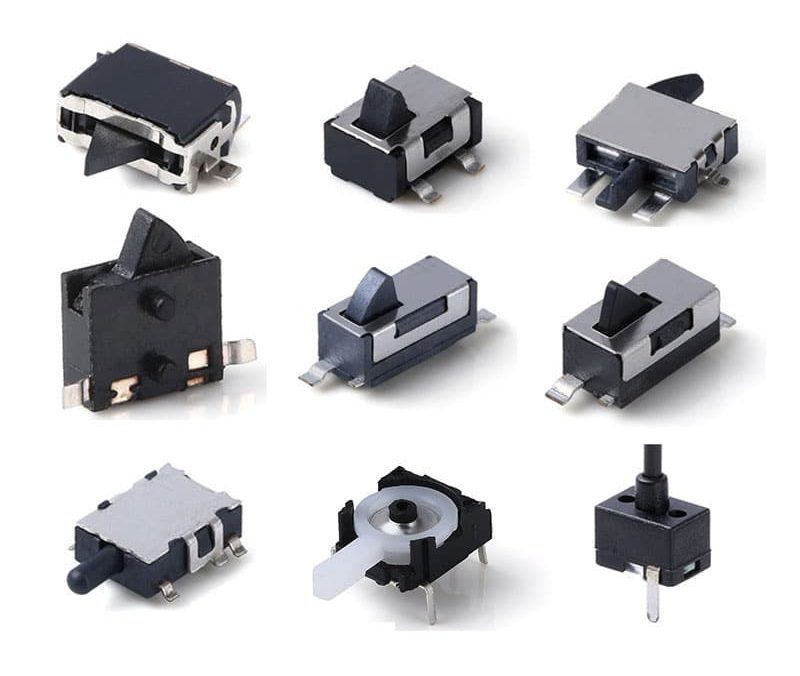
What Is a Detector Switch? Complete Guide for Engineers
In modern electronic products, many critical functions happen silently in the background. A laptop knows when its lid is closed. A printer...