

Reset switch SMD detector switch 4 pin
SMD Detector Switch 4 Pin — Product Overview
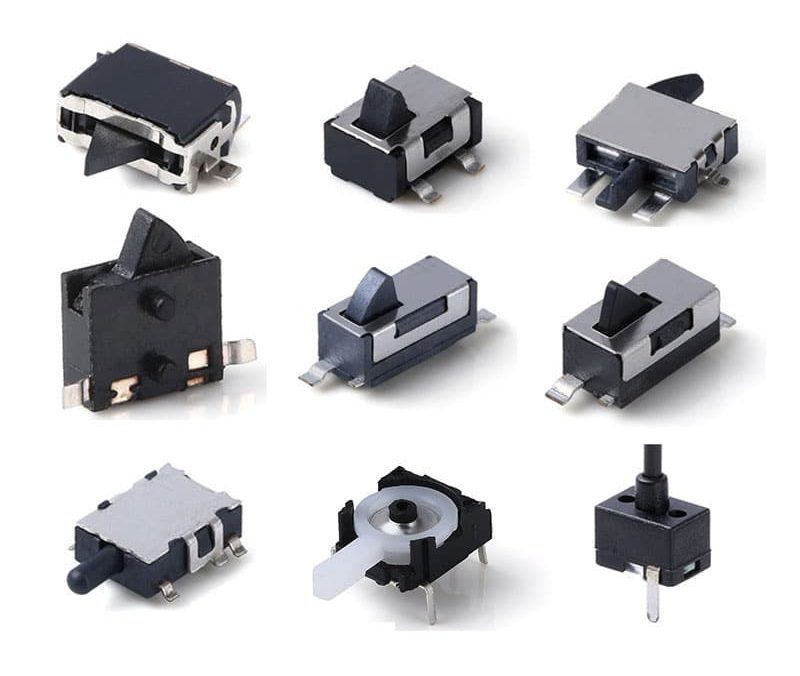
The DS-018 is an SMD detector switch 4 pin that bridges the functional gap between traditional tactile push buttons and fully contactless proximity sensors. Unlike standard tact switches that require direct finger or plunger pressure to actuate, this surface mount reset switch SMD responds to mechanical displacement, insertion, or positional change — making it the ideal choice for applications where a physical object (cartridge, lid, tray, or module) triggers the circuit state rather than a human finger.
The 4-pin SMT configuration provides two independent normally-open (NO) contact pairs, enabling redundant signal paths, differential sensing, or simultaneous detection and reset functions in a single compact package. The detector-style actuator — typically a lever, plunger, or blade that protrudes from the switch body — is displaced by the target object, closing the internal contacts and completing the circuit. When the object is removed, the internal spring returns the actuator to its original position, opening the circuit.
With a remarkably long 100,000 cycle operating life, this 4 pin detector switch smt outperforms many consumer-grade tact switches and micro switches, reducing field failure rates in products subjected to frequent mechanical cycling. The low 35 gf operating force ensures reliable actuation even with lightweight or low-force target objects, while the compact SMT footprint enables placement in space-constrained designs where larger limit switches or mechanical sensors cannot fit.
Surface Mount Reset Switch — Full Technical Specifications
| Parameter | Value | Notes |
|---|---|---|
| Part Number | DS-018 | Standard catalog item |
| Switch Type | SMD Detector Switch 4 Pin | Surface mount reset detection switch |
| Circuit Function | SPST-NO (×2) | Two independent normally-open contacts |
| Pin Count | 4 Pins | 2 contact pairs for redundancy or dual function |
| Mounting Type | SMD (Surface Mount Device) | Reflow solder compatible |
| Actuator Type | Detector Style (Lever/Plunger) | Responds to mechanical displacement |
| Voltage Rating | DC 12V | Maximum working voltage |
| Current Rating | 50 mA | Maximum switching current |
| Contact Resistance | ≤ 100 mΩ | Initial value at rated load |
| Insulation Resistance | ≥ 100 MΩ | At 100V DC |
| Dielectric Strength | 250V AC / 1 minute | No breakdown or flashover |
| Operating Force | 35 gf | Light actuation for sensitive detection |
| Travel | 0.3 ± 0.10 mm | Short detection displacement |
| Operating Life | 100,000 cycles | Exceptional mechanical endurance |
| Contact Material | Silver-plated or Gold-plated | Low resistance, oxidation resistant |
| Actuator Material | High-Grade Thermoplastic | Durable, low-friction surface |
| Base / Housing | High-Temperature Thermoplastic | Reflow compatible, black standard |
| Operating Temperature | −20°C to +70°C | Commercial grade |
| Storage Temperature | −30°C to +80°C | Long-term storage conditions |
| Reflow Soldering | Compatible | Peak 260°C, 10 seconds max |
| Packaging | Reel / Bag | Tape & reel for automated assembly |
Why Engineers Choose the Reset Tact Switch for Detection & Sensing Applications
Detector-Style Actuation — Object-Sensing Without Human Contact
Unlike conventional reset tact switch designs that require finger pressure, the DS-018 responds to mechanical displacement from physical objects — cartridges, lids, trays, modules, or sliding mechanisms. This enables automatic detection without user intervention, reducing wear and extending product life compared to manually actuated alternatives.
4-Pin Dual Contact Configuration — Redundancy & Dual Function
The 4 pin detector switch smt provides two independent SPST-NO contact pairs in one package. Use both pairs for redundant detection (fail-safe sensing), or assign one pair to detection and the other to reset or status indication. This versatility eliminates the need for a second switch, reducing BOM count and PCB area.
100,000 Cycles — Exceptional Durability for High-Cycle Applications
With a 100,000 cycle lifespan, this switch outperforms typical tact switches rated for 30,000–50,000 cycles. Ideal for printer cartridge detection (frequent replacement), industrial position sensing (continuous cycling), and IoT devices requiring long-term reliability without maintenance or replacement.
35 gf Light Operating Force — Sensitive Detection for Lightweight Objects
The exceptionally low 35 gf actuation force ensures reliable switching even with lightweight plastic cartridges, thin metal lids, or low-mass mechanical triggers. This sensitivity is critical for applications where excessive force could damage the target object or impede smooth mechanical operation.
Compact SMT Footprint — Space-Efficient Automated Assembly
The surface-mount configuration enables single-pass reflow assembly alongside other SMT components, reducing manufacturing cycle time and cost. The compact body fits into tight PCB layouts where larger limit switches, micro switches, or through-hole detectors would be impractical.
RoHS Compliant & Production Ready
Fully compliant with RoHS Directive for lead-free manufacturing. Supplied on tape & reel for seamless integration with pick-and-place equipment and automated optical inspection (AOI) systems. Bag packaging available for prototype and low-volume manual assembly.
Where to Use the 4 Pin Detector Switch SMT — Applications for Consumer, Industrial, IoT & Office Equipment
Cartridge detection, paper tray sensing, lid open/close monitoring, and maintenance cover interlocks on inkjet printers, laser printers, copiers, and multifunction devices where reliable mechanical sensing ensures proper operation and prevents damage.
Lid close detection (sleep/hibernate trigger), dock insertion sensing, battery compartment interlocks, and keyboard tray position monitoring where compact SMT mounting and low-profile actuation are essential for slim industrial design.
Door/window position sensing on smart sensors, module insertion detection on gateway expansion slots, battery compartment monitoring, and tamper detection on security devices where long battery life demands minimal standby current and reliable mechanical sensing.
Position feedback on linear actuators, end-stop detection on conveyor systems, tooling presence verification on CNC machines, and safety interlocks on automated equipment where 100,000 cycle durability and SMT assembly efficiency reduce total cost of ownership.
Battery insertion detection on portable devices, accessory port sensing on gaming peripherals, SD card tray interlocks on cameras, and cartridge detection on handheld gaming systems where user experience depends on reliable automatic detection.
Sample tray position sensing on analyzers, cartridge detection on diagnostic devices, lid interlocks on centrifuges, and consumable presence verification on therapy equipment where reliable sensing directly impacts patient safety and test accuracy.
Detector Switch vs Reset Switch: Understanding the Difference
Engineers often search for “reset switch” when they actually need a detector switch — or vice versa. Understanding the distinction ensures you select the right component for your application:
What is a Reset Switch?
A reset switch is typically a momentary push button that, when pressed by a user, triggers a system reset, restart, or default state recovery. Common examples include the small recessed button on routers (“press and hold for 10 seconds to factory reset”) and the reset button on PC motherboards. Reset switches are user-actuated, require deliberate human intervention, and are usually tactile push buttons or small DIP switches.
What is a Detector Switch?
A detector switch (also called a detection switch, position switch, or sensing switch) responds to the presence, absence, or position of a physical object — not human finger pressure. The actuator is displaced by a cartridge, lid, tray, module, or mechanical component, closing contacts to signal detection. Detector switches are automatically actuated, require no user intervention, and are essential for cartridge detection, lid sensing, and position feedback applications.
When to Choose Which
| Application Need | Choose | Why |
|---|---|---|
| User presses a button to reset/restart | Tactile Reset Switch | Requires deliberate human actuation, tactile feedback |
| System detects cartridge insertion | Detector Switch (DS-018) | Responds to object displacement, no user action needed |
| Lid close triggers sleep mode | Detector Switch (DS-018) | Automatic position sensing, 100,000 cycle durability |
| Factory reset button on router | Tactile Reset Switch | Recessed button, infrequent use, user-initiated |
| Battery compartment interlock | Detector Switch (DS-018) | Senses battery presence, enables power circuit |
The DS-018 is fundamentally a detector switch that can also serve reset-related functions (e.g., detecting when a module is removed and triggering a system reset). Its 4-pin configuration allows simultaneous detection and reset signaling, making it more versatile than single-function alternatives.
DS-018 PCB Layout, SMT Assembly & Detection System Design Guidelines
Proper PCB design and mechanical integration are essential to achieving reliable detection performance from this SMD detector switch 4 pin. Follow these engineering best practices:
Footprint & Pad Design
- Use the manufacturer-recommended land pattern. The 4-pin SMT configuration requires precise pad sizing and spacing to ensure proper solder joint formation, coplanarity, and mechanical stability. Verify the footprint against the official datasheet before PCB fabrication.
- Maintain adequate solder mask clearance between adjacent pads to prevent solder bridging during reflow. A minimum 0.2 mm solder mask web is recommended.
- Include polarity markings on the PCB silkscreen to indicate correct switch orientation and pin 1 location, preventing assembly errors that could reverse contact pairs.
Actuator Clearance & Mechanical Integration
- Reserve actuator travel clearance. The 0.3 mm travel requires unobstructed space for the actuator to move freely. Ensure the target object (cartridge, lid, tray) engages the actuator without over-travel that could damage the internal spring mechanism.
- Design positive mechanical stops. Implement hard stops in the target object’s travel path to prevent the actuator from being over-compressed beyond its 0.3 mm rated travel. Over-travel can permanently deform the contact spring and reduce cycle life.
- Maintain actuator alignment. The target object should engage the actuator perpendicular to its travel axis. Angled or offset contact can cause side loading, binding, and premature wear. Consider guide rails or chamfers on the target object to ensure centered engagement.
- Provide return spring assistance if needed. For applications where the target object does not reliably retract (e.g., gravity-fed trays), consider adding an external return spring to ensure positive actuator release and contact opening.
Electrical Design & Signal Conditioning
- Use pull-up or pull-down resistors (typically 10 kΩ to 100 kΩ) on each contact pair to ensure defined logic states when the switch is open. The DS-018 is normally-open — without pull resistors, the signal line floats and may pick up noise.
- Implement debounce in firmware or hardware. Mechanical switches exhibit contact bounce on closure. For detection applications, implement a 10–50 ms software debounce routine to prevent false triggering from bounce-induced multiple pulses.
- Consider ESD protection for exposed actuator interfaces. While the DS-018 is typically enclosed within a product housing, ESD events during assembly or service can damage sensitive downstream circuitry. TVS diodes or RC snubbers provide inexpensive protection.
- Leverage dual contacts for redundancy. For safety-critical applications (medical, industrial), wire both contact pairs to independent MCU inputs and implement voting logic. If one contact pair fails, the second provides continued operation and alerts maintenance.
Reflow Soldering Profile
- Peak temperature: Maximum 260°C for 10 seconds
- Preheat: 150–180°C for 60–120 seconds
- Ramp rate: ≤ 3°C/second to prevent thermal shock
- Cooling: Natural air cooling; avoid forced air directly on the actuator
For the official mechanical drawing, recommended PCB land pattern, 3D STEP model, and actuator force-displacement curves, please contact our sales team or request the DS-018 datasheet.
Quality Assurance & Manufacturing Excellence
All Vistar detector switches, including this SMD detector switch 4 pin, are manufactured under rigorous quality management systems with comprehensive testing at every production stage:
- 100% electrical testing: Every switch is tested for contact resistance, insulation resistance, and dielectric withstand voltage before shipment
- Operating force verification: Statistical sampling confirms actuation force remains within the 35 gf specification across production lots
- Dimensional inspection: Automated optical measurement confirms body dimensions, pin spacing, actuator height, coplanarity, and travel distance
- Life testing: Representative samples undergo 100,000 cycle endurance testing with automated actuator displacement to validate mechanical durability and contact resistance stability
- Environmental testing: Thermal cycling, humidity exposure, and dust ingress testing confirm performance under challenging conditions
- RoHS & REACH compliance: Full material composition documentation available for regulatory compliance and export certification
Our manufacturing facilities maintain ISO 9001 quality management certification, ensuring traceability, consistency, and continuous improvement across all production batches. Certificate of Conformance (COC), material safety data sheets, and RoHS test reports are available upon request.
Engineering Resources & Related Detector Switch Products
For comprehensive guidance on detector switch selection, position sensing design, and reset switch applications, explore these authoritative resources:
- Detector Switch Selection Guide: How to Choose the Right Component for Precision Detection Applications — Comprehensive guide covering actuator types, electrical ratings, sealing options, and SMT specifications for detector switches in consumer electronics and industrial applications.
- Detector Switch vs Micro Switch: What’s the Difference? — Expert analysis of the fundamental differences between contactless detector switches and mechanical micro switches, with selection criteria for position sensing, limit control, and automatic detection scenarios.
- 4 Pin SMT Miniature Detector Switch 2×3×2.5 mm — DS-023 Ultra-Compact Position Sensor for PCB Mount in IoT, Wearables & Consumer Electronics — Ultra-compact detector switch for space-constrained designs requiring sub-3mm body dimensions.
- Detect Switch SMD 4 Pin Vertical — DS-011 Ultra‑Miniature SMT Detection Switch for PCB, IoT & Industrial Sensors — Vertical-mount detector switch alternative for applications where top-actuated sensing is preferred.
Explore our full range of Detector Switches for alternative configurations including miniature 2×3 mm, right-angle, vertical, through-hole, and custom actuator styles for every detection and sensing application.
Understanding SMD Reset Switches and Detector Switches for PCB Design
SMD reset switches and detector switches are essential electromechanical components in modern PCB designs, serving critical functions in consumer electronics, industrial automation, IoT devices, and communication equipment. While both are surface-mountable and occupy minimal PCB area, they serve fundamentally different purposes and respond to different actuation stimuli.
An SMD reset switch is typically a momentary push button that requires deliberate human actuation — pressing the button closes the circuit, releasing it opens the circuit. These switches are commonly found on routers (factory reset), motherboards (CMOS reset), and embedded systems (reboot triggers). The user intentionally presses the switch to initiate a system-level action.
A detector switch like the DS-018 responds automatically to the presence, absence, or position of a physical object — no human interaction required. When a printer cartridge is inserted, a laptop lid is closed, or a battery module is seated, the detector switch’s actuator is mechanically displaced, closing contacts and signaling the system. This automatic detection capability makes detector switches indispensable in products where user-independent position sensing is required for safe and correct operation.
The surface mount reset switch category encompasses both traditional push-button reset switches and detector-style switches that can trigger reset functions. The DS-018’s 4-pin dual-contact configuration is particularly versatile: one contact pair can serve as a detection sensor (cartridge present), while the second pair triggers a reset signal (initialize communication with newly inserted cartridge). This dual-function capability reduces BOM count and PCB area compared to using separate detection and reset switches.
When selecting between reset tact switch and detector switch options for your PCB design, consider the actuation source (human vs. mechanical object), cycle life requirements (detector switches typically need higher durability for automatic cycling), and force sensitivity (detector switches often require lower actuation force for lightweight object sensing). Vistar’s detector switch portfolio spans from ultra-miniature 2×3 mm SMT devices to robust industrial-grade position sensors, ensuring the right component for every detection and reset application.
SMD Detector Switch 4 Pin — Frequently Asked Questions
What is an SMD reset switch, and how does it differ from a detector switch?
An SMD reset switch is a surface-mount momentary switch that, when pressed by a user, triggers a system reset or restart function. It is user-actuated — someone must physically press the button. A detector switch like the DS-018 is automatically actuated by a physical object (cartridge, lid, tray) and requires no human interaction. While both can trigger reset functions, detector switches are designed for position sensing and object detection applications where the system must respond to mechanical state changes without user intervention.
How does a 4 pin reset switch work?
The DS-018 4 pin reset switch (detector switch) uses two independent SPST-NO (Single Pole, Single Throw, Normally Open) contact pairs:
- Pins 1-2: Contact Pair A — closes when the actuator is displaced
- Pins 3-4: Contact Pair B — closes when the actuator is displaced
Both pairs operate simultaneously when the target object displaces the actuator. The dual-contact design provides redundancy for critical applications or enables dual-function operation (e.g., one pair for detection, one pair for reset signaling). When the object is removed, the internal spring returns the actuator to its original position, opening both contact pairs.
Is a reset switch momentary or latching?
The DS-018 is a momentary switch — the contacts close only while the actuator is displaced by the target object. When the object is removed, the contacts open. This is the standard behavior for both reset switches and detector switches used in PCB applications.
Latching switches (push-on, push-off) maintain their state after actuation and are rarely used for reset or detection functions. For reset applications, a momentary switch is preferred because the reset action should only occur during the brief press or detection event, not persist indefinitely.
What is the difference between a reset switch and a tact switch?
A reset switch is defined by its function — it resets or restarts a system. It can be implemented as a tact switch (push button), detector switch (position sensor), slide switch, or even a magnetic reed switch depending on the application requirements.
A tact switch is defined by its mechanism — a momentary push button with tactile feedback (the characteristic “click” feel). Tact switches are commonly used as reset switches, but not all reset switches are tact switches.
The DS-018 is a detector switch that can serve reset-related functions. It is not a tact switch — it lacks the push-button actuator and tactile click of traditional tact switches. Instead, it uses a detector-style actuator that responds to object displacement, making it ideal for automatic detection applications where a tact switch would be impractical.
Can the actuator height or style be customized?
Yes. Vistar offers customization services for the DS-018 SMD detector switch 4 pin, including:
- Actuator height: Modified plunger or lever height to match specific target object engagement requirements
- Actuator style: Blade, lever, roller, or custom profiles for different mechanical engagement scenarios
- Operating force: Adjusted spring rate for lighter or heavier actuation (standard is 35 gf)
- Contact material: Gold-plated contacts for high-reliability or corrosive environments
- Packaging: Custom tape & reel specifications for automated assembly lines
Contact our engineering team with your mechanical drawings, force-displacement requirements, and annual volume forecasts for feasibility assessment and tooling lead time.
What is the MOQ, lead time, and can I request a free sample?
Standard MOQ is 3,000 to 5,000 pieces depending on configuration, with a typical production lead time of 2–4 weeks. Free samples are available for qualified engineering evaluations, prototype builds, and product development projects.
To request samples, contact sales@vistarelectronics.com with your company information, target application (printer, laptop, IoT sensor, etc.), estimated annual usage, and part number (DS-018). Alternatively, click the “Get a Quote” button at the top of this page to submit your inquiry directly.
For high-volume OEM customers, we offer custom actuator designs, alternative plating, special packaging, PPAP support, and long-term supply agreements with volume pricing for programs with forecasted annual requirements above 50,000 pieces.

Mini Through-Hole Detector Switch 4 Pin Right Angle — DS-012 Micro Detect Switch 50mA DC 12V for Printers, Laptops & Industrial Automation

4 Pin SMT Miniature Detector Switch 2×3×2.5 mm — DS-023 Ultra-Compact Position Sensor for PCB Mount in IoT, Wearables & Consumer Electronics

4pin SMT detector switch 3.8*4.7

4 pin SMD Detector switch 3.6*4.8

Detector Switch SMT 4 Pin for Device Detection, Position Sensing & PCB Control Applications

Surface Mount Silent Detector Switch 6 pin

SMT detector switch 3.5×4.3

detector switch DIP 4p

Detector Switch Selection Guide: How to Choose the Right Component for Precision Detection Applications
Detector Switch Selection Guide. Covers actuators, ratings, sealing & SMT specs for consumer electronics and industrial use. The Silent Failure That Kills...

Detector Switch vs Micro Switch: What’s the Difference?
Detector Switch vs Micro Switch: What’s the Difference? When a product fails in the field, engineers often investigate firmware bugs, PCB defects,...
What Is a Detector Switch? Complete Guide for Engineers
In modern electronic products, many critical functions happen silently in the background. A laptop knows when its lid is closed. A printer...