

6 Pin Silent Detector Switch — Compact SMT Switch for PCB Position Detection
6 Pin SMD Detector Switch — Product Overview (Silent Detector Switch SMT for Compact PCB Designs)
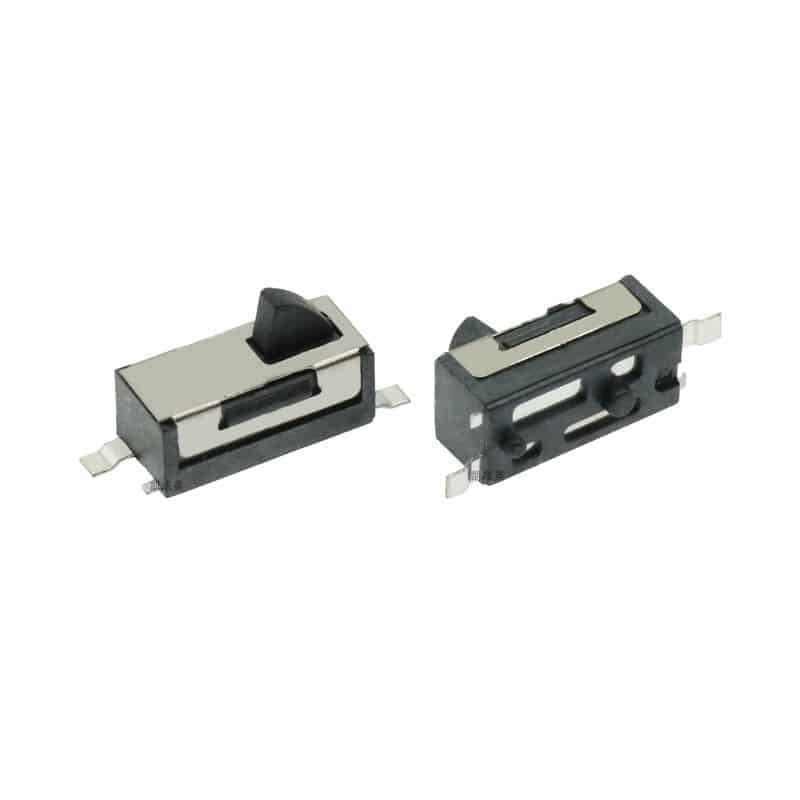
A 6 pin silent detector switch is used when an electronic product needs to detect a mechanical action without relying on a large conventional switch. This 6 pin SMD detector switch is mounted directly onto the PCB and can be actuated by a moving component such as a cover, door, tray, slider, card mechanism, or internal linkage.
The SMT construction is particularly useful for automated PCB assembly — instead of adding a separately wired detection component, engineers can place the switch directly onto the board and process it together with other surface-mount components.
The six-terminal configuration provides a different electrical and mechanical arrangement from common 2-pin, 3-pin, or 4-pin detector switches. As a silent detector switch SMT, the component is designed for products where the acoustic character of a mechanical detection operation matters. In equipment used close to people, repeated clicking or switching noise can become noticeable. A detector switch designed for quieter operation can therefore be useful in office equipment, consumer electronics, portable devices, and other products where acoustic behavior is part of the user experience.
Manufactured in an ISO 9001:2015 certified facility, this surface mount detector switch 6 pin is fully compliant with RoHS 3 and REACH regulations. Available in production packaging, with OEM customization options for volume orders.
Surface Mount Detector Switch 6 Pin — Technical Specifications
Below are the specifications for the surface mount detector switch 6 pin, covering electrical, mechanical, and environmental parameters. Values marked as “refer to current product drawing” should be confirmed against the latest Vistar engineering documentation before production release.
| Parameter | Specification | Notes |
|---|---|---|
| Product Type | Silent Detector Switch | Mechanical position / presence detection |
| Part Number | DS-K1 | |
| Terminal Count | 6 Pin | Confirm terminal function from product drawing |
| Mounting Type | SMT / SMD | Surface-mount PCB assembly |
| Application | Position and Mechanism Detection | Cover, tray, insertion, moving-part detection |
| Actuation | Mechanical | Confirm actuator geometry for the final application |
| PCB Assembly | Automated SMT Assembly | Suitable for production PCB assembly processes |
| Electrical Rating | Refer to Current Product Drawing | Verify before production release |
| Operating Force | Refer to Current Product Drawing | Select according to the mechanical actuator |
| Mechanical Life | Refer to Current Product Drawing | Confirm against expected operating cycles |
| Operating Temperature | Refer to Current Product Drawing | Application dependent |
| Compliance | RoHS 3, REACH | Documentation available for qualified projects |
| Packaging | Production Packaging | Packaging configuration to be confirmed by order |
| OEM / ODM | Available | Custom requirements can be reviewed by engineering |
Electrical, mechanical, and dimensional values should be confirmed against the latest Vistar engineering drawing before PCB layout, tooling, or mass-production approval.
6 Pin Silent Detector Switch — Key Design Advantages for OEM and PCB Engineers
Quiet Detection
The silent operating concept is suitable for products where mechanical switching noise needs to be controlled during normal operation. This 6 pin silent detector switch is designed for refined acoustic performance.
Compact SMT Integration
Surface-mount construction allows the detector switch to be integrated directly into an automated PCB assembly process. This 6 pin SMD detector switch saves board space and simplifies assembly.
Six-Terminal Configuration
The six-pin configuration provides a dedicated terminal arrangement for the intended detection circuit and PCB layout. Terminal function should be confirmed from the manufacturer’s drawing.
Production Oriented
Suitable for OEM and ODM projects requiring repeatable PCB assembly, engineering support, and volume supply. This silent detector switch SMT is designed for high-volume manufacturing.
RoHS & REACH Support
Vistar supports compliance documentation for international electronics supply chains and customer qualification requirements.
OEM / ODM Support
Application requirements such as actuator geometry, terminal configuration, and packaging can be reviewed for customized projects.
How a PCB Detector Switch Works — Position and Mechanism Detection
A PCB detector switch provides a simple interface between a mechanical assembly and an electronic control circuit. When the mechanical actuator changes position, the switch changes its electrical state and the controller can interpret that condition as an open, closed, inserted, removed, or positioned state.
This makes detector switches useful in products where the electronics need to know what is happening mechanically inside the product. The six-terminal arrangement should not be interpreted simply as six independent switching channels.
Depending on the internal construction, some terminals may form electrically common pairs. Engineers should use the product’s electrical diagram rather than assuming pin connectivity from the external appearance alone.
Typical Detection Functions
- Position Detection: Detect the position of moving components, covers, doors, trays, and mechanical assemblies.
- Insertion Detection: Confirm that a removable component, tray, module, or accessory has reached the required position.
- Mechanism Feedback: Provide an electrical signal to the controller when a mechanical mechanism reaches a defined position.
- Low-Noise Operation: Suitable for product designs where repeated mechanical detection should not create unnecessary operating noise.
For a broader explanation of detector switch construction and operation, engineers can also review our Detector Switch Selection Guide.
Where to Use This 6 Pin Silent Detector Switch — Applications Across Industries
As a versatile PCB detector switch, this 6-pin silent SMT component is found across a wide range of applications where reliable mechanical detection is required in a compact, automated-assembly-ready package.
How to Select a Silent SMT Detector Switch for a New PCB
Choosing a detector switch should start with the mechanical function rather than the switch name. The first question is what the switch needs to detect: cover movement, tray position, insertion, end-of-travel movement, or another mechanical condition.
1. Define the Detection Function
Identify the exact position that needs to be detected and determine whether the switch will be normally open, normally closed, or used in another circuit arrangement. This information should be established before selecting the terminal configuration.
2. Check the Six-Pin Arrangement
Do not assume that every six-pin detector switch uses the same internal circuit. Check the terminal diagram and continuity relationship in the manufacturer’s specification.
3. Match the Actuator
The mechanical actuator should reach the switch at the intended position and provide enough travel to achieve reliable switching without excessive force or over-travel.
4. Confirm the PCB Footprint
Use the manufacturer’s recommended PCB pattern. The footprint should include the required copper pads, solder-mask openings, and mechanical clearance around the switch.
5. Consider Production Assembly
For high-volume electronics manufacturing, SMT assembly is normally preferred because the switch can be placed together with other surface-mount components. The assembly process should be validated using the approved component specification.
6. Check Environmental Requirements
Temperature, humidity, contamination, vibration, and mechanical frequency can all affect detector-switch selection. Products used in printers or industrial equipment may experience a very different mechanical environment from small consumer devices.
For a production BOM, the correct approach is to compare the complete electrical and mechanical specification with the actual application rather than selecting only from the component name.
6 Pin Silent Detector Switch — Frequently Asked Questions
What is a 6 pin silent detector switch?
A 6 pin silent detector switch is a surface-mount mechanical switch used to detect the position, presence, or movement of a component inside an electronic product. The six-terminal configuration is intended for the specific electrical arrangement shown in the manufacturer’s product drawing.
What is a silent detector switch SMT used for?
A silent detector switch SMT is commonly used for cover detection, tray detection, insertion detection, mechanism position sensing, and other PCB-based detection functions. It is particularly useful when the product requires compact SMT assembly and controlled mechanical operating noise.
Why use six pins instead of a conventional 2-pin or 4-pin detector switch?
The correct terminal count depends on the internal circuit, mechanical design, and PCB requirements. A 6 pin SMD detector switch should not be selected simply because it has more terminals. Engineers should compare the terminal diagram, footprint, and electrical function with the detection circuit before selecting the component.
Can this detector switch be assembled using SMT equipment?
Yes. The product is designed as an SMT / SMD detector switch for direct PCB assembly. The exact soldering profile, placement requirements, and recommended PCB footprint should be confirmed using the current production specification.
Where are silent SMT detector switches commonly used?
Typical applications include consumer electronics, printers, office equipment, portable devices, communication equipment, smart devices, and industrial electronic assemblies where a PCB-mounted mechanical detection function is required.
How should I choose the correct PCB footprint?
Use the latest manufacturer engineering drawing rather than creating a footprint from product photographs. Verify terminal spacing, pad dimensions, solder-mask openings, actuator clearance, and the mechanical keep-out area before PCB release.
Can Vistar provide samples for engineering evaluation?
Yes. Vistar Electronics can provide samples for qualified engineering and product-development projects. Customers can send the application, estimated quantity, PCB requirements, and required switch characteristics to the sales team for review.
What is the MOQ and can I get a free sample?
Standard MOQ is 1,000 pieces with a 2–4 week production lead time. Free samples are available for qualified engineering and product development projects. Contact sales@vistarelectronics.com with your company details, project description, and requirements.
6 Pin Silent Detector Switch — Complete Guide for Engineers and Procurement Professionals
What Is a 6 Pin Silent Detector Switch?
A 6 pin silent detector switch is a compact surface-mount component used for position and presence detection in electronic devices. Unlike user-facing push buttons, detector switches are typically actuated by mechanical components such as lids, doors, trays, or moving parts.
When the component moves into position, it contacts the switch’s actuator, triggering the switch to change state. The device’s controller then reads this state change and responds accordingly.
The six-terminal configuration provides a specific electrical and mechanical arrangement for the detection circuit. The silent detector switch SMT design combines surface-mount assembly compatibility with a quieter mechanical operating characteristic — useful in products where repeated detection events should not produce unnecessary noise.
6 Pin SMD Detector Switch — Configuration and Selection
A 6 pin SMD detector switch is designed for direct PCB assembly and is well suited to products manufactured with automated pick-and-place and reflow processes. The surface-mount format eliminates the need for conventional through-hole mounting holes and allows the detection component to be positioned within a compact PCB layout.
For engineers, the main advantage of a six-pin configuration is not simply the number of terminals. The actual terminal arrangement determines how the switch interfaces with the detection circuit, while the housing and actuator geometry determine how the mechanical assembly interacts with the switch.
Before selecting a component, compare the terminal count and function, PCB land pattern, overall component height, actuator position and travel, required operating force, and expected number of detection operations against the PCB design.
Surface Mount Detector Switch 6 Pin — PCB Assembly Considerations
A surface mount detector switch 6 pin is normally considered during the PCB design stage rather than after the board has already been finalized. Because the component is soldered directly to PCB pads, the footprint, component height, and mechanical actuation area all need to be considered together.
The PCB footprint should follow the manufacturer’s latest recommended land pattern. Do not estimate pad dimensions from a product photograph — terminal spacing, pad length, solder-mask openings, and mechanical keep-out areas can directly affect solder quality and switch positioning. The mechanical part operating the switch should approach the actuator in the intended direction, and excessive lateral force can affect switch performance even when the electrical circuit is correctly designed.
Silent Detector Switch SMT — Quiet Mechanical Detection
A silent detector switch SMT combines the advantages of surface-mount assembly with a quieter mechanical operating characteristic. This makes the component useful in products where a detection action occurs repeatedly during normal operation — cover detection, tray detection, door position sensing, and mechanism-position feedback.
For example, a printer may need to determine whether a paper tray or cover is correctly positioned. A portable electronic device may need to determine whether a cover has been opened or closed. A compact mechanism may need to confirm that a moving component has reached its end position. In each case, a small detector switch can provide the required feedback without occupying the space of a conventional microswitch.
Applications Across Industries
This PCB detector switch is widely used across multiple industries. Consumer electronics use it for cover position, battery compartment, and accessory detection. Printers and office equipment use it for paper tray, cover, and cartridge detection. Communication equipment uses it for module insertion and access-panel feedback. Smart devices use it for door and cover state detection. Industrial electronics use it for mechanical position feedback and equipment status detection. Portable equipment uses it for compact detection functions where PCB area and mechanical noise are important.
Why Choose Vistar as Your Detector Switch Supplier
Vistar Electronics is a trusted manufacturer and supplier of detector switches serving customers in consumer electronics, office equipment, industrial automation, and portable device markets. Our detector switch lineup includes SMT, SMD, through-hole, and right-angle configurations with various terminal counts, sizes, and operating forces.
With ISO 9001:2015 certification and a commitment to continuous improvement, Vistar is your reliable partner for high-quality switching solutions. For more technical resources, including PCB layout guidelines and switch selection guides, visit our technical blog or contact our engineering support team directly.
Explore our full range of detector switches and related content:
Technical Reference and Industry Standards
Detector-switch selection should be based on the actual electrical and mechanical requirements of the finished equipment. International standards and regulatory references can provide useful background during component qualification.
- IEC 61058-1:2026 — Switches for appliances, general requirements
- European Commission — RoHS Directive
- European Chemicals Agency — REACH Legislation
These references are provided for engineering and compliance background. The applicable standard for a finished product depends on the product category, intended use, and regulatory market. Component qualification should therefore be completed against the applicable product requirements.
Need Custom Detector Switch Solutions?
Vistar Electronics manufactures detector switches in SMT, SMD, through-hole, and right-angle configurations with various terminal counts, sizes, and operating forces. Custom actuator types, plating, and packaging available for OEM projects.
6 Pin Silent Detector Switch — SMT PCB Detection Solution | RoHS 3 & REACH Compliant | OEM/ODM Available

4 Pin SMD Detector Switch DS-005 — Compact PCB Detection Switch

4 pin SMD Detector switch 3.6*4.8
Detect Switch SMD 4 Pin Vertical — DS-011 Ultra‑Miniature SMT Detection Switch for PCB, IoT & Industrial Sensors

detector switch DIP 4p

4Pin DIP detect switch 3*6.5

Mini Through-Hole Detector Switch 4 Pin Right Angle — DS-012 Micro Detect Switch 50mA DC 12V for Printers, Laptops & Industrial Automation

Reset switch SMD detector switch 4 pin

3.5×4.3mm Detector Switch — 4 Pin SMT PCB Detection Switch for Compact Electronics

Detector Switch Selection Guide: How to Choose the Right Component for Precision Detection Applications
Detector Switch Selection Guide. Covers actuators, ratings, sealing & SMT specs for consumer electronics and industrial use. The Silent Failure That Kills...

Detector Switch vs Micro Switch: What’s the Difference?
Detector Switch vs Micro Switch: What’s the Difference? When a product fails in the field, engineers often investigate firmware bugs, PCB defects,...
What Is a Detector Switch? Complete Guide for Engineers
In modern electronic products, many critical functions happen silently in the background. A laptop knows when its lid is closed. A printer...