

2 Position SPDT Slide Switch for Reliable PCB Circuit Selection
2 Position SPDT Slide Switch — Product Overview
The SS-12F27 is a 2 position SPDT slide switch engineered for reliable circuit selection in PCB-based electronic designs. As a plastic slide switch with through-hole mounting, it offers a maintained-contact design — the switch retains its position after actuation, making it ideal for applications where a stable circuit state is required without continuous operator intervention.
This PCB slide switch features a Single Pole Double Throw (SPDT) configuration with ON-ON operation, allowing a single input to be routed between two output circuits. The 3-terminal design provides straightforward integration into both new designs and legacy PCB layouts. The switch is rated for 0.3A at 50V DC with a contact resistance of ≤50mΩ, ensuring reliable low-power signal and control applications.
As a through hole slide switch, the SS-12F27 offers superior mechanical anchoring compared to SMT alternatives — the 3 pins pass through the PCB and are soldered on the back side, providing robust pull-out and side-load resistance. This makes it the preferred choice for panel-mounted controls, industrial equipment, and consumer electronics where mechanical durability is critical.
PCB Slide Switch — Technical Specifications (SS-12F27)
| Parameter | Value | Notes |
|---|---|---|
| Part Number | SS-12F27 | Standard catalog item |
| Switch Type | SPDT (Single Pole Double Throw) | 3-terminal configuration |
| Number of Positions | 2 Positions | ON-ON operation |
| Circuit Function | ON-ON | Maintained contact |
| Mounting Type | Through Hole (PCB Mount) | Vertical orientation |
| Housing Material | Plastic (PA66 / PBT) | UL94V-0 flammability rating |
| Contact Material | Copper Alloy, Silver Plated | Low contact resistance |
| Contact Rating | 0.3A @ 50V DC | Resistive load |
| Contact Resistance | ≤ 50mΩ (initial) | — |
| Insulation Resistance | ≥ 100MΩ @ 500V DC | — |
| Dielectric Strength | 500V AC for 1 minute | — |
| Operating Force | 200 ± 100 gf | — |
| Switch Travel | 2.0mm | — |
| Mechanical Life | 10,000 cycles | — |
| Electrical Life | 10,000 cycles | — |
| Operating Temperature | −25°C to +85°C | Commercial & industrial range |
| Storage Temperature | −40°C to +85°C | — |
| RoHS Compliance | Yes | Globally export ready |
| Packaging | Tray / Bag | Production ready |
Why Engineers Choose the 2 Position SPDT Slide Switch for PCB Applications
🔌 3-Terminal SPDT Design
Single input routed to one of two outputs — ideal for circuit selection, power source switching, and signal routing applications.
🔩 Through-Hole Mounting
Superior mechanical anchoring compared to SMT — the 3 pins pass through the PCB and are soldered on the back side for maximum pull-out resistance.
♻️ Maintained-Contact Operation
ON-ON function with maintained contact — the switch stays in its last position until deliberately actuated, providing stable circuit states.
✅ RoHS & REACH Compliant
Fully compliant with environmental regulations, enabling worry-free export to North America, Europe, and Asia.
How an SPDT Slide Switch Works — Understanding the 3-Pin Configuration
A 2 position SPDT slide switch (Single Pole Double Throw) uses a simple yet versatile 3-terminal architecture. Understanding how it works is essential for proper circuit integration.
🔑 The Three Terminals
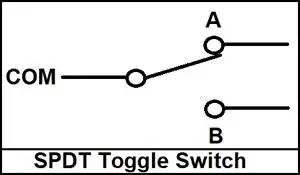
- Common (C) — Pole: The input terminal. This is the single pole that receives the signal or power.
- Throw 1 (NO — Normally Open): One output terminal. Connected to the common when the switch is in Position 1.
- Throw 2 (NC — Normally Closed): The other output terminal. Connected to the common when the switch is in Position 2.
As a SPDT slide switch ON-ON, the switch has no “OFF” position — the common terminal is always connected to one of the two output terminals. Sliding the actuator toggles the connection between the two throws. This is why SPDT switches are often used for selecting between two power sources, swapping inputs, or routing signals between two paths.
The switch uses a maintained-contact mechanism — it stays in its last position until manually actuated. This makes it a reliable and stable solution for various low-power and space-constrained applications.
⚡ Break-Before-Make vs. Make-Before-Break
SPDT slide switches typically use a break-before-make (non-shorting) contact sequence — the common disconnects from one throw before connecting to the other. This prevents momentary short circuits between the two output paths during switching, which is critical in many signal and power applications.
SPDT vs SPST vs DPDT — Choosing the Right Slide Switch Configuration
Understanding the differences between switch configurations is essential for selecting the right component for your application. Here’s how the 2 position SPDT slide switch compares to other common configurations:
| Feature | SPST | SPDT | DPDT |
|---|---|---|---|
| Circuits Controlled | 1 | 1 | 2 (independent) |
| Outputs | 1 (ON/OFF) | 2 (selectable) | 2 per pole |
| Terminals | 2 | 3 | 6 |
| Operation | ON-OFF | ON-ON | ON-ON (dual) |
| Typical Use | Basic ON/OFF control | Circuit selection, source switching | Dual circuit switching |
| Wiring Complexity | Simple (2 terminals) | Moderate (3 terminals) | Complex (6 terminals) |
An SPST (Single Pole Single Throw) switch provides straightforward on-off control by either completing or interrupting a single circuit. It’s ideal for basic power switching.
A SPDT switch like the SS-12F27 enables switching between two circuits — perfect for applications where you need to select between two inputs or outputs.
A DPDT (Double Pole Double Throw) switch is essentially two SPDT switches ganged together, controlling two independent circuits simultaneously. This is useful for applications like motor direction control where both power and ground need to be swapped.
Typical Applications for the 2 Position SPDT Slide Switch
Mode selection, power source switching, and function controls in portable devices, remote controls, and audio equipment
Selecting between battery and external power, or switching between different battery packs in portable instruments
Manual override controls, mode selection, and configuration switches in PLC panels and industrial automation equipment
Configuration selection, communication protocol switching, and manual reset/activation in IoT gateways and sensors
Input selection, impedance matching, and effect bypass in guitar pedals, mixers, and audio interfaces
Range selection, function switching, and calibration controls in multimeters, oscilloscopes, and signal generators
Breadboard prototyping, Arduino projects, and educational kits where simple circuit selection is required
Channel selection, antenna switching, and signal routing in two-way radios and communication equipment
How to Select the Right Slide Switch — 7 Key Considerations
Choosing the right 2 position SPDT slide switch requires careful evaluation of several technical parameters. Here are the seven most important factors to consider:
1. Circuit Configuration — SPST, SPDT, or DPDT?
SPDT provides single-circuit switching between two outputs. Choose SPST for simple ON/OFF or DPDT for dual-circuit switching.
2. Current and Voltage Ratings
Ensure the switch’s contact rating exceeds your circuit’s maximum current and voltage. The SS-12F27 is rated for 0.3A at 50V DC.
3. Contact Material and Plating
Silver-plated copper alloy (standard) offers low contact resistance. Gold plating is available for low-voltage, low-current signal applications.
4. Mounting Method
Through-hole (DIP) offers superior mechanical strength for panel-mounted applications. SMT is available for space-constrained designs.
5. Actuator Height and Travel
Actuator height affects panel protrusion and user ergonomics. Switch travel (2.0mm for SS-12F27) determines the actuation feel.
6. Mechanical Life (Cycles)
Consider the expected actuation frequency. SS-12F27 offers 10,000 cycles. Higher-duty applications may require 30,000+ cycle switches.
7. Operating Environment
Temperature range, humidity, and exposure to contaminants affect switch reliability. SS-12F27 operates from −25°C to +85°C.
2 Position SPDT Slide Switch — Frequently Asked Questions
What is a 2 position SPDT slide switch?
A 2 position SPDT slide switch is a Single Pole Double Throw switch with two positions (ON-ON). It features 3 terminals — one common input and two output throws. Sliding the actuator toggles the connection between the two outputs, making it ideal for circuit selection and source switching applications.
What is the difference between SPDT and SPST?
SPST (Single Pole Single Throw) has 2 terminals and provides simple ON/OFF control by completing or interrupting a single circuit. SPDT (Single Pole Double Throw) has 3 terminals and allows switching between two circuits — the common terminal connects to one of two outputs.
Is this switch ON-ON or ON-OFF?
The SS-12F27 is an ON-ON switch — it has no “OFF” position. The common terminal is always connected to one of the two output terminals. This makes it ideal for applications where a circuit path must always be selected.
Can it be used for PCB mounting?
Yes. The SS-12F27 is a through hole slide switch specifically designed for PCB mounting. The 3 pins pass through the PCB and are wave-soldered or hand-soldered on the back side for robust mechanical anchoring.
What is the rated mechanical life?
The SS-12F27 is rated for 10,000 mechanical and electrical cycles. For higher-duty applications, Vistar offers variants with extended cycle life — contact our sales team for specific requirements.
Is it suitable for wave soldering?
Yes. The SS-12F27 is designed for wave soldering with a maximum temperature of 260°C for 10 seconds. The plastic housing (PA66/PBT) with UL94V-0 rating withstands standard reflow and wave soldering profiles.
Can I customize the actuator color?
Yes. Vistar Electronics offers customization options including actuator color (black, white, red, etc.), actuator height, and operating force. Minimum order quantities apply for custom variants. Contact sales@vistarelectronics.com for details.
What contact plating options are available?
Standard contact plating is silver-plated copper alloy for general-purpose applications. Gold plating is available for low-voltage, low-current signal applications where contact oxidation is a concern.
What is the MOQ and can I get free samples?
Standard MOQ is 1,000 pieces with a 2–4 week production lead time. Free samples are available for qualified engineering and product development projects. Contact sales@vistarelectronics.com with your company details, project application, and part number (SS-12F27).
Are engineering samples available?
Yes. Engineering samples are available for qualified projects. Please submit your request through our sales@vistarelectronics.com with your company information and project details.
Technical Resources & Industry References
- Slide Switches Explained: Types, Specifications, and Applications — DigiKey — Comprehensive overview of slide switch configurations and selection criteria
- Slide Switch Selection Guide — GlobalSpec — Technical specifications and selection parameters for slide switches
- SPST, SPDT, DPST, and DPDT Switches — APEM — Detailed comparison of switch configurations

3 Pin SPDT Slide Switch for PCB Applications
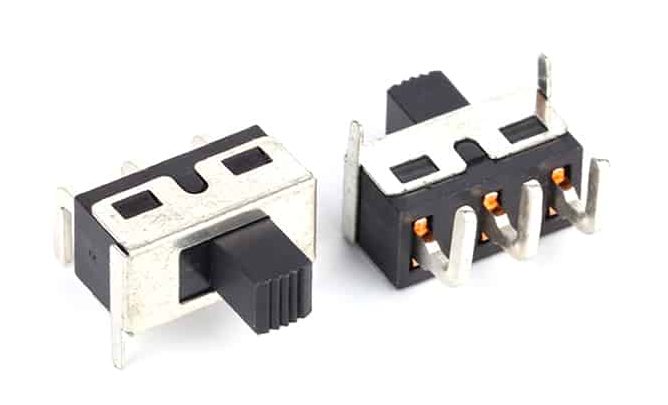
SS-12D11 Miniature Slide Switch SPDT, 3-Pin ON-ON for PCB Mounting

panel Mount Miniature slide switch dpdt 6pin

3 pins slide switch 1p2t

2P4T Vertical slide switch 10 pin DIP Through Hole

Small Slide Switch DPDT 8-Pin for Compact Vertical PCB Designs

3 Pin Vertical Slide Switch 1P2T — SS-12D02 DIP SPDT Toggle Switch for Consumer Electronics, IoT & Industrial Control Panels

DPDT slide switch Vertical 6pin

Mini Slide Switches for Medical Devices: Selection Guide, Applications & Reliability
Selecting mini slide switches for medical devices? Get guidance on electrical ratings, sterilization, SMT vs through-hole, and reliability. Ensure patient safety. When...

Mini Slide Switch Reliability: 8 Factors That Affect Long-Term Performance
What really determines mini slide switch reliability? Explore 8 factors from contact material to PCB mounting that impact lifespan. Improve durability in...
SPDT Slide Switch: A Classic Solution for Precision Control and Circuit Routing
In the control and signal path selection of electronic systems, slide switches have always held an indispensable position due to their intuitive...