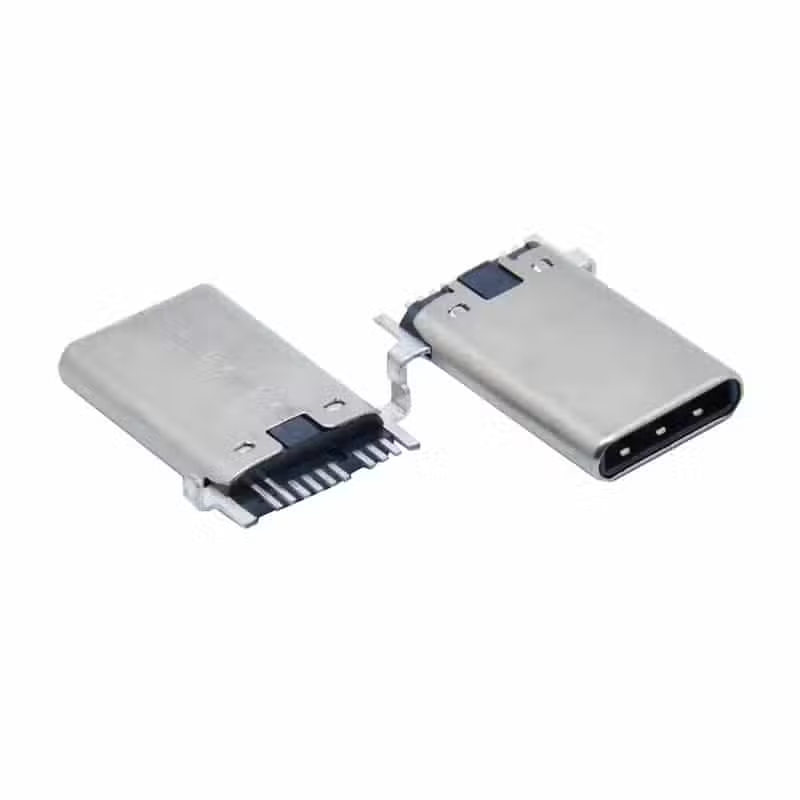
Vistar Electronics manufactures a complete range of USB-C plug (male) connectors for PCB mounting, including 24-pin full-featured and 9-pin USB 2.0 configurations. Our USB-C plug lineup covers USB 2.0 through USB4 Gen 3 (40 Gbps), with mounting styles including mid-mount right-angle, SMT, and through-hole. All products are RoHS 3 and REACH compliant with MOQ from 1,000 pcs.
USB4 Gen 3 / 40 Gbps 5A / USB PD Ready 10,000+ Mating Cycles RoHS 3 & REACH Mid-Mount / SMT / DIP OEM / ODM Available
| Specification | 24-Pin Full-Featured (USB-TC24-M04) | 9-Pin USB 2.0 (USB-TC09-M02) |
|---|---|---|
| USB Standard | USB 3.1 Gen 2 / USB4 | USB 2.0 |
| Data Rate | Up to 40 Gbps | 480 Mbps |
| Current Rating | 5A | 3A |
| Voltage Rating | 30V DC | 30V DC |
| Mounting | Mid-Mount Right Angle SMT | Mid-Mount Right Angle SMT |
| Mating Cycles | 10,000 | 10,000 |
| Alt Mode | DP / HDMI / Thunderbolt | Not supported |


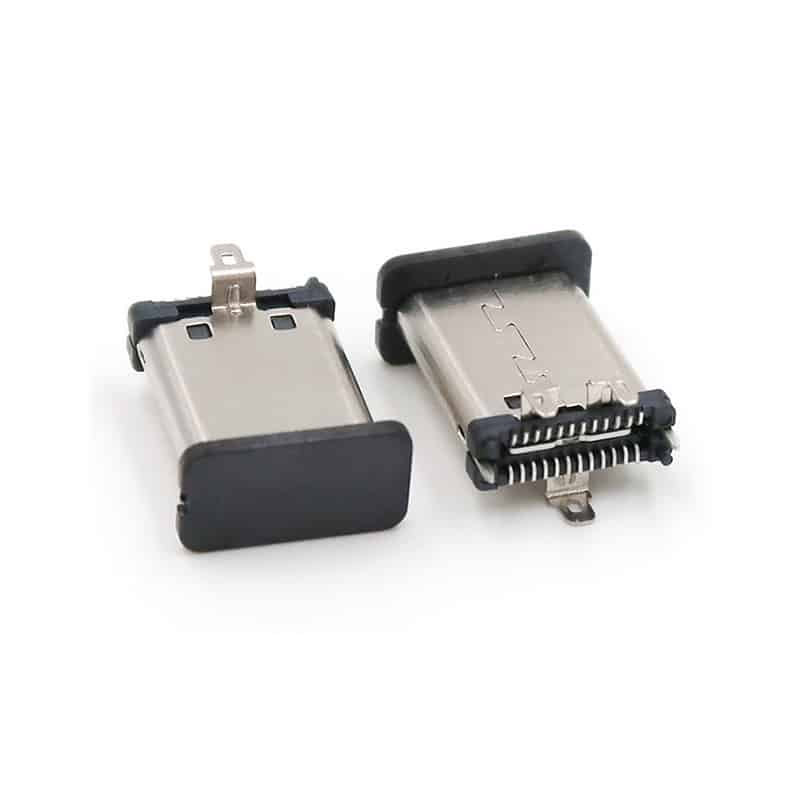
Full 24-pin USB-C plugs support USB4 Gen 3×2 bandwidth (40 Gbps), compatible with Thunderbolt 4, USB 3.2, USB 3.1, and USB 2.0 host devices.
Rated at 5A continuous current. Supports USB Power Delivery up to 100W (20V/5A) with compatible PD controller IC.
All USB-C plugs support the reversible Type-C plug orientation per USB-IF specification, eliminating incorrect insertion and improving user experience.
Full 24-pin models support DisplayPort 1.4 Alt Mode (8K@60Hz) and HDMI Alt Mode via compatible controller, enabling single-cable video + data + power.
Select USB-C plug models feature IP67/IP68 waterproof ratings, suitable for outdoor, marine, and industrial applications.
All USB-C plugs comply with RoHS 3 (EU 2015/863) and REACH SVHC regulations. Full compliance documentation available for EU market entry and supply chain audits.
A USB-C plug is the male connector (the end with the protruding pin) that is attached to a cable, designed to be plugged into a USB-C receptacle (female port) on a device such as a laptop, phone, or docking station. The plug is the “active” part that connects and disconnects, while the receptacle is the fixed port on the PCB.
A 24-pin USB-C plug carries the complete USB-C specification: SuperSpeed data (USB 3.1 Gen 2 / USB4), DisplayPort and HDMI Alt Mode video, and USB Power Delivery up to 100W/240W. A 9-pin USB-C plug supports only USB 2.0 (480 Mbps) and up to 3A charging, omitting the high-speed data pairs and Alt Mode pins — making it ideal for cost-sensitive charging-only or low-speed data applications.
Our USB-C plug range covers USB 2.0 (9-pin models), USB 3.1 Gen 1 (5 Gbps), USB 3.1 Gen 2 (10 Gbps), and USB4 Gen 3 (40 Gbps) — depending on the model. The actual protocol speed depends on the host controller and cable; our 24-pin full-featured plugs support the maximum pin assignment per USB-IF specifications.
A mid-mount USB-C plug is recessed into a slot cut through the PCB, reducing the installed height above the board surface compared to a standard bottom-mount or surface-mount design. It is the preferred choice for ultra-thin laptops, tablets, and 2-in-1 devices where vertical PCB clearance is critical. Vistar offers both 24-pin and 9-pin mid-mount USB-C plugs.
Yes. All Vistar USB-C plugs are fully compliant with RoHS 3 (EU Directive 2015/863) and REACH SVHC regulations, ensuring safe export to the EU, North America, Japan, and all major regulated markets.
Standard MOQ is 1,000 pieces per model. Free samples are available for qualified engineering and product development projects. Contact sales@vistarelectronics.com with your project details, or fill out the quote form on this page.

Is USB-C Waterproof? USB-C connectors are not inherently waterproof. A standard USB-C receptacle has no sealing against moisture or dust. Waterproof USB-C...

In today’s highly integrated electronic devices, connectors, as crucial bridges for signal transmission and power supply, directly determine the stability and security...

USB 2.0 vs USB 3.2 vs USB4 Type-C connector comparison. Learn how each protocol version determines pin count, PCB layout complexity, impedance...