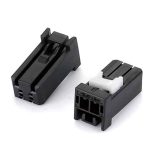
Automotive Connector Types Explained: How to Choose the Right Connector for Every Vehicle System
The Friday Afternoon Call Nobody Wants
It is 4:30 PM on a Friday. Your phone rings. It is the field quality engineer in Detroit. Three hundred vehicles are sitting on the lot with a no-start condition. The root cause? Water ingress into an unsealed connector in the engine harness. The connector was rated for the passenger compartment. Someone on the assembly line installed it six inches from the radiator.
This is the reality of automotive connector selection. The wrong type in the wrong place does not just cause a warranty claim. It stops production lines, triggers recalls, and destroys supplier relationships. Modern vehicles carry between 1,500 and 3,000 individual connectors across 12V body electronics, 48V mild-hybrid systems, 400V–800V high-voltage architectures, and multi-gigabit data networks. Each domain demands a fundamentally different connector philosophy.
This guide breaks down every major automotive connector type, the standards that govern them, and the selection logic that separates a reliable harness from a field failure.
What Automotive Connectors Actually Do (And Why They Fail)
An automotive connector is not merely a plug. It is a system comprising a housing, terminals, seals, a locking mechanism, and often a secondary lock or connector position assurance (CPA) feature. Its job is to maintain electrical continuity across temperature swings from −40°C to +150°C, vibration frequencies up to 2,000 Hz, and exposure to salt spray, engine oil, and pressure washers.
Connectors fail for three primary reasons:
- Mechanical separation under vibration or thermal cycling
- Corrosion from moisture or chemical ingress
- Contact resistance rise due to fretting wear or plating degradation
Understanding the connector type is the first defense against all three.

Low-Voltage Signal and Power Connectors: The Foundation
Unsealed Connectors
Unsealed connectors dominate the passenger compartment. Dashboard modules, infotainment head units, seat controls, and interior lighting all use unsealed variants because the environment is controlled. These connectors are lighter, cheaper, and easier to assemble.
Typical specs: Operating temperature −40°C to +85°C, no IP rating, PA66 or PBT housings, tin-plated brass terminals.
When to use: Any interior application where moisture exposure is negligible.
When to avoid: Engine bay, wheel wells, underbody, or any location that sees washdown or condensation.
Sealed Connectors
Sealed connectors incorporate silicone wire seals, interface seals, and sometimes cavity plugs for unused positions. They are mandatory for engine compartments, exterior lighting, fuel systems, and underbody wiring.
The sealing hierarchy matters:
- IP54: Dust-protected, splash-resistant. Suitable for engine periphery with minimal direct spray exposure.
- IP67: Dust-tight, temporary immersion to 1 meter. The baseline for most exterior and engine-bay applications.
- IP6K9K: Dust-tight, high-pressure steam jet cleaning. Required for direct engine mounting, transmission control modules, and commercial vehicle applications.
Major sealed connector families include the Deutsch DT series (vibration-resistant, −55°C to +125°C), TE AMP Superseal (single-wire sealing, compact footprint), and Molex MX150 (CPA feature, body electronics focus). These families are validated against USCAR-2 or LV214 standards, which we will examine in detail later.
Multi-Pin Rectangular Connectors
These are the workhorses of complex harnesses. ECUs, fuse boxes, and junction blocks use multi-pin rectangular connectors with 8 to 120+ positions. They feature blade-style terminals with high normal force, secondary locks, and polarization keys to prevent mis-mating.
Key parameter: Terminal retention force. A terminal that pulls out of the housing during assembly creates an open circuit that is invisible until the vehicle fails in the field. USCAR-2 specifies minimum retention forces by terminal size—typically 30N to 75N depending on gauge.
Coaxial and RF Connectors: The Antenna and Camera Backbone
FAKRA Connectors
FAKRA (Fachkreis Automobil) connectors are the de facto standard for RF signal transmission in vehicles. Based on SMB coaxial technology, they operate up to 6 GHz and handle GPS, GSM, radio, and camera signals. The defining feature is the color-coded mechanical keying system—thirteen distinct codes (A through N, plus neutral Z) that prevent cross-connection between different RF channels.
| Code | Color | Application |
|---|---|---|
| A | Black | Analog radio, no supply voltage |
| C | Signal blue | GPS, navigation |
| D | Claret violet | GSM telephone |
| E | Leaf green | TV 1 |
| Z | Water blue | Neutral, universal |
FAKRA connectors feature a primary locking latch with tactile feedback and a secondary retention mechanism for the coaxial insert. The plastic housing is shock and vibration resistant, and the interface is standardized under USCAR-18 and ISO 20860-1.
Critical design note: FAKRA connectors are not interchangeable with standard SMB connectors. The mechanical keying and housing dimensions are automotive-specific. Using a generic SMB part in a FAKRA application guarantees a field failure.
HSD Connectors
High-Speed Data (HSD) connectors handle differential signal transmission for infotainment, USB, and camera links. Unlike FAKRA, which is coaxial, HSD uses shielded twisted-pair construction to support protocols like LVDS and automotive Ethernet. They are commonly found between the surround-view camera module and the head unit, and between the head unit and display screens.
HSD connectors also use the Z-code (neutral, water blue) color scheme for universal compatibility. They support data rates up to 3 Gbps in current implementations, with impedance control at 100Ω differential.
Mini-FAKRA (HFM)
As camera resolutions climb past 8 megapixels and ADAS systems demand higher bandwidth, Mini-FAKRA (also called HFM, High-Speed FAKRA Mini) is replacing standard FAKRA in new designs. Mini-FAKRA offers up to 28 Gbps data rates with an 80% smaller footprint than traditional FAKRA. It supports the same color coding and is backward-compatible in terms of application mapping, but the physical interface is smaller and more densely packed.
Migration consideration: A vehicle platform using standard FAKRA cannot simply swap to Mini-FAKRA without redesigning the PCB footprint and cable harness. Plan this transition at the architecture phase, not during a mid-cycle refresh.
High-Voltage Connectors: The EV Revolution
Electric and hybrid vehicles introduced a fundamentally new connector category: high-voltage interconnects operating at 400V, 800V, and beyond. These are not scaled-up 12V connectors. They are engineered for touch protection, arc suppression, and isolation monitoring.
Key High-Voltage Parameters
| Parameter | Typical Range | Design Implication |
|---|---|---|
| Rated voltage | 400V–1,000V DC | Insulation clearance and creepage distances must scale with voltage |
| Rated current | 50A–500A+ | Contact size and plating must handle thermal rise without excessive voltage drop |
| Contact resistance | ≤0.2 mΩ | Every milliohm generates heat at high current; 0.5 mΩ at 200A is 20W of loss |
| Insulation resistance | ≥5,000 MΩ (dry), ≥500 MΩ (damp heat) | Prevents leakage current and safety hazards |
| Withstand voltage | 3,000V AC | Validates dielectric integrity under overvoltage conditions |
| Operating temperature | −40°C to +125°C | Battery and inverter environments run hot; thermal management is critical |
| Protection level | IP67 (mated) | Prevents water ingress into live high-voltage circuits |
High-Voltage Connector Types
Circular high-power connectors: Used for battery-to-inverter links, DC fast charging inlets, and motor phase connections. These feature large-diameter contacts (25 mm² to 70 mm²), 360° shielding, and push-pull or bayonet locking. Metal housings provide EMI shielding and structural rigidity.
Rectangular high-voltage connectors: Common in power distribution units and junction blocks. They integrate multiple high-voltage circuits with HVIL (High-Voltage Interlock Loop) pins that monitor connector integrity. If a connector is unplugged while energized, the HVIL circuit opens first, triggering a safety shutdown before the main contacts separate.
Charging connectors: Regional standards dominate this space. CCS (Combined Charging System) in Europe and North America, CHAdeMO in Japan, and GB/T in China each define unique mechanical and electrical interfaces. A vehicle platform targeting multiple markets needs multiple charging inlet variants or a modular design.
Touch Protection and Anti-Spark Design
High-voltage connectors must prevent human contact with live parts under all conditions, including partial mating. This is achieved through:
- Shrouded contacts: Live pins are recessed inside insulating housings
- HVIL monitoring: A low-voltage circuit detects connector integrity
- Pre-charge circuits: Limit inrush current during connection
- Arc quenching: Special contact geometries and materials suppress arcing during disconnect under load
These features are governed by standards including SAE J1742, LV215-1, and LV215-2, which extend the validation philosophy of LV214 into the high-voltage domain.
Data Connectors: The Nervous System of Modern Vehicles
Automotive Ethernet
As ADAS and infotainment systems generate data volumes 100× higher than traditional vehicles, automotive Ethernet has emerged as the backbone network. Operating at 100 Mbps to 10 Gbps, it connects domain controllers, sensor clusters, and central compute modules.
Automotive Ethernet connectors are typically smaller and lighter than coaxial alternatives, with shielded twisted-pair cabling. They support single-pair (100BASE-T1, 1000BASE-T1) and multi-pair configurations. The trend is toward modular, lightweight designs that reduce harness weight while maintaining signal integrity.
Board-to-Board and Wire-to-Board Connectors
Inside ECUs and control modules, board-to-board connectors link stacked PCBs, while wire-to-board connectors bring harness signals onto the PCB. These connectors must survive solder reflow temperatures (peak 260°C for lead-free) and maintain coplanarity tolerances during assembly.
Key considerations include:
- Pitch: 0.5 mm to 2.54 mm, with smaller pitches enabling higher density but demanding tighter manufacturing control
- Retention: Board locks, solder tabs, or press-fit tails to prevent lifting during vibration
- Polarization: Keys and shrouds to prevent 180-degree mis-insertion
Automotive Connector Standards: USCAR-2 vs. LV214
No discussion of automotive connector types is complete without understanding the validation standards. These documents define the test methods, acceptance criteria, and performance classes that separate automotive-grade parts from industrial or consumer-grade alternatives.
USCAR-2 (North American Standard)
Developed by the United States Council for Automotive Research and maintained by SAE, USCAR-2 is the primary benchmark for North American OEMs including GM, Ford, and Stellantis. It covers performance testing across development, production, and field analysis of electrical terminals, connectors, and components.
USCAR-2 defines classification systems for:
- Temperature (T1–T5): T1 covers passenger compartment (−40°C to +85°C), T5 covers direct engine mounting (−40°C to +150°C)
- Vibration (V1–V5): V1 is body-mounted light duty; V5 is unsprung wheel-mounted components experiencing direct road input
- Sealing (S1–S3): S1 is unsealed passenger compartment; S3 is sealed with pressure decay validation
Testing under USCAR-2 includes mechanical stressing, vibration, fluid immersion, thermal cycling, and electrical resistance validation (500 MΩ minimum at 500 VDC). The standard is nearly 80 pages and serves as the contractual baseline for most North American supplier agreements.
LV214 (European Standard)
LV214 was developed by the German OEM consortium—Audi, BMW, Daimler, Porsche, and Volkswagen—and has become the de facto European benchmark. While it shares USCAR-2’s goal of zero-failure performance, LV214 places heavier emphasis on mechanical endurance and assembly-line robustness.
Key LV214 differentiators:
- Koshiri Security: Ensures terminals cannot be bent or damaged if the connector is inserted at an angle during high-speed assembly
- Slow-Motion Test: Analyzes the force-displacement curve during mating to identify wear points and predict long-term reliability
- Severity Groups (SG1–SG4): More granular than USCAR’s V levels, with SG4 representing direct cylinder head or gearbox mounting
- IPX9K sealing: High-pressure steam jet cleaning validation, simulating aggressive engine bay washdown
Practical Implications for Engineers
| Aspect | USCAR-2 | LV214 |
|---|---|---|
| Geographic dominance | North America | Europe, increasingly global |
| Vibration philosophy | V-levels aligned with engine profiles | SG groups with fretting corrosion focus |
| Sealing validation | Pressure decay, vacuum tests | IPX9K high-pressure spray, thermal shock submersion |
| Mechanical emphasis | Balanced | Heavier focus on Koshiri and contact force |
| Contact resistance (0.64 mm tin) | ≤20 mΩ | ≤20 mΩ |
| Contact resistance (0.64 mm Au/Ag) | ≤10 mΩ | ≤10 mΩ |
For global platforms, the pragmatic approach is to design to the more stringent of the two standards. A connector that passes LV214 SG4 and IPX9K will almost certainly pass USCAR-2 T5/V3. The reverse is not guaranteed.
Core Parameters for Connector Selection
Current Rating and Wire Gauge
Connector current rating must align with wire ampacity, which is a function of gauge, insulation temperature rating, and ambient conditions. The GM Electrical Best Practices document provides a clear methodology:
- Determine maximum circuit current including inrush and stall conditions
- Select preliminary wire gauge based on length and current from standard tables
- Verify ampacity against the maximum ambient temperature using temperature-derated tables
- Size the connector terminals to match the selected wire gauge
Critical rule: The connector terminal must be rated for the same or higher current as the wire it terminates. A 16 AWG wire rated for 25A connected to a terminal rated for 15A creates a thermal bottleneck at the crimp joint.
Temperature Rating
Standard automotive wire insulation types include:
- GPT (General Purpose Thermoplastic): PVC insulated, +80°C continuous. Passenger compartment only.
- GXL (General Purpose Cross-Linked): XLPE insulated, +135°C continuous. Engine compartment and high-temperature zones.
Connector housings must match or exceed the wire temperature rating. A +135°C wire terminated in a +105°C connector housing will see the housing soften and deform before the wire fails.
Vibration Class
Match the connector’s vibration rating to its mounting location:
| Location | USCAR V-Level | LV214 SG | Example Application |
|---|---|---|---|
| Body/interior | V1 | SG1 | Dashboard modules, seat controls |
| Chassis, engine perimeter | V2–V3 | SG2 | ABS modules, fuel pumps |
| On-engine, transmission | V3–V4 | SG3 | Ignition coils, injectors |
| Unsprung, wheel-mounted | V5 | SG4 | Wheel speed sensors, brake wear indicators |
Sealing Level
| Environment | Minimum IP Rating | Connector Type |
|---|---|---|
| Passenger compartment | None (unsealed) | Standard rectangular, JST |
| Engine periphery, dry | IP54 | Basic sealed, grommeted |
| Engine bay, exterior | IP67 | Deutsch DT, TE Superseal |
| Direct spray, commercial | IP6K9K | Deutsch HD, Amphenol AT |
| Submersion, marine | IP68+ | Specialized overmolded assemblies |
Common Design Mistakes (And How to Avoid Them)
Mistake 1: Specifying Interior Connectors for Engine-Bay Applications
The cost delta between an unsealed and a sealed connector is real—often 30–50% at volume. But the warranty cost of a corroded terminal in the field is orders of magnitude higher. Never downgrade sealing class to save pennies on the BOM. If the connector lives in the engine bay, it must be sealed to at least IP67.
Mistake 2: Ignoring Terminal Retention Force
A terminal that pushes back into the housing during mating creates an intermittent open circuit. This is one of the most difficult field failures to diagnose because the contact looks seated until vibration or thermal cycling shifts it. Always specify connectors with secondary locks (TPA—Terminal Position Assurance) and validate retention force per USCAR-2 or LV214.
Mistake 3: Mismating Due to Insufficient Keying
In a harness with twenty identical 8-position connectors, assembly errors are inevitable without proper polarization. Use connectors with distinct keying colors or mechanical keys for each circuit variant. FAKRA’s color-coded system is the gold standard here—adopt the same philosophy for your multi-pin connectors.
Mistake 4: Overlooking Crimp Quality
The crimp joint is the weakest link in any automotive connection. A poor crimp increases contact resistance, generates heat, and accelerates corrosion. USCAR-21 and LV214-4 both specify crimp force monitoring requirements. Invest in crimp validation equipment and reject any terminal that does not meet pull-force specifications.
Mistake 5: Assuming All “Automotive-Grade” Claims Are Equal
The term “automotive-grade” is not legally defined. A connector marketed as automotive-grade may only meet basic temperature requirements without passing USCAR-2 or LV214 validation. Demand test reports. Verify the specific standard revision, test conditions, and acceptance criteria. A connector without documented validation is a liability.
Practical Selection Framework
Use this decision tree to navigate the connector landscape:
Step 1: Define the electrical domain.
Is this 12V body electronics, 48V mild hybrid, or 400V+ high voltage? High voltage demands an entirely different connector family with touch protection and HVIL.
Step 2: Characterize the environment.
What is the temperature range? Is there moisture, chemical, or pressure-wash exposure? Map this to the appropriate sealing class.
Step 3: Determine the signal type.
Is this DC power, analog signal, RF, or high-speed data? RF and data require impedance-controlled coaxial or differential-pair connectors. Power requires current-rated terminals with appropriate wire gauge.
Step 4: Quantify the mechanical stress.
What vibration level will the connector experience? Is it body-mounted, engine-mounted, or unsprung? Match to USCAR V-level or LV214 SG.
Step 5: Validate against OEM standards.
Does your target OEM require USCAR-2, LV214, GMW 3191, or a proprietary specification? Design to the most stringent applicable standard.
Step 6: Prototype and test.
Build harness samples. Run thermal cycling, vibration, and sealing validation. Measure contact resistance before and after testing. No datasheet replaces empirical validation.
Conclusion
Automotive connector selection is not a commodity decision. The right connector for a GPS antenna is wrong for a battery pack. The right connector for a dashboard module will fail catastrophically in a wheel well. Every connector type—unsealed rectangular, sealed Deutsch, FAKRA coaxial, HSD differential, high-voltage circular—exists because a specific set of electrical, mechanical, and environmental demands created it.
The engineers who master this taxonomy—who understand why LV214 demands Koshiri security, why FAKRA uses color coding, why high-voltage connectors need HVIL monitoring, and why a 16 AWG wire needs a matching terminal rating—are the ones who ship vehicles that survive 200,000 miles and fifteen years of thermal cycling without a single field failure.
At Vistar Electronics, we supply automotive-grade connectors across the full spectrum: sealed and unsealed rectangular connectors for body electronics, FAKRA and HSD coaxial assemblies for RF and data links, and high-voltage interconnects validated to SAE J1742 and LV215. Whether you are wiring a 12V sensor module or a 400V battery pack, the connector is where reliability begins. Choose it with the rigor it deserves.
Related Reading:
- Complete Design Guide for Choosing a USB-C Connector
- USB-C Connector Pinout Explained: Complete 24-Pin Guide
- USB Type C Connector Product Catalog
External References:
- SAE USCAR-2 Performance Specification for Automotive Electrical Connector Systems — Official SAE standard for North American automotive connectors
- LV214 Motor Vehicle Connectors Test Specification — German OEM connector validation standard
- GM Electrical Best Practices for Upfitters — Wire gauge selection and current rating guidelines
- FAKRA and HSD Plug Connections — Technical overview of automotive RF connector standards
- USCAR-2 vs. LV214: Comprehensive Standards Guide — Detailed comparison of North American and European validation standards
- Automotive High Voltage Connectors — EV connector types and electrification trends
- Guide to Cable and Connector Selection for Automotive Engineering — Step-by-step selection methodology