

2×4 Horizontal Tact Switch for Compact Side-Actuated PCB Designs
2×4 Horizontal Tact Switch – Product Overview
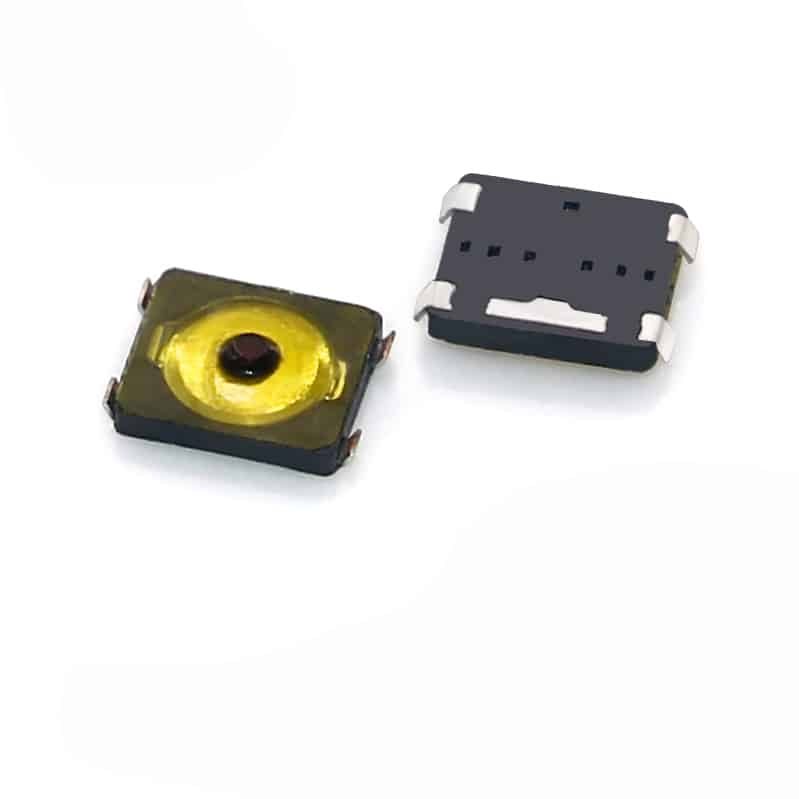
The 2×4 Horizontal Tact Switch is a compact, side-actuated SMT tactile switch engineered for space-constrained PCB layouts where vertical height is at a premium. Unlike traditional top-actuated switches that require clearance above the PCB, the horizontal (side-push) design allows the button to be accessed from the edge of the board — making it the ideal right angle tactile switch for ultra-thin devices such as Bluetooth earbuds, smartwatches, and portable medical equipment.
This 2 pin horizontal tact switch features a momentary SPST-NO (normally open) circuit with crisp tactile feedback, rated at 50mA / DC 12V. The side actuated tactile switch design is optimized for SMT reflow soldering, enabling high-speed automated assembly and consistent manufacturing quality. With a compact 2×4mm footprint, this switch delivers reliable performance in high-density mounting applications where every millimeter of board space matters.
For engineers and procurement professionals seeking a reliable 2×4 tactile switch solution, this series offers multiple operating force options (180gf / 260gf), mechanical life ratings up to 100,000 cycles, and full RoHS & REACH compliance. Whether you’re designing consumer electronics, industrial controls, or IoT devices, this horizontal tact switch provides the durability and design flexibility your project demands. For a broader understanding of tactile switch technologies, we recommend reviewing the Tactile Switch Guide from Vistar Electronics.
2×4 Horizontal Tact Switch – Full Technical Specifications
| Parameter | Value | Notes |
|---|---|---|
| Part Number | TS-1100E | Standard catalog item |
| Product Type | Horizontal Tact Switch | Side-actuated tactile switch |
| Size (L×W×H) | 2×4×3.5 mm | Compact SMT footprint |
| Mounting Type | SMT (Surface Mount) | Reflow solderable |
| Actuation Direction | Side Actuated (Horizontal) | Edge-push design |
| Pin Count | 2 Pins | SPST-NO circuit |
| Circuit Type | SPST-NO (Normally Open) | Momentary contact |
| Contact Rating | 50mA / DC 12V | Signal-level switching |
| Contact Resistance | ≤ 100 mΩ (initial) | Low, stable contact |
| Insulation Resistance | ≥ 100 MΩ at DC 100V | High insulation |
| Dielectric Withstanding Voltage | 100 VAC min. | No breakdown |
| Travel | 0.2 ± 0.10 mm | Tactile stroke |
| Operating Force | 180gf / 260gf | Two options available |
| Mechanical Life | 50,000 cycles (180gf) / 100,000 cycles (260gf) | Durable for high-use applications |
| Contact Material | Silver-plated metal dome | Reliable switching |
| Housing Material | High-temperature thermoplastic | Reflow compatible |
| Operating Temperature | −25°C to +70°C | Standard indoor environments |
| Packaging | Reel / Bag | Production ready |
| RoHS | Yes (RoHS 3) | EU Directive 2015/863 |
| REACH | Yes | SVHC compliant |
Why Choose a 2×4 Horizontal Tact Switch for Your PCB Design?
Low-Profile Side Operation
The horizontal actuation direction allows the switch to be activated from the edge of the PCB, eliminating the need for vertical clearance above the board. This makes the 2×4 horizontal tact switch ideal for ultra-thin devices where height is strictly limited.
Space-Saving PCB Design
With a compact 2×4mm footprint, this 2 pin horizontal tact switch minimizes board space usage, enabling higher component density on your PCB. This is particularly valuable in portable and wearable electronics where every square millimeter counts.
Reliable SMT Assembly
Designed for automated SMT reflow soldering, this side actuated tactile switch ensures consistent, high-quality assembly with minimal manual intervention. The high-temperature thermoplastic housing withstands reflow profiles without deformation.
Crisp Tactile Feedback
The precision metal dome delivers a distinct tactile “click” upon actuation, providing clear operator feedback. This is essential for user interfaces where confirmation of button press is critical for user experience.
Long Mechanical Life
Rated for 50,000 to 100,000 cycles depending on operating force, this 2×4 tactile switch is built to withstand high-frequency use in consumer and industrial applications.
RoHS & REACH Compliance
Fully compliant with RoHS 3 and REACH SVHC regulations, ensuring seamless global market access for your finished products.
Horizontal vs Vertical Tact Switch – Which One Should You Choose?
| Feature | Horizontal (Side-Actuated) | Vertical (Top-Actuated) |
|---|---|---|
| Button Direction | Side Push | Top Push |
| Product Height Profile | Lower | Higher |
| Side Access / Edge Mount | Excellent | Limited |
| Ideal for Compact Devices | Excellent | Good |
| PCB Layout Preference | Side Edge | Top Surface |
| Actuator Accessibility | From board edge | From above board |
The right angle tactile switch (horizontal) is the preferred choice when your product design requires a side-push button — such as power buttons on the edge of a smartphone, reset switches on a PCB edge, or volume controls on a wearable device. The vertical (top-actuated) switch, on the other hand, is better suited for applications where the button is accessed from the top surface of the device, such as a keypad or membrane interface.
Choose horizontal when: you need edge-mounted access, your device is height-constrained, or you want to minimize PCB footprint. Choose vertical when: you have ample height clearance, the button is accessed from the top, or you’re using a standard through-hole mounting configuration.
Typical Applications – Where to Use the 2×4 Horizontal Tact Switch
Bluetooth Earbuds
Side-push buttons for power, pairing, and volume control in compact wireless earbuds where vertical space is extremely limited.
Smart Watches
Edge-mounted crown buttons and function keys in wearable devices, enabling intuitive side-press interaction.
Portable Medical Devices
Handheld diagnostic tools, patient monitors, and portable therapy devices requiring reliable, compact side-actuated controls.
Handheld Scanners
Barcode scanners, RFID readers, and data collection terminals where side-mounted trigger buttons are ergonomically preferred.
POS Terminals
Payment processing devices with side-mounted function keys for power, reset, and menu navigation.
Industrial Controllers
Handheld programming units, remote controls, and industrial pendants where side-actuated switches provide intuitive operation.
Consumer Electronics
Digital cameras, portable gaming devices, and remote controls requiring compact, side-mounted push buttons.
Remote Controls
TV remotes, smart home controllers, and presentation clickers with side-actuated buttons for power and mode selection.
PCB Design Recommendations for 2×4 Horizontal Tact Switch Integration
Proper PCB layout is critical to ensure reliable operation of the 2×4 horizontal tact switch. Follow these design guidelines for optimal performance:
- Keep-out Area: Reserve adequate clearance around the switch for actuator movement and to prevent interference with adjacent components. Ensure the side-push button has sufficient travel distance without obstruction.
- Button Clearance: For edge-mounted designs, verify that the switch actuator aligns correctly with the product’s external button or housing opening. The horizontal actuation requires precise mechanical alignment for consistent user experience.
- Actuator Alignment: The side-push mechanism relies on accurate alignment between the switch plunger and the external actuator. Consider using a mechanical stop or guide feature in the housing to prevent over-travel.
- SMT Pad Design: Follow the recommended land pattern provided in the datasheet. Ensure pad dimensions and spacing match the switch’s terminal layout for reliable solder joint formation.
- Reflow Soldering: This right angle tactile switch is compatible with standard SMT reflow profiles. Use a no-clean solder paste and follow the recommended temperature profile to avoid damage to the high-temperature thermoplastic housing.
- Mechanical Reinforcement: For applications subject to high actuation forces or repeated use, consider adding additional PCB support or mounting holes near the switch to reduce stress on solder joints.
For comprehensive guidance on tactile switch integration, refer to the Tactile Switch Testing Standards Guide from Vistar Electronics.
How to Select the Right 2×4 Horizontal Tact Switch
Choosing the optimal 2 pin horizontal tact switch for your application requires careful consideration of several key parameters:
- Operating Force: Select between 180gf (lighter touch, 50,000 cycles) and 260gf (firmer feel, 100,000 cycles). Lower force is preferred for consumer devices where user comfort is paramount; higher force is suitable for industrial applications where accidental actuation must be minimized.
- Actuator Height: Ensure the switch’s actuator height matches your product’s external button design. Custom actuator heights may be available for OEM projects.
- Mounting Space: Verify that the 2×4mm footprint fits within your PCB’s available area, with adequate clearance for SMT soldering and reflow processing.
- SMT Compatibility: Confirm that your assembly process supports SMT reflow soldering. This side actuated tactile switch is designed for standard reflow profiles and high-temperature resistance.
- Expected Lifecycle: Choose the operating force based on the expected number of actuations over the product’s lifetime. The 260gf option offers 100,000 cycles for high-use applications.
- Environmental Requirements: The TS-1100E is rated for operation from −25°C to +70°C, suitable for standard indoor environments. For harsh or outdoor conditions, consider Vistar’s IP-rated tactile switch options.
For custom requirements — including unique actuator heights, specific operating forces, or OEM marking — contact Vistar Electronics for engineering support and sample availability.
2×4 Horizontal Tact Switch – Frequently Asked Questions
What is a horizontal tact switch?
A horizontal tact switch (also known as a side-actuated or right-angle tactile switch) is a momentary push-button switch where the actuation force is applied from the side rather than from the top. This design allows the switch to be mounted on the edge of a PCB, enabling low-profile, space-saving layouts in compact electronic devices.
What is the difference between horizontal and vertical tactile switches?
A horizontal tact switch is actuated from the side (edge-push), making it ideal for devices where the button is accessed from the product’s edge. A vertical tact switch is actuated from the top (top-push), suitable for applications where the button is pressed from above the PCB. The horizontal design offers a lower height profile and is preferred for ultra-thin devices.
Is this switch normally open?
Yes. The TS-1100E 2×4 horizontal tact switch is an SPST-NO (Single-Pole Single-Throw, Normally Open) momentary switch. The circuit is open when the button is not pressed and closes temporarily when the button is actuated.
What is the rated mechanical life?
The mechanical life depends on the operating force: 50,000 cycles for the 180gf version and 100,000 cycles for the 260gf version. The higher force option provides longer life due to reduced contact wear.
Can it be used in automated SMT production?
Yes. This side actuated tactile switch is designed for SMT reflow soldering and is fully compatible with automated pick-and-place assembly. The high-temperature thermoplastic housing withstands standard reflow profiles.
What operating force options are available?
The TS-1100E is available in two operating force options: 180gf (lighter touch) and 260gf (firmer feel). The 180gf option is suitable for consumer devices requiring light actuation, while the 260gf option is preferred for industrial applications where accidental presses must be avoided.
Is it suitable for compact handheld devices?
Absolutely. With a compact 2×4mm footprint and low-profile side-actuated design, this 2×4 tactile switch is specifically engineered for space-constrained handheld devices such as Bluetooth earbuds, smartwatches, and portable medical equipment.
Can actuator height be customized?
Yes. Custom actuator heights, operating forces, and other modifications are available for OEM projects. Contact Vistar Electronics with your specific requirements for engineering support and customization options.
What is the MOQ?
Standard MOQ for the TS-1100E 2 pin horizontal tact switch is 1,000 pieces, with production lead times of 2–4 weeks. Lower MOQs may be available for sample or prototype orders. Contact our sales team for specific MOQ requirements.
Are engineering samples available?
Yes. Free engineering samples of the TS-1100E are available for qualified projects. Contact Vistar Electronics with your company details and project application to request samples for evaluation and testing.
Industry Standards & Resources
For engineers and procurement professionals seeking additional technical guidance, we recommend the following authoritative industry resources:
- IPC Standards – PCB assembly and electronic component reliability standards
- IEC Standards – International electrotechnical standards for electronic components
- JEDEC Standards – SMT packaging and reliability for solid-state electronics

4 Pin Tact Switch SMT – Compact Momentary Push Button for PCB Applications

3×4×2 SMD Tactile Switch — Micro Momentary Push Button Switch for Ultra-Compact Consumer Electronics, Wearables & IoT Devices

Snap-in Type Tactile Switch 4.5×4.5

3×4 Tact Switch with Locating Pin for Compact Electronic PCB Applications
Tact Membrane Switch 2.63 0.65 — TS-2630 SMD Membrane Tactile Switch for Industrial Control, Medical Devices & Consumer Panels

12×12 Tact Switch 4 Pin DIP for Through Hole PCB Mounting

4 Pin SMD Tactile Switch for Surface Mount PCB Applications

12mm SMD Tact Switch 4 Pin — TS-1103S 180gf / 260gf Large Body Surface Mount Tactile Pushbutton for Home Appliances, Automotive & Industrial PCB

Waterproof Tactile Switch Guide: Everything You Need to Know
Introduction Learn everything about waterproof tactile switch guide, including IP67 protection, sealing technologies, switch types, testing standards, applications, and expert tips for...

Tactile Switch Selection Guide: How to Choose the Right Switch for Your Application
Master tactile switch selection with this engineering guide. Learn sizing, mounting, IP ratings, operating force, and avoid common sourcing mistakes. Read now....

Tactile Switch Types: 7 Options Engineers Should Know
A design team once finished the entire PCB layout for a handheld diagnostic tool, only to discover that the selected tactile switch...