

SPDT Slide Switch 3 Pin DIP Horizontal — PCB Mount ON-ON Toggle Switch for Audio, Industrial Control & Consumer Electronics
The SK-12D02 is an SPDT slide switch 3 pin — a standard DIP horizontal through-hole slide switch featuring single-pole, double-throw (SPDT) circuit configuration. Rated 0.3A at DC 50V with a robust 10,000 cycle mechanical life. This 3 pin slide switch SPDT provides reliable circuit routing between two outputs with a single common input, making it the industry-standard choice for audio equipment power routing, industrial mode selection, consumer electronics configuration switching, and embedded system signal path control. DIP horizontal through-hole mounting with metal bracket retention. Bag/Tray packaging. Free sample available for qualified projects.
SPDT Slide Switch 3 Pin — Product Overview
The SK-12D02 is an SPDT slide switch 3 pin that represents the foundational building block of slide switch technology — the most widely used, most searched, and most universally understood electromechanical switch configuration in electronics. SPDT (Single Pole, Double Throw) provides one common input terminal that can be routed to either of two output terminals by sliding the actuator, enabling functions such as power ON/OFF, input source selection, mode configuration, and signal path routing in a single compact, intuitive component.
Unlike push-button or rotary switches that require vertical clearance or circular panel cutouts, this SPDT switch DIP horizontal configuration positions the actuator parallel to the PCB surface, requiring only a narrow rectangular slot in the enclosure side panel. This low-profile orientation is ideal for handheld devices, rack-mount equipment, and industrial control panels where front-panel depth is limited and multiple switches must be arranged in tight rows. The horizontal slider moves left-to-right (or right-to-left) with positive detent feedback at each position, providing tactile confirmation of the selected circuit state.
The 3-pin configuration follows the universal SPDT standard: one Common (COM) pin in the center, with one Normally Closed (NC) and one Normally Open (NO) pin on either side. In the default position, COM connects to NC; sliding the actuator switches COM to NO. This simple, predictable behavior makes the 3 pin on off on slide switch immediately understandable to engineers, technicians, and end users alike — no training required, no configuration software needed, and no ambiguity about which circuit is active.
With a 10,000 cycle mechanical life and through-hole DIP mounting with integrated metal bracket retention, the SK-12D02 delivers commercial-grade reliability suitable for products that undergo regular mode changes, configuration adjustments, or field service operations. The 0.3A at 50V DC rating covers the vast majority of low-power signal switching and small-load control applications, from audio signal routing and sensor enable lines to LED mode indication and microcontroller configuration.
SPDT Switch DIP Horizontal — Full Technical Specifications
| Parameter | Value | Notes |
|---|---|---|
| Part Number | SK-12D02 | Standard catalog item |
| Switch Type | SPDT Slide Switch 3 Pin | Single pole, double throw |
| Circuit Function | SPDT (1P2T) | ON-ON configuration |
| Pin Count | 3 Pins | COM, NC, NO |
| Mounting Type | DIP Through-Hole (Horizontal) | PCB mount with metal bracket |
| Actuator Orientation | Horizontal (Parallel to PCB) | Side-panel access design |
| Voltage Rating | DC 50V | Maximum working voltage |
| Current Rating | 0.3A | Maximum switching current |
| Contact Resistance | ≤ 50 mΩ | Initial value at rated load |
| Insulation Resistance | ≥ 100 MΩ | At 500V DC |
| Dielectric Strength | 500V AC / 1 minute | No breakdown or flashover |
| Operating Force | 150 – 350 gf | Smooth sliding with detent feedback |
| Operating Life | 10,000 cycles | Mechanical endurance rating |
| Contact Material | Silver-plated or Gold-plated Copper Alloy | Low resistance, oxidation resistant |
| Actuator Material | High-Grade Thermoplastic | Ribbed for grip; black standard |
| Bracket / Housing | Stamped Metal with Insulator Base | Provides PCB retention and shielding |
| Operating Temperature | −25°C to +85°C | Commercial and light-industrial grade |
| Storage Temperature | −40°C to +85°C | Long-term storage conditions |
| Soldering Method | Wave or Hand Soldering | Compatible with lead-free solder |
| Packaging | Bag / Tray | Production and prototype friendly |
Why Engineers Choose the SPDT PCB Slide Switch for Reliable Circuit Control
SPDT Circuit — Two Outputs, One Input, Zero Ambiguity
The single-pole, double-throw design provides two mutually exclusive output paths from one common input. The user always knows which circuit is active by the physical slider position — no LEDs, no software, no guesswork. This visible, tactile state indication is invaluable in industrial control panels, audio equipment, and test instruments where the operator must confirm configuration at a glance.
Horizontal DIP Mounting — Low-Profile Panel Integration
The SPDT switch DIP horizontal orientation positions the slider parallel to the PCB surface, requiring only a narrow rectangular slot in the enclosure side panel. This is simpler to machine than circular cutouts for rotary switches and provides better sealing than large apertures for potentiometers. The low profile enables dense switch arrays on front panels, rack-mount equipment, and handheld instruments.
Metal Bracket Retention — Secure PCB Mounting & EMI Shielding
The stamped metal mounting bracket snaps into PCB slots before soldering, holding the switch precisely in position during wave soldering and preventing displacement during handling. Post-soldering, the bracket absorbs sliding forces, protects solder joints from fatigue, and provides basic EMI shielding around the contact area — reducing radiated emissions in sensitive analog and RF circuits.
0.3A 50V Rating — Versatile for Signal and Small-Power Switching
The 0.3A at 50V DC rating covers a wide range of applications including audio signal routing, sensor input selection, low-power relay coil driving, LED mode indication, and microcontroller GPIO configuration. The 50V voltage headroom accommodates 5V, 12V, 24V, and 48V systems with adequate safety margin, while the conservative current rating ensures minimal contact heating and extended electrical life.
10,000 Cycles — Durable for Professional and Industrial Use
With a 10,000 cycle endurance rating, this switch outperforms economy-grade alternatives rated for only 3,000–5,000 cycles. Suitable for test equipment subjected to daily calibration changes, audio mixers with frequent input selection, industrial controllers requiring regular reconfiguration, and consumer products with mode-dependent feature sets. The detent mechanism provides positive position feedback at each stop, preventing accidental mid-position states.
Universal 3-Pin Standard — Drop-In Replacement Compatibility
The 3 pin on off on slide switch footprint and pinout follow the de facto industry standard, ensuring compatibility with thousands of existing PCB designs, breadboard projects, and replacement part scenarios. Engineers can substitute the SK-12D02 for equivalent switches from other manufacturers without PCB redesign, reducing supply chain risk and enabling competitive sourcing.
Where to Use the 3 Pin Slide Switch SPDT — Applications for Audio, Industrial, Consumer & Embedded Systems
Input source selection (CD/Aux/Phono), effects bypass, amplifier channel switching, EQ mode selection, and monitor routing on mixing consoles, guitar amplifiers, DJ equipment, and professional audio processors where visible switch position confirms the active signal path.
Manual/auto mode selectors, enable/disable switches, configuration setting on sensor interface modules, and parameter selection on process control equipment where robust through-hole mounting and visible switch state are critical for operator safety and system reliability.
Power source selection (battery/adapter), region mode switches (PAL/NTSC), input routing on AV receivers, and feature enablement on retro gaming hardware, portable media players, and multi-function remote controls where user-accessible mode selection enhances product versatility.
Function mode selection on multimeters, bandwidth filters on oscilloscopes, attenuation settings on signal generators, and probe compensation on laboratory equipment where frequent calibration and measurement configuration changes demand reliable mechanical switching.
Logic level configuration on FPGA development boards, boot mode selection on microcontrollers, address setting on communication modules, and protocol selection on STEM learning platforms where visible switch states aid student comprehension and debugging.
Configuration DIP alternatives, baud rate selectors, termination enable switches, and address setting on communication modules, serial converters, and embedded networking appliances where reliable mechanical state retention is preferred over software-configurable alternatives.
Quality Assurance & Manufacturing Standards
All Vistar slide switches, including this SPDT slide switch 3 pin, are manufactured under stringent quality management systems with comprehensive testing at every production stage:
- 100% electrical testing: Every switch is tested for contact resistance, insulation resistance, and dielectric withstand voltage before shipment
- Operating force verification: Statistical sampling confirms sliding force and detent engagement remain within the 150–350 gf specification across production lots
- Dimensional inspection: Automated optical measurement confirms body dimensions, pin spacing, bracket coplanarity, pin-to-bracket alignment, and actuator travel distance
- Position accuracy testing: Representative samples verify that the common pin connects to exactly one throw position at each detent stop, with no bridging or floating states
- Life testing: Representative samples undergo 10,000 cycle endurance testing with automated sliding actuation to validate mechanical durability, contact resistance stability, and detent retention
- Environmental testing: Thermal cycling, humidity exposure, and salt spray testing confirm performance under challenging conditions
- RoHS & REACH compliance: Full material composition documentation available for regulatory compliance and international export
Our manufacturing facilities maintain ISO 9001 quality management certification with full lot traceability. Certificate of Conformance (COC), material safety data sheets, and RoHS test reports are available upon request for customer qualification and audit requirements.
Engineering Resources & Related Slide Switch Products
For comprehensive guidance on slide switch selection, SPDT circuit design, and application best practices, explore these authoritative resources:
- SPDT Slide Switch: A Classic Solution for Precision Control and Circuit Routing — Comprehensive coverage of SPDT slide switch applications, wiring configurations, and selection criteria for signal path management.
- Mini Slide Switches for High-Precision Medical Devices: 5 Critical Applications & Reliability Verification Methods — Expert analysis of slide switch reliability requirements in precision equipment, including verification methods applicable to test and measurement instruments.
- Slide Switch Working Principle Explained: A Procurement Engineer’s Deep-Dive Guide — In-depth technical guide covering slide switch internal mechanisms, contact materials, actuator types, and procurement best practices.
Explore our full range of Slide Switches for alternative configurations including DPDT (2P2T), 3-position (1P3T), vertical mount, SMD, and custom position-count options for your specific application.
SPDT Slide Switch 3 Pin — Frequently Asked Questions
What is a 3 pin SPDT slide switch?
A 3 pin SPDT slide switch is an electromechanical switch with three terminals that routes one electrical circuit (Single Pole) between two possible output paths (Double Throw). The three pins are: COM (Common — the input), NC (Normally Closed — connected to COM by default), and NO (Normally Open — connected to COM when the slider is moved). The user slides the actuator left or right to select which output receives the input signal. This 3 pin on off on slide switch configuration is the most common slide switch type, used in audio equipment, industrial controls, consumer electronics, and embedded systems for power routing, source selection, and mode configuration.
How does an SPDT switch work?
An SPDT switch works by mechanically moving a conductive contact bridge between two fixed contact positions inside the switch body:
- Default position: The contact bridge connects COM to NC. Current or signal flows from the input through COM to the NC output path.
- Slider movement: When the user slides the actuator, the internal contact bridge breaks away from NC and moves toward NO.
- Break-before-make: The connection to NC breaks before the connection to NO makes, preventing momentary shorting between the two outputs.
- Switched position: The contact bridge connects COM to NO. Current or signal now flows from the input through COM to the NO output path.
- Detent retention: A spring-loaded ball or leaf spring engages notches in the slider track, holding the switch securely in the selected position and preventing accidental movement from vibration or incidental contact.
The entire mechanism is purely mechanical — no power, no software, no electromagnetic actuation required. This simplicity is the SPDT switch’s greatest reliability advantage.
What is the difference between SPDT and SPST switch?
SPDT (Single Pole, Double Throw) has 3 pins and switches one input between two outputs. SPST (Single Pole, Single Throw) has 2 pins and simply opens or closes one circuit. Think of SPDT as an A/B selector switch; SPST as an ON/OFF switch.

8 Pin Slide Knob Switch 2P3T Horizontal DIP — SK-23E01 SK Series 3-Position Dual-Pole Slide Switch for Audio, Instruments & Consumer Electronics

6pin Slide switch 90 degree SK-22H09

4 pin DIP Slide switch horizontal 1P3T

2P3T Slide Switch: 8 Pin 90 Degree DIP for PCB Selection

2 position Slide switch DIP 6PIN SK-22H02

Horizontal slide switch 1P3T

6Pin Slide switch DpDt SK-22F06

4P2T 12-Pin Horizontal Slide Switch DIP — SK-42D03 Through-Hole DIP Slide Switch with G Knob for PCB Control & Signal Switching
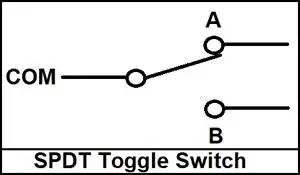
SPDT Slide Switch: A Classic Solution for Precision Control and Circuit Routing
In the control and signal path selection of electronic systems, slide switches have always held an indispensable position due to their intuitive...

Mini Slide Switch Reliability: 8 Factors That Affect Long-Term Performance
What really determines mini slide switch reliability? Explore 8 factors from contact material to PCB mounting that impact lifespan. Improve durability in...

Mini Slide Switch: The Complete Guide to Types, Applications & Selection
Explore the complete mini slide switch guide covering types, specifications, applications, and selection tips. Learn how engineers choose reliable slide switches. A...