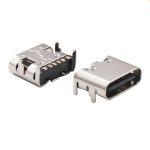
You have a USB-C port that works flawlessly on your smartphone. You drop it into a dashboard mount in a vehicle—and within three months, the connection is intermittent. The contacts are worn. The shielding has degraded from thermal cycling. The port fails its mating cycle test at 800 insertions instead of the 10,000 you expected.
This is not a hypothetical. Consumer-grade USB-C connectors are not built for the automotive environment. The thermal range, vibration profile, and EMI environment inside a vehicle are fundamentally different from what a laptop or phone experiences. And yet, automotive designers are increasingly being asked to integrate USB-C into infotainment systems, rear-seat entertainment, diagnostic ports, and EV charging interfaces.
The gap between what a connector can do and what a vehicle demands is where most design failures occur.
This guide walks through the technical requirements, connector types, selection criteria, and common pitfalls of specifying automotive USB-C connectors—written for engineers and procurement professionals who need to get this decision right the first time.
Why USB-C Is Becoming Standard in Automotive Electronics
USB-A is on its way out. The writing has been on the wall for years. USB-C offers a reversible form factor, higher power delivery, and significantly faster data rates—all in a smaller package.
For automotive systems, the advantages are particularly compelling:
- Higher power output: USB-C with USB Power Delivery (PD) can deliver up to 240W (48V at 5A), compared to the 7.5W ceiling of standard USB-A. This enables fast charging for laptops, tablets, and even some power tools directly from vehicle ports.
- Faster data transfer: USB-C supports USB 3.2 Gen 2×2 at 20 Gbps and USB4 at 40 Gbps. For infotainment systems streaming high-definition video or handling navigation data, this bandwidth is non-negotiable.
- Reversible connector: This is not just a consumer convenience. In a vehicle cabin with limited visibility, a connector that works in either orientation reduces mechanical stress on the port and cable during insertion.
Market data reflects this shift. The automotive USB power delivery system market was valued at USD 0.55 billion in 2025 and is projected to reach USD 1.03 billion by 2030, growing at a CAGR of 13.27%. The USB Type-C segment alone held 53.6% of the car charger market share in 2025.
From 2025 production vehicles onward, the number of USB Type-C ports per vehicle is expected to increase from two to four. This is not a niche trend—it is the new baseline.
Automotive USB-C Connector Requirements
Consumer USB-C connectors are rated for office environments. Automotive USB-C connectors are rated for survival.
The difference comes down to five core requirements.
AEC-Q200 Qualification
This is the non-negotiable starting point.
Automotive-grade components must meet AEC-Q standards. For connectors—which are passive components—AEC-Q200 is the relevant qualification. For active ICs like USB PD controllers, AEC-Q100 applies.
AEC-Q200 Stress Test Qualification for Passive Components — official standard from the Automotive Electronics Council.
What does AEC-Q200 actually require?
- Temperature range: -40°C to +125°C operational. Some connectors are rated to +105°C or +85°C, but the wider range is preferred for under-dash and engine-adjacent installations.
- Service life: 15+ years of reliable operation in the vehicle.
- Thermal cycling: The connector must withstand repeated expansion and contraction without losing contact integrity or developing cracks in the housing.
If a connector datasheet does not explicitly state AEC-Q200 compliance, it is not an automotive-grade part. Do not assume otherwise.
High Vibration Resistance
A vehicle is a vibrating platform. Engine vibrations, road noise, and suspension movement create a continuous mechanical stress environment.
Automotive USB-C connectors must be designed for this. Features to look for:
- Die-cast metal housings that provide mechanical rigidity
- Screw-thread assembly or other locking mechanisms that prevent unmating under vibration
- Secure PCB mounting—through-hole or reinforced SMT footprints, not standard surface-mount alone
Some manufacturers offer connectors specifically validated for vibration environments, with test data available upon request.
Extended Temperature Range
Inside a parked vehicle on a summer day, cabin temperatures can exceed 70°C. In winter, they can drop below -30°C. Under-dash locations near HVAC ducts experience even more extreme swings.
Consumer-grade connectors are typically rated for 0°C to 70°C or -20°C to 85°C. Automotive connectors need -40°C to +85°C at minimum, with -40°C to +105°C or +125°C preferred.
Temperature affects:
- Contact resistance: Thermal expansion can loosen contacts over time
- Housing integrity: Plastic housings can become brittle at low temperatures or soften at high temperatures
- Solder joint reliability: PCB-mounted connectors experience stress from differential thermal expansion between the connector and the board
EMI Protection
The automotive environment is electrically noisy. Alternators, ignition systems, electric motors, and switching power supplies generate significant electromagnetic interference (EMI).
USB-C connectors operating at high data rates (USB 3.2 and above) are particularly susceptible to EMI. Shielded connectors with robust grounding are essential. Look for:
- Full metal shielding around the connector body
- Multiple ground pins (USB-C has four GND pins for this reason)
- Compliance with CISPR-25 Class 5 for automotive EMI emissions
Waterproof Protection (IP Rating)
Vehicles are not dry environments. Spilled drinks, rain through open windows, condensation, and pressure washing all introduce moisture.
The minimum standard for automotive USB-C ports is IP67—dust-tight and protected against immersion in 1 meter of water for 30 minutes. Some applications require IP68 for continuous immersion.
IEC 60529 Ingress Protection (IP) Code — the international standard that defines IP ratings
Critical distinction: Some connectors are only IP67-rated when mated (with a cable inserted). Automotive-grade connectors should maintain their IP rating even when unmated.
Long Service Life (Mating Cycles)
A consumer phone is plugged and unplugged perhaps once per day. A vehicle USB-C port may see dozens of insertions per day across multiple users over the vehicle’s 15-year life.
Automotive connectors are typically rated for 10,000 mating cycles or more. Some high-durability variants are rated for 15,000 cycles.
Contact plating matters here. Gold plating (0.2μm minimum) or palladium-nickel alloys are preferred over tin plating for automotive applications. Gold provides lower contact resistance and better corrosion resistance over repeated insertions.
Automotive USB-C Connector Types

Not all USB-C connectors are created equal. The physical configuration of the connector affects PCB layout, assembly method, and environmental protection.
For a broader overview of USB-C connector categories, see our guide: USB Type-C Connectors Types .
Standard USB-C Connector (Top-Mount)
This is the most common configuration. The connector sits on top of the PCB, with pins soldered to the board surface or through plated through-holes.
Best for: Infotainment head units, dashboard modules, and applications where PCB space above the board is available.
Trade-offs: The connector body extends above the PCB, which may be problematic in low-profile designs.
Mid-Mount USB-C Connector
The mid-mount configuration places the connector body partially recessed into the PCB, with a lower overall profile above the board. Contact height can be as low as 0.98mm.
Best for: Space-constrained designs, portable devices mounted in vehicle cabins, and applications where the connector must sit flush with a panel.
Trade-offs: Mid-mount connectors typically require more complex PCB routing and may have different soldering profiles.
Waterproof USB-C Connector
These connectors incorporate sealing gaskets, O-rings, or molded housings to achieve IP67 or IP68 ratings. Many feature die-cast metal housings for additional mechanical protection.
Best for: Exterior-facing ports, convertible vehicles, motorcycle applications, and any location exposed to moisture.
Trade-offs: Waterproof connectors are typically more expensive and may have larger footprints due to sealing features.
24-Pin Full-Featured USB-C Connector
The full 24-pin configuration supports all USB-C capabilities:
- USB 3.2 / USB4 data rates
- USB PD up to 240W
- DisplayPort Alt Mode and HDMI Alt Mode
- Sideband use (SBU) pins for audio and other functions
Best for: Infotainment systems that require video output, high-speed data, and high-power charging simultaneously.
16-Pin USB-C Connector (USB 2.0 Only)
The 16-pin variant omits the high-speed data pairs (SSTX/SSRX) and Alt Mode pins. It supports USB 2.0 at 480 Mbps and up to 5A charging.
Best for: Cost-sensitive charging-only applications or low-speed data ports where high-speed transmission is not required.
Trade-offs: The 16-pin connector cannot support USB 3.x, USB4, or video output. If requirements change later, the PCB will need a redesign.
USB-C Applications in Vehicles
USB-C is appearing in nearly every vehicle subsystem that involves human interaction or data transfer.
Infotainment Systems
The central touchscreen and head unit are the primary interfaces for USB-C in most vehicles. These ports handle:
- Smartphone projection (Apple CarPlay, Android Auto)
- Media playback from USB drives
- System updates and diagnostics
- Power delivery for connected devices
USB-C’s ability to carry video signals (DisplayPort Alt Mode) means a single cable can handle both display output and touch input for the infotainment system.
Rear Seat Entertainment
Rear-seat passengers expect the same connectivity as front-seat occupants. USB-C ports in rear consoles or seat-back screens provide charging and data access for tablets, phones, and gaming devices.
Dashboard Connectivity
Beyond infotainment, USB-C ports are appearing in:
- Overhead consoles for dashcams and radar detectors
- Center console storage compartments
- Glovebox-mounted diagnostic ports
Vehicle Diagnostics
OBD-II ports are gradually being supplemented or replaced by USB-C diagnostic interfaces. The higher data rates enable faster firmware updates and more detailed telemetry downloads.
EV Charging Accessories
Electric vehicles use USB-C for:
- Portable charging cable interfaces
- Battery management system diagnostics
- Accessory power for EV-specific devices (portable chargers, adapters)
Waterproof USB-C Connectors for Automotive Use
If there is one area where the original “protective” article content finds its natural home, it is here.
Waterproofing is not a single feature—it is a system-level requirement that involves:
- The connector itself: Sealed housing, gasketed interfaces, potted internals
- The PCB mounting: Conformal coating, underfill, or sealing around solder joints
- The panel interface: Gaskets or O-rings between the connector flange and the vehicle panel
IP67 is the baseline for automotive USB-C. IP68 is increasingly common for exterior or convertible applications.
Key specification to check: Does the connector maintain its IP rating when unmated? Many connectors are only sealed when a cable is inserted. Automotive applications frequently need protection even when the port is empty.
Automotive USB-C Connector Selection Guide
Choosing the right connector involves balancing performance, cost, and physical constraints. Here is a decision framework.
Power Delivery Requirements
Start with power. What is the maximum current and voltage the port must deliver?
- Up to 15W (5V, 3A): Basic USB-C alone is sufficient
- Up to 100W (20V, 5A): USB PD required—ensure connector is rated for 5A on VBUS and GND pins
- Up to 240W (48V, 5A): USB PD 3.1 Extended Power Range—requires connectors with higher voltage ratings and better creepage/clearance
The connector’s current rating must match or exceed the system’s maximum power delivery.
Data Speed Requirements
What data rate does the application require?
- USB 2.0 only (480 Mbps): 16-pin connector is sufficient
- USB 3.2 Gen 1 (5 Gbps): Full 24-pin connector required
- USB 3.2 Gen 2 (10 Gbps): Full 24-pin with controlled impedance routing
- USB4 (40 Gbps): Full 24-pin with strict signal integrity requirements
Higher data rates demand better shielding, tighter impedance control, and shorter trace lengths on the PCB.
Installation Space
Measure the available PCB area and height above the board.
- Top-mount: Requires clearance above the PCB
- Mid-mount: Lowers the profile but may require cutouts in the PCB
- Right-angle: Useful for edge-mounted connectors in thin profiles
Waterproof Rating
Determine the required IP rating based on the port location.
- Interior, dry locations: IP54 (splash-resistant) may suffice
- Interior, wet locations (cup holders, door pockets): IP67 minimum
- Exterior or convertible: IP67 or IP68
Mating Cycle Requirements
Estimate the number of insertions over the vehicle’s lifetime.
- 5,000 cycles: Minimum for most automotive applications
- 10,000 cycles: Standard for high-use ports (center console, front dash)
- 15,000+ cycles: For fleet vehicles, ride-share, or high-usage commercial applications
Common Design Challenges
Even with the right connector, integration into a vehicle system presents challenges.
EMI Interference at High Data Rates
USB 3.2 and USB4 operate at gigahertz frequencies. In a vehicle, the same wiring harness that carries USB signals may also carry power, CAN bus, and other signals.
Solution: Use shielded connectors, route USB traces on inner PCB layers with ground planes above and below, and maintain 90Ω ± 10% differential impedance. Consider using USB redrivers or retimers for longer cable runs.
Vibration-Induced Contact Fretting
Even with gold plating, micro-motion between the connector and PCB contacts can cause fretting corrosion over time.
Solution: Specify connectors with high normal force (the force that holds contacts together). Use through-hole soldering for mechanical strength. Apply conformal coating to protect solder joints.
Dust and Moisture Ingress
Dust accumulation on contacts increases contact resistance. Moisture causes corrosion and short circuits.
Solution: IP67-rated connectors with sealed interfaces. For unmated ports, consider protective covers or door mechanisms.
High Temperature Degradation
Prolonged exposure to high temperatures degrades plastic housings, solder joints, and contact plating.
Solution: Select connectors rated for the full -40°C to +125°C range. Use high-temperature solder alloys (SAC305 or similar) for PCB assembly. Avoid connectors with housings made from low-temperature plastics.
Future of USB-C in Electric Vehicles
The USB-C ecosystem continues to evolve, and automotive applications will benefit from each advancement.
USB PD 3.1 Extended Power Range enables 240W delivery, which is sufficient to charge laptops and some power tools directly from vehicle ports. For EVs, this means fewer dedicated power outlets and more universal charging capability.
USB4 brings 40 Gbps data rates to the vehicle cabin. This enables high-resolution video streaming, fast data transfers for infotainment updates, and future applications like in-vehicle gaming or augmented reality navigation.
Standardization is the overarching trend. As USB-C becomes mandatory for consumer electronics in many regions, automotive designers benefit from the economies of scale and ecosystem maturity that consumer volumes provide.
The automotive USB-C market is projected to grow significantly through 2030, driven by increasing port counts per vehicle and the transition to USB PD systems.
FAQ
What is an automotive USB-C connector?
An automotive USB-C connector is a USB Type-C receptacle or plug designed and qualified for use in vehicle environments. It meets AEC-Q200 standards, operates across a -40°C to +125°C temperature range, and provides enhanced vibration resistance, EMI shielding, and waterproofing (typically IP67 or higher).
Are automotive USB-C connectors waterproof?
Most automotive-grade USB-C connectors are rated at least IP67—dust-tight and protected against temporary immersion in water. Some models achieve IP68 for continuous immersion. The rating should apply both when mated and unmated for true automotive protection.
What USB-C connector is used in EVs?
EVs use the same AEC-Q200-qualified USB-C connectors as other vehicles, but with an emphasis on higher power delivery (up to 240W with USB PD 3.1) for charging accessories and diagnostic interfaces. Waterproofing is also critical given the proximity of some ports to battery compartments and exterior panels.
Can USB-C support automotive charging systems?
Yes. USB-C with USB Power Delivery supports up to 240W (48V at 5A), which exceeds the requirements for most vehicle accessory charging applications. Automotive charging systems typically operate at 12V or 24V, well within USB PD’s capabilities.
What is the difference between consumer and automotive USB-C connectors?
Consumer connectors are rated for office/home environments: limited temperature range, low vibration, minimal EMI, and few mating cycles. Automotive connectors are AEC-Q200 qualified, rated for -40°C to +125°C, tested for vibration and shock, IP67/IP68 sealed, and designed for 10,000+ mating cycles over a 15-year vehicle life.
Final Thoughts
Specifying an automotive USB-C connector is not about picking the cheapest part that fits the footprint. It is about understanding the environmental demands of the vehicle and selecting a connector that will survive them.
The gap between consumer-grade and automotive-grade is not marketing—it is engineering. Temperature cycling, vibration, EMI, moisture, and mating cycles all degrade connectors in ways that datasheets often understate. The connector that passes the initial functional test may fail at 5,000 cycles or after two summers of thermal cycling.
For procurement professionals and engineers alike, the decision comes down to one question: Is this connector built for the vehicle, or just placed in it?
At Vistar Electronics, we understand this distinction. Our USB-C connector portfolio includes automotive-grade options with AEC-Q200 qualification, IP67 waterproofing, and configurations ranging from 16-pin charging-only to 24-pin full-featured designs. We work with design teams to match the right connector to the application—not just the datasheet, but the real-world environment.
Whether you are designing an infotainment system, a rear-seat entertainment module, or an EV diagnostic interface, the connector choice matters. Choose one that is built to last.
For technical specifications, samples, or application support, contact the Vistar Electronics engineering team.