
Master waterproof automotive connector selection with this engineer’s guide. Learn IP67 vs IP69K sealing, USCAR testing, material selection, and how to source reliably for harsh environments.
The Recall That Started with a $0.40 Seal
In the winter of 2019, a European automaker recalled 340,000 SUVs across Scandinavia and the Baltic states. The defect was not in the engine, the transmission, or the braking system. It was a 4-pin connector in the rear lighting harness—a component that cost less than a euro to manufacture.
Road salt, driven by slush and spray into the connector cavity during highway driving, had corroded the tin-plated terminals. The corrosion increased contact resistance until the resistance heating itself accelerated the degradation. Tail lights failed intermittently, then permanently. The recall cost exceeded €12 million.
The root cause was a single specification error: the connector was rated IP54, adequate for splash protection but catastrophically insufficient for the sustained salt-spray environment of a vehicle underbody in winter conditions. The engineering team had specified a “water-resistant” connector where a truly waterproof automotive connector was mandatory.
For overseas procurement teams, design engineers, and Tier-1 suppliers, this story is not exceptional. It is representative. The difference between a connector that survives 15 years and 240,000 kilometers and one that fails in 18 months is rarely visible in a catalog photo. It lives in the seal geometry, the terminal plating thickness, the housing material’s moisture absorption rate, and the validation testing that the component has—or has not—actually passed.
This guide unpacks waterproof automotive connectors from the seal up. We will examine the IP rating system as it applies to road vehicles, decode the sealing architectures that separate genuine protection from marketing claims, expose the common specification traps that derail automotive programs, and provide a practical framework for selecting the right connector for under-hood, underbody, exterior, and powertrain applications.
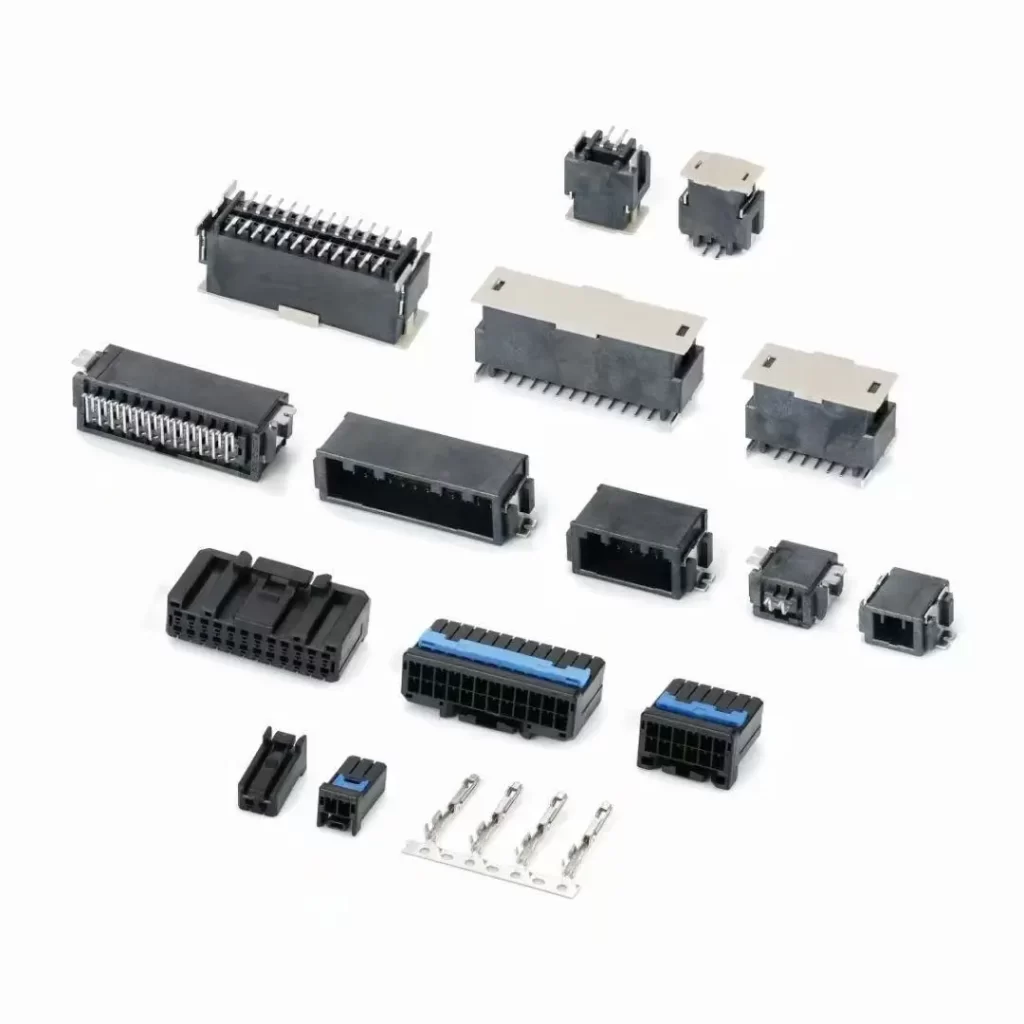
IP Ratings for Automotive: Beyond the Marketing Label
The Ingress Protection code, defined in IEC 60529, is the universal language of environmental sealing. For automotive connectors, the relevant ratings are IP67, IP68, and IP69K. Understanding what each actually tests—and what each does not—is the foundation of correct specification.
IP67: The Baseline for Automotive Survival
IP67 guarantees two things: complete dust-tightness (the “6”) and protection against temporary immersion in water to 1 meter depth for 30 minutes (the “7”). The test conditions are standardized and unambiguous. Every IP67 connector from every manufacturer is tested to the same protocol.
For automotive applications, IP67 is the minimum acceptable rating for:
- Under-hood engine bay connectors: Exposed to pressure washing during service, rain ingress through hood gaps, and steam from cooling system failures.
- Exterior lighting harnesses: Subject to road spray, car wash jets, and standing water in trunk or door cavities.
- Wheel well and underbody sensors: Directly exposed to salt slush, gravel impact, and pressure from puddle strikes at speed.
IP68: The Variable Rating
IP68 also guarantees dust-tightness, but the “8” for water protection is manufacturer-defined. IEC 60529 specifies “continuous immersion under conditions specified by the manufacturer.” One supplier’s IP68 may be validated at 1.5 meters for 1 hour. Another’s may be tested at 3 meters for 24 hours. Both are legitimately IP68.
This variability is a procurement trap. When specifying IP68 for submersible applications—EV battery pack cooling lines, marine adapters, or flood-prone infrastructure—always demand the exact test conditions in writing: depth, duration, and water temperature. A connector rated IP68 at 1 meter for 30 minutes is not functionally different from IP67. A connector rated IP68 at 3 meters for 72 hours is an entirely different product.
IP69K: The Pressure-Wash Standard
IP69K originates from ISO 20653, the road vehicle standard developed by the German automotive industry. The test blasts the connector with 80°C water at 80–100 bar pressure from a nozzle held 10–15 cm away, attacking from multiple angles. This is not merely a water test; it is a mechanical stress test. The jet force can shear poorly designed seals, strip adhesive labels, and deform soft housings.
IP69K is mandatory for:
- Food processing and agricultural machinery: Daily steam cleaning with high-pressure hot water.
- Construction and mining equipment: Regular site clean-downs with pressure washers.
- Commercial vehicle underbodies: Automated truck wash systems using high-pressure jets.
Critical Warning: IP69K does not automatically include IP67 or IP68. A connector rated only IP69K may fail immersion testing because its seals are optimized for jet resistance, not sustained hydrostatic pressure. For applications requiring both immersion survival and pressure-wash resistance, specify dual-rated connectors: “IP67/IP69K” or “IP68/IP69K” with independent test reports for each.
| Rating | Dust Protection | Water Protection | Test Standard | Automotive Application |
|---|---|---|---|---|
| IP67 | 6 (dust-tight) | 7 (1m, 30 min immersion) | IEC 60529 | Under-hood, exterior lighting, wheel wells |
| IP68 | 6 (dust-tight) | 8 (manufacturer-defined depth/duration) | IEC 60529 | EV battery packs, marine, submersible sensors |
| IP69K | 6 (dust-tight) | 9K (80°C, 80–100 bar jet) | ISO 20653 | Food/agriculture machinery, commercial vehicle washdown |
Sealing Architecture: How Waterproof Connectors Actually Work
A waterproof connector is not merely a standard connector with an O-ring added. The sealing system is an integrated architecture with three distinct zones: the interface seal, the wire seal, and the housing integrity.
The Interface Seal: Mated Face Compression
When a plug and receptacle mate, an interfacial seal—typically a fluoroelastomer (FKM/Viton) or silicone O-ring—compresses between the mating faces. This creates the primary barrier against water and dust ingress. The seal material must maintain elasticity across the full automotive temperature range (-40°C to +125°C, with under-hood peaks to +150°C) and resist compression set after thousands of thermal cycles.
Silicone is the default for general automotive applications due to its wide temperature range and flexibility. FKM/Viton is required for fuel, oil, and solvent exposure—common in powertrain and fuel system connectors. EPDM handles steam and hot water, making it suitable for IP69K applications.
The compression force is generated by the locking mechanism. Threaded couplings provide the highest and most uniform compression, making them the standard for high-vibration environments. Bayonet and push-pull mechanisms offer faster mating but achieve lower compression forces, limiting their IP rating potential.
The Wire Seal: Individual Conductor Protection
The wire seal—also called a cable seal or mat seal—is the most overlooked component in waterproof connector design. It consists of precision-molded silicone grommets with individual holes for each wire, inserted into the rear of the connector housing. When the wire is pushed through, the grommet hole stretches and compresses around the wire insulation, creating a watertight seal that prevents moisture from wicking along the conductor into the contact cavity.
Critical Design Rules:
- The grommet hole diameter must be matched to the wire insulation outer diameter (OD) within ±0.1 mm. Too loose, and the seal fails. Too tight, and assembly becomes impossible or the grommet tears.
- Self-lubricating (oil-bleeding) silicone grades reduce insertion force by 40–60%, enabling high-speed automated harness assembly at 2,000+ insertions per hour without seal damage.
- Cavity plugs (blind seals) must be installed in any unused grommet holes. An open hole is a direct water ingress path.
Terminal Sealing: The Secondary Barrier
In high-reliability automotive connectors, each terminal cavity has an individual terminal seal—a small silicone boot or wedge that seals around the terminal body where it transitions from the wire crimp to the contact blade. This provides redundant protection: even if the wire seal is compromised, the terminal seal prevents water from reaching the contact interface.
Housing Integrity: Material and Mold Quality
The connector housing must be dimensionally stable, chemically resistant, and impermeable. The two dominant materials are:
PA66 (Nylon 66): The automotive workhorse. High mechanical strength, excellent chemical resistance to oils and fuels, and good heat resistance (continuous use to +85°C, short-term to +150°C with glass fiber reinforcement). PA66 absorbs moisture (1–3% at saturation), which can cause dimensional changes and reduce insulation resistance in high-humidity environments. For critical applications, PA66 must be conditioned or dried before assembly.
PBT (Polybutylene Terephthalate): The precision alternative. Near-zero moisture absorption (0.1–0.5%), excellent dimensional stability, and superior electrical insulation properties. PBT is the preferred material for connector housings in humid or precision applications where PA66’s moisture absorption would compromise seal fit or electrical performance. However, PBT has lower impact toughness than PA66 and is more brittle in cold temperatures.
| Material | Moisture Absorption | Temperature Range | Chemical Resistance | Best For |
|---|---|---|---|---|
| PA66 | 1–3% | -40°C to +150°C | Excellent (oils, fuels) | Under-hood, powertrain, fuel systems |
| PBT | 0.1–0.5% | -40°C to +130°C | Good (solvents, weak acids) | Humid environments, precision seals, exterior lighting |
| PA66 GF30 | 1–2% | -40°C to +155°C | Excellent | High-vibration, high-load structural connectors |
| PBT GF30 | 0.1–0.3% | -40°C to +140°C | Good | High-precision, moisture-critical applications |
Terminal Plating: The Hidden Failure Point
A waterproof housing is meaningless if the terminals inside corrode. Terminal plating is the final defense against the environment that has penetrated—or may yet penetrate—the seal system.
Gold Plating: The Signal Integrity Standard
Gold is chemically inert. It does not oxidize, tarnish, or form insulating films. Gold-plated terminals maintain contact resistance of 1–3 mΩ with exceptional stability over thousands of mating cycles and decades of service. Automotive gold plating typically ranges from 0.5 to 2.5 microns thickness, applied over a nickel barrier layer.
Gold is mandatory for:
- Low-voltage signal circuits: ECU sensors, CAN bus, LIN bus, and Ethernet connections where even milliohm resistance changes cause signal errors.
- High-mating-cycle applications: Diagnostic ports, modular ECU connections, and test interfaces requiring 100+ mating cycles without degradation.
- Corrosive environments: Marine, salt-spray, and chemical exposure where tin or silver would fail.
Critical Rule: Never mate gold-plated terminals with tin-plated terminals. The galvanic potential difference between gold and tin creates an electrochemical cell that accelerates corrosion in the presence of humidity, producing an insulating intermetallic layer that causes intermittent failure.
Tin Plating: The Cost-Effective Power Solution
Tin plating is economical, solderable, and widely available. It is the standard for high-volume automotive power connectors where cost pressure is extreme and mating cycles are low. However, tin is vulnerable to fretting corrosion—the gradual buildup of tin oxide debris caused by micro-movement from vibration and thermal cycling. Over time, this oxide layer increases contact resistance until the connection fails.
Tin is acceptable for:
- Fixed-installation power distribution: Battery terminals, fuse box connections, and chassis grounds.
- Controlled environments: Interior cabin electronics with minimal vibration and no chemical exposure.
- Single-mate applications: Wire-to-board headers and PCB connectors that are mated once during assembly and never disconnected.
Silver Plating: The High-Current Compromise
Silver offers the highest electrical conductivity of any metal (106% IACS) and maintains conductivity even when tarnished. It is the preferred choice for high-current power connectors in EV charging systems, battery interconnects, and industrial power distribution. However, silver is susceptible to sulfur tarnish in contaminated atmospheres and has moderate mating cycle durability (~50 cycles).
| Plating | Contact Resistance | Oxidation Resistance | Mating Cycles | Cost | Best For |
|---|---|---|---|---|---|
| Gold | 1–3 mΩ | Excellent | 100–1,000+ | High | Signal, sensors, high-cycle, corrosive environments |
| Tin | Variable (fretting) | Poor | < 50 | Low | Power, fixed install, cost-sensitive, interior |
| Silver | Low | Fair (sulfur tarnish) | ~50 | Moderate | High-current power, EV charging, RF |
Mechanical Reliability: CPA, TPA, and Vibration Resistance
In automotive environments, connectors are subjected to continuous vibration, thermal cycling, and mechanical shock. A waterproof seal that fails under vibration is not a waterproof seal. Two critical mechanisms ensure long-term mechanical integrity.
CPA (Connector Position Assurance)
CPA is a secondary locking mechanism—typically a sliding or hinged component—that can only be engaged after the connector halves are fully mated. If the connector is not properly seated, the CPA cannot lock, providing immediate visual and tactile feedback to the assembly operator. This prevents the most common assembly error in high-volume production: partial mating that appears correct but leaves the seal uncompressed.
TPA (Terminal Position Assurance)
TPA is a secondary lock that secures individual terminals within the housing after insertion. It prevents terminal back-out caused by vibration, wire pull, or thermal expansion. If a terminal is not fully seated, the TPA cannot engage, blocking final assembly. TPA is critical in maintaining contact integrity over the 15-year vehicle lifecycle.
Vibration and Shock Testing
Automotive connectors must pass vibration testing per USCAR-2 or LV214 standards. USCAR-2 specifies five vibration levels, with Level V requiring survival at 50g acceleration across 10–2000 Hz with no contact resistance excursions exceeding 1Ω. LV214, the German standard used by BMW, Audi, and VW, adds random vibration profiles and more severe thermal cycling.
For high-vibration applications—engine mounts, suspension sensors, and transmission harnesses—specify connectors with:
- Threaded or high-retention bayonet locking: Not friction-fit or simple snap-latch designs.
- Gold-plated contacts: To resist fretting corrosion from micro-movement.
- CPA and TPA mechanisms: To prevent loosening and terminal back-out.
Common Procurement Traps and How to Avoid Them
Trap 1: Assuming IP69K Includes IP67/IP68
This is the most expensive misconception in waterproof connector procurement. IP69K tests high-pressure jet resistance, not immersion. A connector rated only IP69K may leak during sustained submersion. For applications requiring both pressure-wash survival and immersion protection, demand dual-rated connectors with independent test reports for each rating.
Trap 2: Ignoring the Unmated State
Most waterproof connectors lose their IP rating when unmated. The seal is created by compression between plug and receptacle. Once separated, the receptacle drops to IP55 or lower unless a sealed dust cap is fitted. For serviceable connectors—diagnostic ports, battery maintenance connectors, and modular harnesses—specify connectors with integrated sealing caps or specify separate protective caps as part of the BOM.
Trap 3: Mismatched Plating Materials
Mating gold-plated terminals with tin-plated terminals creates a galvanic corrosion cell. The resulting intermetallic compound is electrically insulating and will cause intermittent failure within months in humid conditions. Always match plating materials across mating pairs, or specify selective plating where only the contact interface is gold and the crimp barrel is tin for solderability.
Trap 4: Underspecifying Salt Spray Resistance
Road salt is the silent killer of automotive connectors. Standard tin-plated terminals may show corrosion after 48 hours in neutral salt spray (NSS) testing per ISO 9227. For winter climates and coastal applications, specify connectors with 96-hour minimum salt spray resistance and gold-plated or nickel-plated contacts. For marine and extreme environments, demand 240–500 hour salt spray validation.
Trap 5: Neglecting Wire Seal Compatibility
A connector rated IP67 with a wire seal designed for 2.0–2.5 mm insulation OD will fail if mated with 1.5 mm wire. The grommet hole will be oversized, creating a leak path. Always verify that the wire insulation OD falls within the connector’s specified seal range, and use cavity plugs for any unused positions.
Practical Selection Framework
Use this structured approach to specify waterproof automotive connectors with confidence.
Step 1: Define the Environmental Exposure
- Is the connector exposed to rain, splash, immersion, or high-pressure washdown?
- What is the worst-case temperature range and thermal cycling profile?
- Is road salt, chemical exposure, or fuel contact present?
Step 2: Select the IP Rating
- Rain and splash only → IP65
- Under-hood, exterior, wheel wells → IP67 minimum
- Submersible, EV battery, marine → IP68 with specified depth/duration
- Pressure-wash, food/agriculture machinery → IP69K, ideally dual-rated with IP67/IP68
Step 3: Specify Housing Material
- Under-hood, fuel exposure, high vibration → PA66 or PA66 GF30
- Humid environments, precision sealing critical → PBT or PBT GF30
- Extreme chemical exposure → PPS or specialized blends
Step 4: Select Terminal Plating
- Low-voltage signals, sensors, high cycles → Gold (0.5–2.5 µm over nickel)
- High-current power, EV charging → Silver
- Fixed power distribution, cost-sensitive → Tin (with CPA/TPA for vibration resistance)
Step 5: Verify Mechanical Features
- Threaded or high-retention bayonet locking for vibration?
- CPA for mating assurance?
- TPA for terminal retention?
- Salt spray hours validated?
Step 6: Confirm Certifications and Testing
- USCAR-2 or LV214 vibration compliance?
- IATF 16949 quality system certification?
- RoHS, REACH material compliance?
- Independent third-party test reports (not self-certification)?
Sourcing with Confidence: The Vistar Electronics Standard
A waterproof automotive connector is only as reliable as the weakest element in its supply chain: the silicone grommet’s compression set, the terminal plating’s thickness uniformity, the housing mold’s dimensional stability, and the validation testing that the manufacturer has actually performed. These factors are invisible in a catalog but determine whether your product survives its warranty period or generates a field service nightmare.
At Vistar Electronics, our waterproof automotive connector portfolio is engineered for the environments where failure is not an option. We manufacture sealed connectors in 2-pin to 24-pin configurations, with IP67, IP68, and IP69K ratings validated to IEC 60529 and ISO 20653. Our housings are molded from PA66 and PBT with glass fiber reinforcement, rated for continuous operation from -40°C to +125°C and short-term peaks to +150°C.
Our sealing system uses multi-lip silicone and FKM grommets with individual wire seals and cavity plugs, achieving true IP67 immersion protection and IP69K pressure-wash survival. Terminal options include gold-plated phosphor bronze for signal integrity, silver-plated copper for high-current power, and tin-plated brass for cost-optimized distribution. All terminals are available with integrated TPA and CPA mechanisms for assembly assurance and vibration resistance.
Every connector series undergoes 100% continuity testing, salt spray validation (96 hours minimum), and thermal cycling before release. We source materials with full lot traceability and comply with RoHS 3, REACH, and IATF 16949 quality standards. For engineers navigating prototype-to-production transitions, we provide free samples for qualified automotive projects, DFM reviews for seal and wire compatibility, and support for custom pin configurations, housing geometries, and plating specifications through our OEM/ODM services.
The goal is not to sell a connector. It is to ensure that the connector you specify is the most reliable component in the entire vehicle.
Keywords Summary
- Focus Keyword: waterproof automotive connectors
- Secondary Keywords: IP67 automotive connector, IP69K connector, automotive connector sealing, USCAR-2 connector, waterproof connector selection
External Resources
- IP67 vs IP68 vs IP69K: Which Waterproof Rating Do You Actually Need?
- Automotive Connector Standards: IP Rating, USCAR, and ISO Requirements
- How CPA and TPA Improve Automotive Connector Reliability
- Salt Spray Testing Standards for Automotive Connectors
- Tin vs. Silver vs. Gold Automotive Terminals | Plating Guide
- Connector Plating Comparison: Gold vs. Tin vs. Silver Selection Guide


