
Driven by the global wave of automotive electronics intelligence, FPC (Flexible Printed Circuit) connectors have become indispensable components in modern vehicle electronic systems.
According to industry data, the global automotive FPC connector market reached USD 1.45 billion in 2024 and is projected to grow to USD 2.74 billion by 2033, with a CAGR of 7.2%. With new energy vehicle penetration exceeding 45% and L3+ autonomous driving vehicles incorporating 4-6 ADAS domain controllers, the usage and value of Automotive FPC Connector per vehicle are experiencing explosive growth.
However, the harsh automotive environment poses unprecedented challenges to connector reliability. Continuous vibration in engine compartments, thermal cycling, humidity variations, and salt spray corrosion can all lead to contact degradation, signal interruption, or even system failure.
This article provides B2B customers with systematic reliability enhancement solutions, helping global automotive electronics manufacturers and purchasers select and apply automotive-grade FPC connectors efficiently with support from Vistar Electronics.
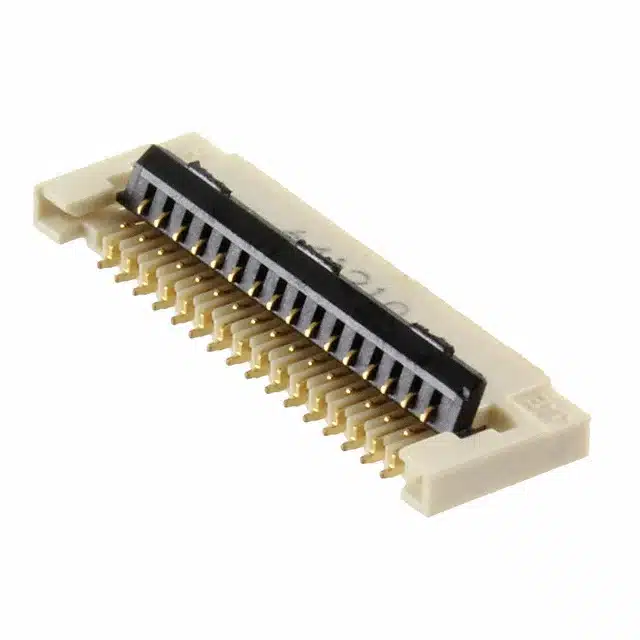
I. Structural Design: The First Line of Defense Against Vibration
The structural design is the primary guarantee for resisting vibration impact, directly determining the stability of FPC connection and avoiding loosening or detachment under long-term vibration.
1. Redundant Locking Mechanisms
In high-vibration automotive applications (such as engine compartments and chassis), single-lock structures can no longer meet reliability requirements. We recommend prioritizing Automotive FPC Connector with Secondary Lock or Self-Locking Mechanisms. These designs utilize independent sliders or latches to provide a second mechanical lock after FPC insertion into the primary lock, improving vibration resistance by over 300%. F
or example, the Hirose FH Series Automotive FPC Connector adopts a dual-lock structure, which is widely used in automotive ADAS systems and has passed strict vibration resistance tests.
2. Multi-Point Contact Terminal Design
High-quality automotive-grade FPC connectors should feature dual or triple contact points per signal terminal. This redundancy ensures that even if one contact point experiences transient impedance changes due to vibration, other contacts maintain signal continuity.
According to IPC standards, multi-point contact designs can control contact resistance fluctuations within ±5mΩ, meeting the stability requirements for high-speed data transmission in automotive infotainment and ADAS systems. As a professional supplier, we provide automotive-grade FPC connectors with multi-point contact terminals, which can be customized according to customer signal transmission needs.
II. Material Selection: Core Assurance for Long-Term Durability
Material performance directly affects the service life and reliability of connectors in harsh automotive environments. Scientific material selection is the key to ensuring that connectors can withstand high temperature, vibration, and corrosion.
1. High-Temperature Tolerance for Housing Materials
Automotive internal operating temperatures typically range from -40°C to +125°C (engine compartments up to +150°C). Therefore, connector housings should utilize high-strength, high-temperature engineering plastics such as LCP (Liquid Crystal Polymer) or PPS (Polyphenylene Sulfide), with heat deflection temperatures exceeding 260°C to prevent creep-induced locking force degradation at elevated temperatures. For high-temperature application scenarios such as engine compartments, we recommend our high-temperature resistant automotive FPC connectors, which can maintain stable performance in extreme temperature environments.
2. Terminal Materials and Surface Treatment
Terminal base materials should employ Beryllium Copper or high-elasticity Phosphor Bronze with excellent stress relaxation resistance, ensuring that terminals can maintain stable contact force after millions of vibrations. Surface plating should use thick gold plating (≥0.76μm) with nickel underplating, significantly reducing contact resistance (<20mΩ) and enhancing salt spray corrosion resistance to meet ISO 20653 IP6K9K protection level requirements. For more details on material selection, you can refer to the IPC-6012 Automotive FPC Connector Material Standard released by IPC.
III. Installation Process: The Foundation of Reliability
Even high-performance connectors will have hidden reliability risks if the installation process is not standardized. Standardized assembly operations are the key to giving full play to the vibration resistance of automotive FPC connectors.
1. Standardized Assembly Procedures
When installing connectors, utilize professional crimping tools to ensure completely straight FPC insertion, avoiding terminal deformation from eccentric loading. Locking mechanisms must receive uniform pressure; we recommend torque-controlled screwdrivers set to 0.2-0.3N·m to prevent over-compression damage. Our technical team at
Vista Electronics
File can provide on-site guidance on standardized assembly to help customers avoid installation errors.
2. Prevention of Initial Damage
During installation, it is necessary to avoid excessive FPC bending (<R5mm) or compression. We recommend using positioning fixtures before FPC insertion to ensure concentricity deviation <0.1mm from the connector opening. Any micro-damage during installation can propagate into fatigue cracks under long-term vibration, leading to early failure.
IV. Reinforcement Measures: Ultimate Protection for Extreme Environments
For extreme vibration scenarios such as automotive engine compartments and chassis sensors, additional reinforcement measures are required to further improve reliability and achieve double insurance for connection stability.
1. Mechanical Auxiliary Fixing
For critical connection points such as instrument panels and center displays, apply high-strength acrylic adhesive tape (3M 4914 or equivalent) to the connector backside to suppress vibration amplitude. The tape must have a temperature resistance of +120°C and peel strength ≥15N/cm, ensuring that the connector and FPC remain stable under long-term vibration. This reinforcement method is simple and cost-effective, suitable for most automotive interior applications.
2. Structural Enhancement Solutions
A more reliable approach employs FPC Stiffener + Reinforcement Module combinations. By integrating FR-4 or stainless steel stiffeners (0.2-0.3mm thickness) into the FPC body and utilizing dedicated mounting brackets on the PCB to mechanically lock both ends of the stiffener, FPC pull-out from the connector can be fundamentally prevented. This solution is particularly suitable for combating severe, continuous vibrations at engine compartment levels and is widely used in new energy vehicle BMS systems. We can provide customized structural enhancement solutions according to customer specific application scenarios.
V. Recommended Selection Decision Process
When selecting automotive FPC connectors for automotive applications, we recommend following this systematic approach to ensure that the selected connectors meet the reliability requirements of high-vibration environments:
- Vibration Level Assessment: Determine the vibration intensity level based on mounting location (engine compartment/chassis/body/cabin), referencing ISO 16750-3 standards;
- Supplier Screening: Prioritize product lines with AEC-Q200 certification from well-known manufacturers such as TE Connectivity, Hirose, JST, Molex, etc. As a professional supplier, Vista ElectronicsFile cooperates with these top manufacturers to provide authentic and high-quality automotive-grade connectors;
- Critical Parameter Verification: Confirm key parameters, including operating temperature range, mating cycles (≥50), contact resistance, insulation resistance (≥1000MΩ), and voltage withstand (AC 500V/min);
- Reinforcement Reservation Design: Reserve mechanical space for secondary locks and stiffeners during PCBA layout to avoid space constraints affecting reinforcement measures;
- Process Documentation: Incorporate installation steps and inspection criteria into SOPs, and provide IPC-A-610 certification training for production line personnel to ensure standardized operation.
Conclusion
In the fiercely competitive global automotive electronics market, product reliability is the core competitiveness of enterprises. As a key component of automotive electronic connections, the vibration resistance performance of Automotive FPC Connector is directly related to the safety and stability of the entire vehicle.
With the continuous popularization of new energy vehicles, the demand for automotive-grade FPC connectors in BMS battery management systems, intelligent cockpits, and ADAS systems is increasing, and the requirements for its reliability are also getting higher and higher.
As a professional electronic components supplier, Vistar Electronics deeply understands B2B customers’ dual requirements for supply chain stability and technical adaptability. In the FPC connector domain, we not only provide AEC-Q200-compliant automotive-grade products but also offer full-chain technical support from selection consulting, sample testing to volume delivery, tailored to customers’ specific vibration environments, space constraints, and signal integrity requirements.
For detailed technical comparison materials on specific product series (such as Hirose FH Series, TE AMPMODU, JST SMK Series) or to discuss customized reinforcement solutions, please contact our technical team at any time.


