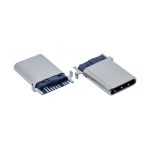
Industrial systems are rapidly adopting USB-C as the standard interface for data, power, and control. But consumer-grade USB-C connectors fail quickly in factory floors, automotive bays, and outdoor installations. Understanding what makes an industrial USB-C connector different—and how to select the right one—can mean the difference between years of reliable operation and costly field failures.
This guide covers everything engineers need to know about industrial USB type C receptacle connectors, from environmental ratings and mechanical durability to pin configurations and real-world application requirements.
What Makes a USB-C Connector “Industrial-Grade”?
Not every USB-C connector labeled “rugged” is truly industrial-grade. True industrial USB-C connectors meet specific criteria that go far beyond consumer specifications.
Environmental Sealing: IP Ratings Explained
Industrial environments expose connectors to dust, moisture, chemicals, and pressure washing. The IP (Ingress Protection) rating system defines this resistance:
| Rating | Protection Level | Typical Industrial Use |
|---|---|---|
| IP54 | Dust-protected, water splashing | Indoor control panels, clean factory floors |
| IP65 | Dust-tight, water jets | Food processing, light industrial |
| IP67 | Dust-tight, immersion 1m/30min | Outdoor equipment, marine, automotive |
| IP68 | Dust-tight, extended immersion | Submersible systems, harsh outdoor, military |
For most industrial automation and outdoor applications, IP67 is the minimum standard. IP68 is required for equipment exposed to prolonged moisture, such as marine electronics or outdoor EV charging stations.
Temperature Range
Consumer USB-C connectors typically operate from 0°C to +50°C. Industrial variants must handle:
- Standard industrial: -30°C to +85°C
- Extended range: -40°C to +105°C or higher
- Automotive grade: -40°C to +125°C (AEC-Q200 compliance)
Temperature cycling causes material expansion and contraction, leading to contact fatigue and seal degradation. Industrial connectors use high-performance housing materials like LCP (Liquid Crystal Polymer) or PA66 with glass fiber reinforcement to maintain dimensional stability across temperature extremes.
Mechanical Durability
Industrial applications demand significantly higher mating cycle ratings:
| Application Type | Minimum Mating Cycles | Typical Industrial Rating |
|---|---|---|
| Consumer electronics | 5,000–10,000 | Baseline |
| Industrial automation | 10,000+ | Standard |
| High-frequency docking | 20,000+ | Premium |
| Automotive / MIL | 50,000+ | Specialized |
The 10,000-cycle rating is the industrial baseline. For equipment with frequent connection cycles—such as portable diagnostic tools or modular industrial systems—select connectors rated for 20,000+ cycles.
Vibration and Shock Resistance
Industrial machinery generates continuous vibration. Standard USB-C connectors can experience solder joint fatigue, shell loosening, and contact intermittent under vibration. Industrial-grade solutions address this through:
- Enhanced board retention: Additional solder tabs, through-hole mounting, or screw-lock flanges
- Metal shell construction: Stainless steel or nickel-plated brass for mechanical rigidity
- Locking mechanisms: Threaded collars, bayonet locks, or slide locks to prevent accidental disconnection
TE Connectivity’s industrial USB-C design specifically emphasizes “additional connector board retention features compared to the industry standard footprint” for enhanced durability in factory automation and industrial machinery.
Industrial USB-C Connector Types by Pin Count
Pin count determines functionality, cost, and PCB complexity. Industrial applications have specific requirements for each configuration.
24-Pin Industrial USB-C Receptacle
The full-featured industrial USB-C receptacle supports all USB-C capabilities and is required for high-performance industrial systems.
Key Industrial Features:
- USB 3.2 Gen 2×2 (20 Gbps) or USB4 (40 Gbps/80 Gbps) data
- USB Power Delivery up to 240W (EPR)
- DisplayPort Alt Mode for HMI and industrial displays
- Full differential pairs for high-speed industrial communication
Industrial Applications:
- Industrial PCs and edge computing gateways
- Machine vision systems with high-bandwidth camera interfaces
- HMI panels requiring video output
- High-speed data acquisition systems
Mounting Considerations:
- Mid-mount for slim industrial tablets and portable HMI
- Top-mount with enhanced retention for vibration-prone environments
- Panel-mount with flange and screws for enclosure integration
Browse our 24-Pin Industrial USB-C Receptacle for ruggedized full-featured options.
16-Pin Industrial USB-C Receptacle
The 16-pin industrial USB-C receptacle offers a cost-optimized solution for USB 2.0 industrial applications.
Key Industrial Features:
- USB 2.0 data (480 Mbps) sufficient for most industrial control protocols
- USB Power Delivery up to 100W
- Simplified PCB routing in space-constrained industrial boards
- Lower BOM cost for high-volume industrial products
Industrial Applications:
- PLC programming ports
- Industrial sensor nodes and IoT gateways
- Power delivery interfaces for industrial handheld devices
- Legacy equipment USB-C upgrades
Trade-offs:
- No USB 3.x high-speed data
- No DisplayPort video output
- Not suitable for machine vision or high-speed data logging
6-Pin Industrial USB-C Receptacle
The 6-pin industrial USB-C receptacle is the minimalist solution for pure power industrial applications.
Key Industrial Features:
- Charging only (VBUS, GND, CC pins)
- Lowest BOM cost for cost-sensitive industrial products
- Simplest PCB layout
- Often available with IP67 waterproof rating for outdoor power applications
Industrial Applications:
- Industrial LED lighting systems
- EV charging station indicator interfaces
- Solar power management systems
- Simple industrial charging docks
Trade-offs:
- No data transmission
- No USB PD negotiation (basic resistor-based or fixed voltage)
- Limited to 5V or basic charging profiles
Industrial USB-C Connector Types by Mounting Style
Mounting style directly impacts mechanical reliability in industrial environments.
Mid-Mount Industrial USB-C
Mid-mount connectors recess into the PCB, reducing installed height.
Industrial Advantages:
- Lower profile for compact industrial enclosures
- Protected position reduces mechanical stress on solder joints
- Ideal for industrial tablets, portable testers, and slim HMI devices
Industrial Considerations:
- Requires precise PCB slot machining
- Slightly more complex assembly process
- Verify retention strength under vibration
Top-Mount Industrial USB-C
Top-mount connectors sit on the PCB surface with the shell soldered to the board.
Industrial Advantages:
- Standard SMT assembly compatible with high-volume production
- Widest range of industrial variants available
- Easiest inspection and rework for field maintenance
Industrial Best Practice:
- Select variants with enhanced board retention (additional solder tabs or through-hole legs)
- Specify metal shell with full EMI shielding for noisy industrial environments
Panel-Mount Industrial USB-C
Panel-mount connectors install through an enclosure or chassis wall.
Industrial Advantages:
- Isolates PCB from external mechanical stress
- Allows cable connection without opening enclosures
- Screw-lock or flange-mount options prevent accidental disconnection
Industrial Applications:
- Industrial control panel interfaces
- Test equipment chassis
- Outdoor equipment enclosures
- Modular industrial systems
Right-Angle Industrial USB-C
Right-angle connectors extend parallel to the PCB edge.
Industrial Advantages:
- Natural cable routing along enclosure edges
- Reduced strain on cable and connector
- Most common form factor for industrial portable equipment
Industrial USB-C Connector Standards and Compliance
Industrial applications require specific certifications beyond basic USB-IF compliance.
Key Industrial Standards
| Standard | Requirement | Relevance |
|---|---|---|
| RoHS / REACH | Hazardous substance restriction | Mandatory for EU and global markets |
| UL94V-0 | Flammability rating | Required for industrial equipment safety |
| IEC 60529 | IP rating verification | Third-party testing for IP67/IP68 claims |
| AEC-Q200 | Automotive qualification | Required for automotive industrial applications |
| MIL-STD-810 | Military environmental testing | Required for military-industrial applications |
EMI Shielding in Industrial Environments
Industrial environments are electrically noisy. Variable frequency drives, motor controllers, and switching power supplies generate significant electromagnetic interference. TE Connectivity specifically highlights “enhanced electromagnetic interference (EMI) shielding on the receptacle shell” as a critical feature for industrial USB-C connectors, helping eliminate unwanted EMI leakage that can disrupt data transmission or cause regulatory compliance failures.
For industrial applications, specify connectors with:
- Full metal shell with 360-degree shielding
- Ground connection to PCB ground plane
- Proper shield continuity through the cable assembly
Industrial USB-C Applications by Sector
Factory Automation and Industrial Control
Requirements:
- IP65 minimum for factory floor exposure
- 10,000+ mating cycles for maintenance access
- Vibration resistance for machinery-mounted systems
- USB 2.0 (16-pin) typically sufficient for PLC programming and HMI
Typical Products:
- PLC programming ports
- Industrial HMI touch panels
- Machine operator interfaces
- Sensor configuration ports
Automotive and EV Systems
Requirements:
- IP67/IP68 for under-hood and exterior exposure
- -40°C to +125°C temperature range
- AEC-Q200 qualification
- Vibration and shock resistance per automotive standards
Typical Products:
- EV charging station interfaces
- Vehicle diagnostic ports (OBD)
- In-vehicle infotainment systems
- Battery management system interfaces
Medical and Diagnostic Equipment
Requirements:
- IP54 minimum for cleaning and sterilization exposure
- High reliability for patient-connected devices
- Isolation requirements for patient safety
- Long life for equipment with high usage cycles
Typical Products:
- Portable diagnostic instruments
- Patient monitoring systems
- Medical imaging equipment
- Laboratory automation systems
Outdoor and Marine Electronics
Requirements:
- IP68 for submersion and prolonged moisture exposure
- Corrosion-resistant materials (salt spray resistance)
- UV resistance for prolonged sun exposure
- Wide temperature range
Typical Products:
- Outdoor communication equipment
- Marine navigation systems
- Solar power management systems
- Smart agriculture sensors
Industrial USB-C Connector Selection Checklist
Use this framework for your next industrial design:
1. Define Environmental Requirements
- [ ] What IP rating is required? (IP54 / IP65 / IP67 / IP68)
- [ ] What is the operating temperature range?
- [ ] Will the connector be exposed to chemicals, oils, or cleaning agents?
- [ ] Is submersion or pressure washing involved?
2. Define Mechanical Requirements
- [ ] How many mating cycles over the product lifetime?
- [ ] Will the connector experience vibration or shock?
- [ ] Is accidental disconnection a risk? (If yes, specify locking mechanism)
- [ ] What mounting style fits the enclosure design?
3. Define Electrical Requirements
- [ ] What data speed is required? (USB 2.0 / USB 3.2 / USB4)
- [ ] What power delivery level? (5V / 100W / 240W EPR)
- [ ] Is video output required? (DisplayPort Alt Mode)
- [ ] What is the current rating per pin?
4. Define Compliance Requirements
- [ ] Is RoHS/REACH compliance required?
- [ ] Is AEC-Q200 required for automotive?
- [ ] Is UL or IEC certification required?
- [ ] Are there specific country or industry certifications?
5. Define Supply Chain Requirements
- [ ] What is the expected annual volume?
- [ ] Is long-term supply availability critical? (Industrial products have 5–10 year lifecycles)
- [ ] Are second-source requirements specified?
- [ ] What is the target BOM cost?
Industrial USB-C Connector Comparison
| Feature | Standard Industrial | High-Performance Industrial | Ruggedized Outdoor |
|---|---|---|---|
| Pin Count | 16-pin | 24-pin | 16/24-pin |
| IP Rating | IP65 | IP67 | IP68 |
| Temperature | -30°C to +85°C | -40°C to +105°C | -40°C to +105°C |
| Mating Cycles | 10,000 | 10,000+ | 10,000+ |
| Data Speed | USB 2.0 | USB 3.2 / USB4 | USB 2.0 / USB 3.2 |
| Power Delivery | 100W | 240W | 100W |
| Mounting | Top / Mid | Top / Mid / Panel | Panel with locking |
| EMI Shielding | Standard | Enhanced | Enhanced |
| Best For | Indoor automation | High-speed industrial | Outdoor / Marine |
Frequently Asked Questions About Industrial USB-C Connectors
What IP rating do I need for factory automation?
For most factory automation applications, IP65 is sufficient to protect against dust and water jets from cleaning operations. For equipment near washdown areas or exposed to outdoor conditions, upgrade to IP67.
Can I use a consumer USB-C connector in industrial equipment?
No. Consumer USB-C connectors lack the temperature range, vibration resistance, sealing, and mechanical durability required for industrial environments. Using consumer-grade connectors in industrial applications typically results in premature failure, field returns, and warranty costs.
What is the difference between industrial and automotive USB-C connectors?
Automotive USB-C connectors must meet AEC-Q200 qualification standards, which include additional temperature cycling, vibration, and humidity testing beyond standard industrial requirements. For non-automotive industrial applications, standard industrial ratings are typically sufficient and more cost-effective.
Do industrial USB-C connectors support USB4?
Yes, but only 24-pin industrial USB-C connectors support USB4’s 40 Gbps throughput. These require full differential pair implementation and careful PCB routing with controlled impedance. For most industrial control applications, USB 2.0 (16-pin) or USB 3.2 (24-pin) is sufficient.
How do I prevent EMI issues with industrial USB-C connectors?
Specify connectors with full metal shell construction and 360-degree EMI shielding. Ensure the shell connects to the PCB ground plane with multiple ground points. Use shielded cables with proper ground termination. For high-noise environments, consider additional ferrite suppression on data lines.
What is the typical lifecycle for industrial USB-C connectors?
Industrial equipment typically requires 5–10 year component availability. When selecting connectors, verify with the manufacturer that the part is not near end-of-life and that long-term supply agreements are available. Vistar Electronics provides lifecycle management support for industrial customers.
External References
- USB Implementers Forum (USB-IF)
- USB Type-C Cable and Connector Specification
- IEC 60529 IP Rating Standards
- TE Connectivity USB Type-C Industrial Solutions