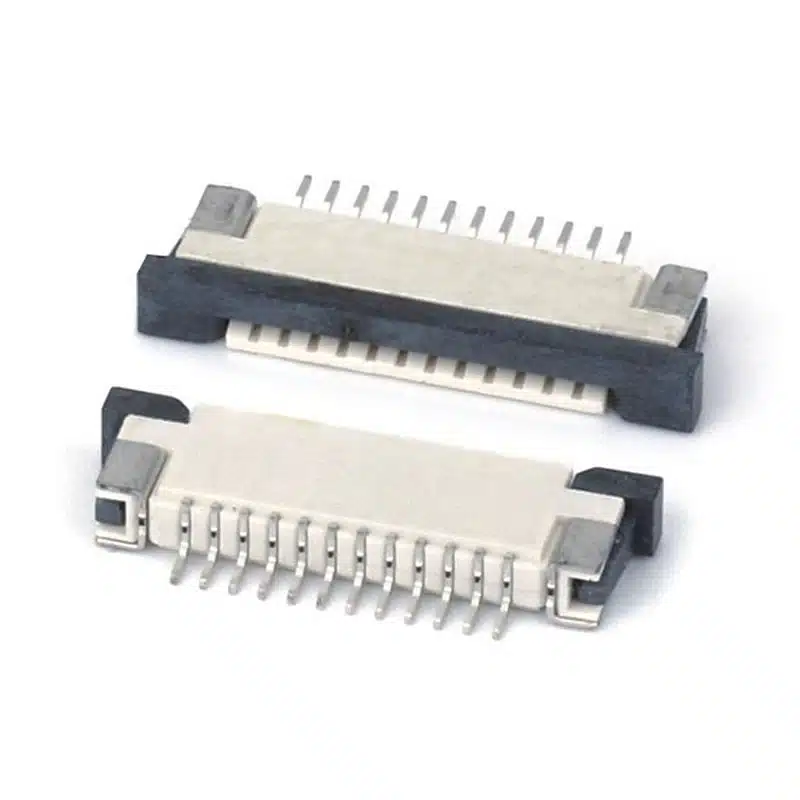
Ensuring the reliability of automotive FPC connectors in high-temperature and high-humidity automotive environments requires systematic consideration.
The table below summarizes the core requirements for automotive FPC connectors in terms of material selection and coating processes, allowing you to quickly grasp the key points.
| Component/Process | Core Requirements | Recommended Selection/Solution | Core Requirements | Recommended Selection/Solution |
| Connector Housing | High heat resistance, high strength, stable insulation | PEEK, PAI, PES and other high-performance engineering plastics |
| Terminal Contacts | Excellent conductivity, corrosion resistance, long-term stress resistance | Phosphor bronze, beryllium copper base material, thick gold plating (or ENEPIG process) |
| FPC Reinforcement Board | Enhanced rigidity, heat resistance, matching thermal expansion | PI (flexible and heat-resistant), stainless steel (high strength and corrosion resistance), FR-4 (rigid support) |
| Protective Coating/Sealing | Moisture-proof, corrosion-proof, insulation protection | Parylene vacuum vapor deposition, conformal coating, sealant, Hardcoat |

Specific Considerations for Material Selection of automotive FPC connectors
The materials mentioned in the table each have their own applicable scenarios. A deeper understanding will help you make more precise choices.
- Graded selection of housing materials: Different areas of a car have vastly different temperature requirements. For extremely high-temperature areas such as the engine compartment (potentially exceeding 125°C), PEEK (polyether ether ketone) and PAI (polyamide-imide) are preferred.
They can withstand high temperatures above 200°C for extended periods while maintaining excellent mechanical strength and dimensional stability. For areas with slightly lower temperatures but still requiring high reliability, such as cockpit electronics, PPS (polyphenylene sulfide) and high-performance PA (polyamide) offer a good balance of cost and performance. - Scenario-based application of reinforcement materials: The choice of reinforcement board directly affects the mechanical strength and welding reliability of the FPC at the connector.
- PI reinforcement: Good compatibility with the FPC substrate, maintains overall flexibility, suitable for areas requiring slight bending, and is resistant to high-temperature welding.
- FR-4 reinforcement: Provides very high rigidity, effectively preventing bending of the FPC at the connector, but has poor flexibility, making it more suitable for completely fixed scenarios.
- Stainless Steel Reinforcement: For areas requiring extremely high mechanical strength and excellent heat dissipation, stainless steel is the ideal choice, but it also has the highest rigidity.
Advanced Coating and Sealing Processes
In addition to the base material, the surface protection process is a key barrier against environmental corrosion.
- Enhanced Surface Plating Corrosion Resistance: In high-temperature and high-humidity environments, a simple gold plating layer may not be sufficient to guarantee long-term reliability. Electroless Nickel Palladium Gold (ENEPIG) plating is worth considering. It adds a layer of palladium between the nickel and gold layers, which more effectively prevents nickel corrosion and the “black pad” phenomenon, providing a more durable and reliable contact surface. For terminals, sufficient gold plating thickness should be ensured (e.g., 0.76µm or more is recommended) to resist corrosion and wear.
- Application of High-Performance Protective Coatings:
- Parylene: This is a thin-film coating formed by vacuum vapor deposition. It can cover the entire surface of the FPC with extremely uniform thickness (up to micron level) without dead ends, including gaps and the bottom of the pins, forming a dense, pinhole-free protective film with excellent moisture resistance and chemical corrosion resistance.
- Hardcoat: For exposed plastic parts, this technology can be used to significantly improve their surface hardness, wear resistance, and weather resistance. This technology requires extremely high cleanliness and temperature and humidity control of the construction environment to ensure coating quality.
- Implementation of Structural Sealing Design:
- After the connector is mated, using special electronic silicone or epoxy adhesive for sealing can effectively prevent moisture from entering through the interface gaps.
- For the entire FPC assembly, sealing rings or potting compounds can be considered for overall protection, achieving a higher level of sealing.

Systematic Assurance from Design to Verification
Achieving long-term reliability requires comprehensive consideration from the initial design stage and rigorous verification.
- Risk Avoidance at the Design Stage: When laying out the PCB, try to avoid placing automotive FPC connectors in areas of the board that are most prone to bending or vibration stress concentration. At the same time, reasonable cable routing and fixing point design can reduce uneven stress on the connector caused by assembly stress.
- Rigorous Reliability Verification: In addition to conventional performance testing, targeted environmental reliability testing must be conducted, which usually requires testing conditions that are more stringent than general standards.
- High Temperature and High Humidity Testing: For example, a 1000-hour endurance test is conducted under conditions of 85°C/85%RH, with continuous monitoring of contact resistance.
- Salt Spray Corrosion Testing: Simulating environments such as de-icing agents used in winter, the test should far exceed the standard 96 hours to verify its long-term corrosion resistance. Testing standards can refer to GB/T 2423.17, etc.
We hope this specific information on materials, processes, and verification will provide valuable references for your design. If you encounter more specific situations in your application, we can continue to discuss them in more detail. For more info, you may refer to this post.