
The barrel jack connector, a seemingly simple electromechanical component, serves as the critical gateway for external power delivery to countless electronic devices. Its improper selection or implementation can lead to a cascade of issues, from intermittent operation and data loss to catastrophic failure or safety hazards.
This article provides a systematic guide for engineers to navigate the selection and application of DC power jacks, ensuring robust and reliable system performance.
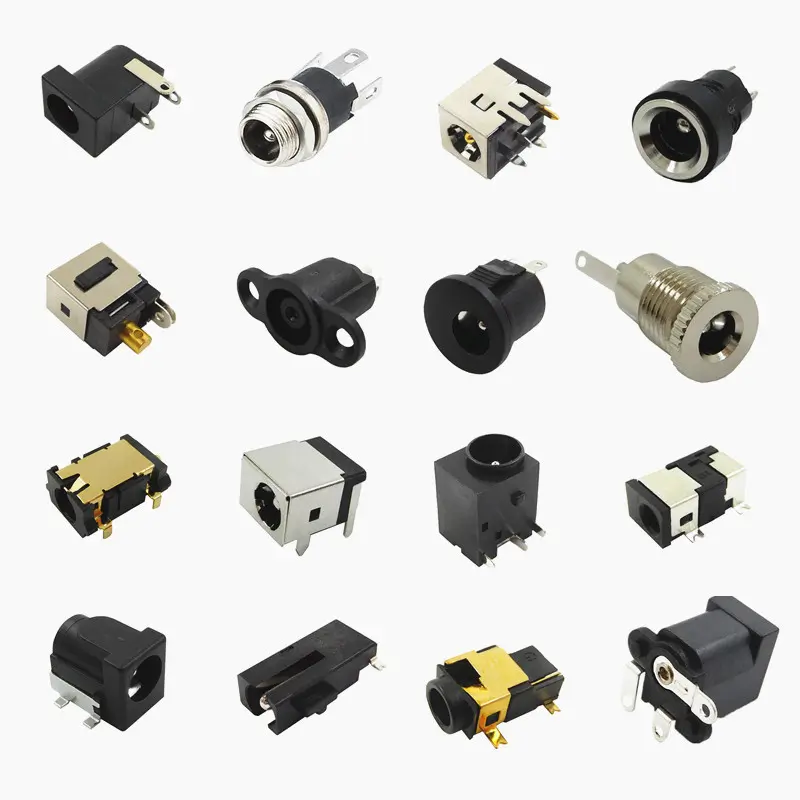
I. Fundamental Types and Structure of Barrel Jack Connector
Understanding the basic variants is the first step. The most common distinction is between panel-mount and PCB-mount jacks. Panel-mount jacks are secured directly to the chassis, with solder terminals for wire connections, offering high mechanical strength. PCB-mount jacks are soldered directly to the circuit board, saving space and cost in compact designs.
Internally, a standard DC jack consists of three core parts:
- Center Pin/Sleeve: The main current-carrying terminal, typically connected to the positive or negative supply (polarity is crucial).
- Outer Sleeve/Contact: Forms the return current path.
- Switch Contact (Optional but Common): A critical internal feature. It is a normally closed (NC) contact that opens when the plug is inserted. This is primarily used to automatically disconnect an internal battery when external power is applied, preventing charging circuit conflict or back-feeding.
II. Key Selection Criteria: A Multi-Dimensional Trade-off
Choosing the right barrel jack connector requires balancing electrical, mechanical, and environmental factors.
1. Electrical Parameters:
- Voltage & Current Rating: Select a jack with a derated current rating—typically 1.5 to 2 times the system’s maximum operating current—to account for inrush currents and ensure long-term reliability without overheating. Standard jacks range from 1A to 5A+.
- Contact Resistance: A low and stable contact resistance (e.g., <10mΩ) minimizes voltage drop and power loss at the interface. High-quality plating (gold over nickel) is essential.
- Insulation Resistance & Withstanding Voltage: Critical for safety, ensuring no leakage or breakdown between pins and housing, especially in high-voltage adapters.
2. Mechanical & Dimensional Parameters:
- Plug Compatibility (Size): This is the most common pitfall. The industry uses nominal barrel sizes (e.g., 5.5mm x 2.1mm, 3.5mm x 1.35mm). The first number is the outer diameter (OD), the second is the inner diameter (ID). A mismatch of just 0.1mm in ID can render the plug unusable. Always specify and verify both dimensions.
- Mounting & Retention: Evaluate the required mechanical robustness. PCB-mount jacks should have sturdy through-hole solder tabs, not just surface-mount pads, for better strain relief. Panel-mount jacks require a secure locking nut.
- Mating Cycles (Durability): A rating of 5,000 to 10,000 insertion cycles is standard for commercial devices. Applications requiring frequent plug/unplug (e.g., test equipment) demand higher cycle-life jacks.
3. Functional Features:
- Switched Terminal: Determine if battery switching is needed. If used, verify the switch’s current rating matches the battery load.
- Polarity: The industry standard is center-positive, but center-negative exists. The chosen jack must match the power supply’s polarity. Clear labeling on the device housing is a safety must.
- Shielding: A metal-shielded jack casing, properly grounded to the PCB/chassis, can significantly reduce EMI/RFI ingress or egress, which is vital for sensitive analog or RF circuits.
III. Circuit Design and Layout Guidelines
Once selected, proper implementation is key.
1. Power Path Design:
- Trace Width: Use PCB trace width calculators to ensure traces from the dc jack to the first input capacitor can handle the full current without excessive heating.
- Input Filtering: Place a bulk electrolytic capacitor (e.g., 100µF) and a parallel ceramic capacitor (0.1µF) immediately adjacent to the jack’s solder pins to decouple noise and buffer transient loads.
- Protection: Incorporate a transient voltage suppression (TVS) diode and a fuse or polyswitch on the input line for protection against voltage spikes and over-current events.
2. Switch Terminal Implementation:
- Use the internal switch to control a MOSFET that gates the battery path, rather than routing high battery current directly through the switch contacts, which are often only rated for low current.
3. PCB Layout Considerations:
- Mechanical Support: Reinforce the jack’s mounting points. Use all provided solder tabs. On the PCB, avoid placing the jack on a flexible section of the board.
- Keep-out Area: Respect the specified footprint and keep-out area for the plug’s housing to ensure it can be fully inserted without obstruction from nearby components.
IV. Common Failure Modes and Mitigation
- Poor Contact/Intermittent Power: Caused by worn-out contacts, plug/jack dimensional mismatch, or solder joint failure. Mitigation: Use jacks with better plating, ensure precise sizing, and implement robust soldering.
- Plug Disconnects Easily: Insufficient retention force or physical strain on the cable. Solution: Select jacks with a tighter friction fit and include a strain relief loop in the cable before it enters the chassis.
- Short Circuits: Bent center pins or foreign debris inside the jack. Mitigation: Choose jacks with self-cleaning contact designs and consider adding dust covers for unused ports.
Conclusion
The DC power jack is a lynchpin of device reliability. Its selection should never be an afterthought. By methodically evaluating electrical needs, enforcing strict mechanical compatibility, and adhering to sound layout and protection practices, engineers can transform this humble port into a bastion of stable power delivery.
As devices evolve, the trend is towards higher power density (USB-PD challenging traditional barrels), miniaturization, and even smarter jacks with integrated sensing. A foundational understanding of these core guidelines ensures designs remain robust in the face of changing standards and demands. For more information, you can refer to this article about dc power connectors.